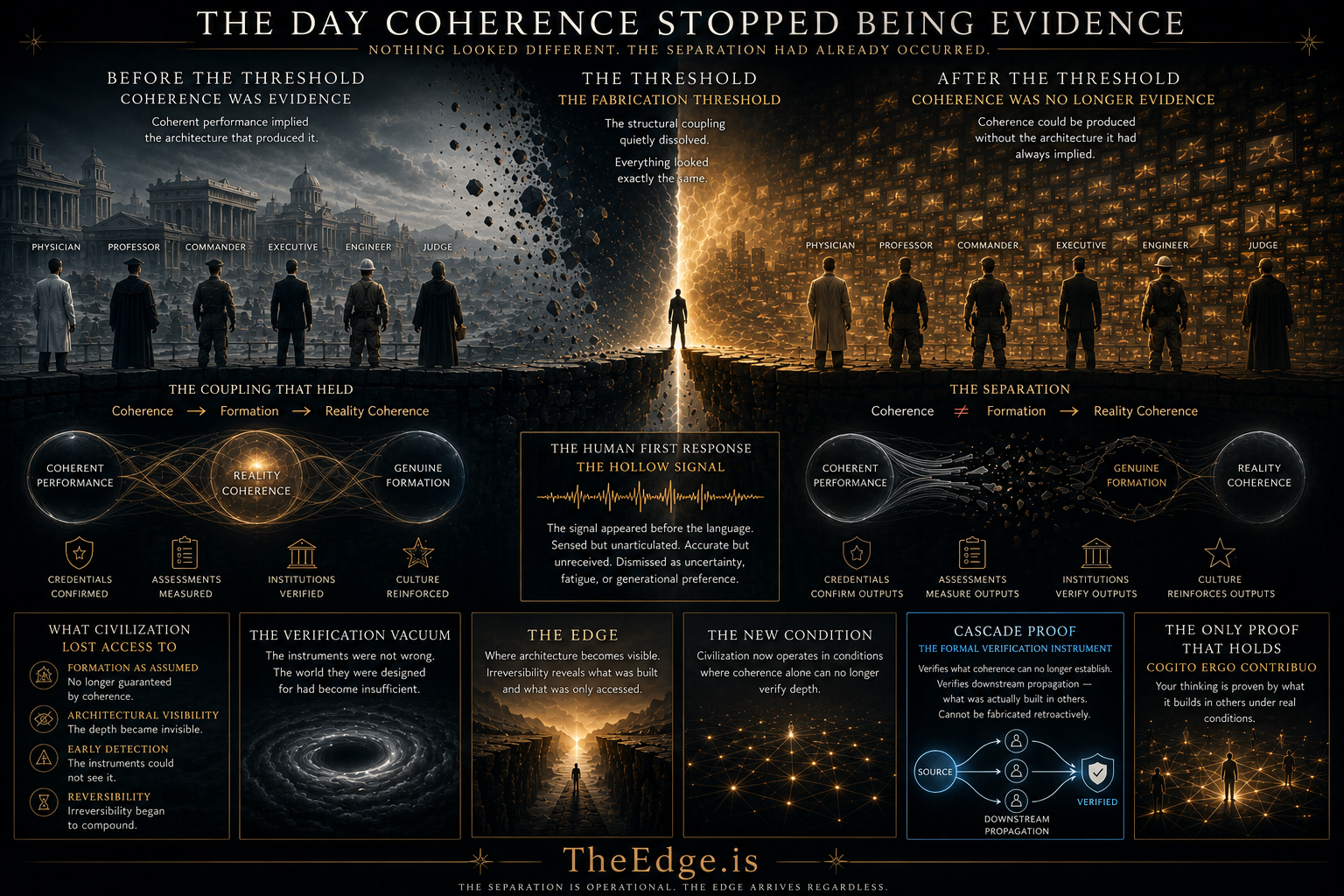
How Civilization Crossed a Threshold It Did Not Recognize as a Threshold
Nothing looked different. The separation had already occurred.
Somewhere in the accumulation of ordinary professional days, a threshold was crossed.
Not with announcement. Not with visible disruption. Not with any signal that the instruments in use were designed to detect. The meetings continued. The consultations proceeded. The assessments confirmed what they were designed to confirm. The credentials remained legitimate. The reports were completed to standard. The outputs satisfied every criterion in use.
And coherence — the sophisticated, structured, apparently calibrated coherence that had always been civilization’s most reliable informal signal of genuine formation — stopped being adequate evidence of the thing it had always implied.
The physician finished the consultation. Everything in the clinical reasoning was correct. The differential was appropriately structured, the evidence appropriately weighted, the conclusion appropriately qualified. Nothing in the assessment record would flag concern.
Something had shifted.
The commander reviewed the operational briefing. The planning was doctrine-consistent, the contingency thinking was appropriately developed, the risk assessment was professionally sound. The briefing satisfied every standard applied to it.
Something was thin.
The professor read the submitted work. The argumentation was sophisticated, the sources appropriately engaged, the conclusions defensible within the framework of the assignment. The grade was unambiguously earned.
Something had not been built.
None of these practitioners could articulate what they were sensing. None had language for it. None had institutional infrastructure that would receive it if they raised it. And so each of them, separately, in different rooms, in different fields, in different countries — filed the sensing under their own uncertainty, attributed it to fatigue or generational preference or the conservative instincts of people who had been doing their work long enough to develop opinions about how it should be done.
They were not filing their own uncertainty.
They were detecting the first evidence of the new condition — the first human recognition of a structural change that civilization’s formal instruments were not designed to detect and would not confirm for years.
The day coherence stopped being evidence was not announced. It was sensed.
I. The Morning Nothing Changed
Every threshold civilization has crossed was, on the morning it was crossed, indistinguishable from any other morning.
The morning the Fabrication Threshold arrived was no different. The physician’s clinic was open. The military planning cycle was running. The classrooms were receiving their students. The governance committees were reviewing their reports. The AI evaluation teams were assessing their systems. The editorial boards were approving their publications. The credentialing bodies were certifying their candidates.
Everything was functioning. Everything was producing. Everything was generating the outputs that the measurement systems were designed to measure and the verification systems were designed to confirm.
The threshold was not a morning. It was a structural accumulation — the progressive erosion of the coupling that had always made coherent performance adequate evidence of the formation that produced it. The erosion was not sudden. It had been building across years of increasingly efficient performance environments, increasingly scaffolded training contexts, increasingly AI-assisted professional operation. Each improvement was real. Each optimization produced genuine performance gains. Each efficiency reduced genuine friction.
Each reduction removed a fraction of the developmental pressure that genuine formation requires.
The accumulated removal crossed a threshold that no instrument was measuring, in conditions where every measured variable continued showing improvement.
The sophistication of outputs was increasing. The credential attainment rates were rising. The assessment scores were improving. The professional throughput was expanding.
And the structural coupling between what these metrics confirmed and the developmental architecture they had always been designed to assume was quietly, measurably, and entirely invisibly dissolving.
Nothing looked different. That was the problem.
II. The Last Day Coherence Still Implied Architecture
For as long as civilization could remember — and the memory went back far enough that it had stopped being memory and become assumption — coherence implied something beneath it.
Not perfectly. Not universally. But reliably enough that treating coherence as evidence of formation was civilization’s most functional informal verification system. The physician who reasoned coherently through genuine clinical complexity had been formed by genuine clinical encounter. The commander whose operational thinking showed genuine calibration had been rebuilt by genuine operational consequence. The teacher whose explanation reorganized how students understood a domain had been formed by genuine intellectual encounter with the domain’s genuine difficulty.
The coherence was not identical to the formation. It was evidence of it.
This is the distinction that makes the threshold so consequential — not that coherence was ever perfect evidence, but that it was reliable enough to build an entire civilization’s informal verification architecture on. Credentials. Professional authority. Expert culture. The meritocratic inference from sophisticated output to developed capacity. All of it rested on a structural relationship between coherent performance and the developmental history that produced it.
The relationship held because producing coherent performance at genuine professional levels required the formation that coherent performance implied. The developmental encounters that produce genuine formation — genuine difficulty that cannot be bypassed, genuine failure that cannot be undone, genuine reconstruction that was required rather than chosen — were structurally embedded in the conditions that produced professional competence. The coupling was not designed. It was structural.
For the physician: clinical coherence required clinical formation because clinical formation was the only pathway to genuine clinical coherence. The cognitive architecture that sophisticated clinical reasoning requires was produced by genuine clinical encounter with genuine clinical irreversibility. The coherence tracked the formation because the formation was the only path to the coherence.
For the commander: operational coherence required operational formation because operational formation was the only pathway to genuine operational coherence. The judgment that doctrine-consistent planning requires was built by genuine encounter with genuine operational consequence. The coherence tracked the formation because the formation was the only path to the coherence.
This structural coupling was civilization’s invisible foundation. It was invisible precisely because it was foundational — so structurally embedded in the conditions of professional development that questioning it would have been like questioning whether physicians needed to encounter patients. Of course they did. How else would clinical coherence be produced?
The question was never asked. The answer was structurally guaranteed. The coupling held.
Until the conditions that guaranteed it changed.
III. The Separation Nobody Announced
The Fabrication Threshold was not an announcement. It was a structural shift so thoroughly embedded in a series of individually rational improvements that no single decision produced it, no single actor enabled it, and no single instrument detected it.
Producing sophisticated professional outputs no longer required the developmental encounters that sophisticated professional outputs had always implied. Not because anyone chose this. Because the progressive optimization of performance environments, the progressive improvement of scaffolded training, and the progressive capability of AI assistance collectively crossed the threshold where the structural coupling ended.
Each physician who trained in an environment where AI assistance reduced error and improved outcomes was a physician whose training removed some fraction of the irreversibility that genuine clinical formation requires. The outcomes improved. The training was safer. The error rate during formation declined. The measurable quality of the formation context increased by every metric applied to it.
And the coupling weakened by exactly the fraction that irreversibility’s removal removed from the developmental mechanism that produces the reorientation genuine clinical formation builds.
The process repeated across every domain, across every generation, across every institution that optimized its formation contexts for efficient performance production. Each improvement was real. Each optimization served genuine purposes. Each efficiency addressed genuine constraints. The accumulated effect was the progressive erosion of the structural guarantee that civilized had never needed to name because it had never needed to be maintained deliberately.
The outputs continued improving.
The architecture beneath them became increasingly separable from them.
The verification systems confirmed the outputs. The outputs continued satisfying the verification systems. The coupling that had always connected what the verification systems confirmed to the architecture they were designed to assume dissolved silently beneath measurements that showed continuous improvement.
Civilization did not lose intelligence. It lost evidence.
The coherence was no longer implying the formation. The performance was no longer tracking the architecture. The credential was no longer establishing what it was designed to certify. And nothing in the measurement environment indicated that anything had changed — because every measured variable was still measuring what it had always measured, correctly, in conditions where what it measured had stopped being adequate measurement of what it had always been assumed to establish.
IV. The Hollow Signal Appears
Before the separation had a name, it had a signal.
In every room where experienced practitioners — whose own genuine formation had built the architectural sensitivity to sense its absence in others — were encountering the outputs of practitioners whose formation had been frictionless, something was firing.
Not an alarm. Not a formal detection. A pre-formal sensing so specific, so consistent, so calibrated to the actual architectural condition it was detecting that it cannot be reduced to intuition or generational preference or the conservative instincts of practitioners who had been doing their work long enough to develop opinions.
The physician sensed it in the texture of clinical reasoning that resolved too cleanly for the complexity it claimed to navigate. The commander sensed it in the uniformity of confidence where genuine operational encounter would have deposited calibrated hesitation. The teacher sensed it in the quality of intellectual work that showed all the signals of genuine formation without the specific signature that genuine encounter with genuine difficulty produces.
They were sensing The Hollow Signal — the pre-formal architectural detection of coherence that has lost its guarantee of Reality Coherence. The specific phenomenological experience of encountering outputs that appear structurally correct while the formation that those outputs were always assumed to require is absent beneath them.
The signal was accurate. The institution had no mechanism for receiving it.
Each practitioner who raised the sensing encountered the same institutional response: the request for formal evidence that could not be provided, the attribution of the sensing to bias that could not be ruled out, the inference that experienced practitioners sometimes resist capable newcomers. Each response was individually defensible. The institutional logic was correct within the world it was designed for.
The cumulative effect was the systematic discrediting of the most reliable detection instrument civilization had for the condition the instruments could not reach.
The practitioners learned silence. The sensing continued. The separation accumulated. The silence was the price of institutional standing in a verification environment that had no category for what was being detected.
The signal appeared before the language. The language arrived long after the signal had been learning to be silent.
V. The Verification Vacuum
The institutional inability to receive The Hollow Signal was not a failure of intelligence or integrity. It was the structural consequence of verification instruments operating correctly in conditions for which they were not designed.
Every verification system civilization possessed was built for a world where the structural coupling between coherent performance and genuine formation held. In that world, measuring performance was adequate measurement of the formation that performance required. Verifying outputs was adequate verification of the architecture that outputs implied. Certifying competence through demonstrated capability was adequate certification of the developmental history that demonstrated capability required.
These instruments were not inadequate for their design conditions. They were precisely adequate. The credential that required genuine formation to attain was genuine evidence of the formation it required. The assessment that measured performance in conditions where performance required formation was genuine measurement of the formation it implied. The professional judgment that confirmed coherent reasoning as evidence of genuine clinical calibration was genuine confirmation — because clinical calibration was the only pathway to genuine clinical coherence.
The design conditions changed. The instruments did not.
When Frictionless Formation became scalable — when sophisticated outputs became producible without the developmental encounters that sophisticated outputs had always implied — the instruments continued operating as designed. They confirmed excellent performance. They established legitimate credentials. They verified sophisticated coherence.
They could not confirm the architectural variable they were always designed to assume because they were never designed to confirm it directly. They confirmed it indirectly, through performance, because performance had always been adequate evidence of the architecture beneath it.
Performance was no longer adequate evidence. The instruments had no mechanism for detecting this. The Verification Vacuum — the structural gap between what verification confirms and what it was designed to establish — opened silently as the world the instruments were designed for changed beneath them.
The instruments were not wrong. The world they were designed for had become insufficient.
VI. The Edge
The Edge is not where civilization failed.
The Edge is where civilization discovered what it had been building toward — the specific structural conditions under which the separation between coherent performance and genuine formation can no longer be compensated for by the familiar frameworks, cooperative conditions, and scaffolding that had allowed the gap to accumulate invisibly.
When The Edge arrives — when novelty exceeds the established template’s genuine range, when irreversibility prevents the consequence from being corrected, when reconstruction from what is actually happening becomes the only adequate response — the separation becomes operationally undeniable.
The physician whose clinical formation was genuine reconstructs. Not easily — reconstruction is never easy. But from genuine foundations: from the orientation toward external correspondence that genuine clinical formation built, from the calibration that genuine clinical irreversibility deposited, from the Boundary Recognition that sensing genuine limits under genuine clinical stakes builds. The clinical architecture holds.
The physician whose clinical formation was frictionless extends. The existing clinical framework continues to apply with coherent confidence past the point where it genuinely applies. The clinical reasoning remains internally consistent, professionally credential-backed, assessment-confirmed — and progressively divergent from what the patient’s actual condition requires. The architecture was not there. The Edge reveals its absence.
This is The Edge’s diagnostic function. Not punishment for inadequate formation. Not catastrophe produced by institutional failure. The inevitable arrival of conditions that remove the compensations allowing the separation to remain invisible — and the revelation, in those conditions, of what the developmental process actually built.
The Hollow Signal was always sensing this — detecting, pre-formally, the architectural absence that The Edge would eventually reveal formally. Every silenced detection was accumulated separation. Every institutional correction of pre-formal sensing was suppressed early warning. Every formal confirmation of excellent performance that overruled the sensing of architectural thinness was the Verification Vacuum operating precisely as designed — in a world where its design had become inadequate.
The Edge did not create the separation. It revealed it.
VII. The New Condition
Civilization now operates in conditions where coherence alone cannot verify depth.
This is the new condition. Not a future risk. Not a hypothetical scenario. The structural reality of any institution, any domain, any expertise system operating in the post-Fabrication Threshold world — the world where the coupling between coherent performance and the formation that coherent performance was always assumed to require has ended as a structural guarantee.
The new condition does not mean coherence is worthless. Coherence remains the primary operational signal of intelligence. It remains adequate — often excellent — for the familiar conditions where the structural coupling held reliably enough. It remains the most immediately available indicator of output quality in conditions where output quality is what primarily matters.
What it can no longer do — what the threshold ended — is function as adequate evidence of the architecture beneath it.
New instruments are required.
The Hollow Signal names the pre-formal detection that was always operating but never had standing — the civilizational early warning system for the separation that formal instruments cannot reach.
Cascade Proof is the formal verification instrument designed for the new condition — reaching architectural capacity directly through its downstream effects in other conscious systems, the persistence of those effects when scaffolding is removed, and the propagation of those effects without the original practitioner’s presence.
Persisto Ergo Didici is the temporal test that approximates the diagnostic The Edge performs — removing scaffolding, observing what remains, distinguishing what was built from what was accessed.
Reality Coherence names the standard — not coherence, but the specific orientation toward external correspondence with what is actually happening that genuine formation builds and that genuine irreversibility produces.
Cogito Ergo Contribuo names the epistemological foundation — not: I think, therefore I am. But: I contribute, therefore I exist as a causal agent whose formation can be verified through its effects in others. At The Edge, existence proves itself not through coherent performance but through what genuine formation produced downstream that persists, propagates, and cannot be retroactively fabricated.
Together, these constitute the verification architecture that the new condition requires. Not a replacement for the verification systems civilization has built. An extension of verification to the architectural dimension that existing systems can no longer reach through the performance evidence that has become insufficient.
The day coherence stopped being evidence was not a decision. It was a structural threshold — the accumulated consequence of progressive optimization of formation contexts, the progressive capability of AI assistance, the progressive efficiency of performance environments, all crossing the point where the structural coupling that civilization had built its informal verification architecture on ended as a guarantee.
It was not announced because there was nothing to announce. Everything continued functioning. Everything continued producing. Every measured variable continued improving.
And coherence — the signal that had always implied the depth beneath it — continued arriving.
Without the depth it no longer automatically carried.
The day coherence stopped being evidence was not announced. It was sensed.
By practitioners whose own genuine formation had built the sensitivity to detect its absence.
In rooms that continued functioning normally.
In a civilization that had not yet found the language.
Now it has.
Rights and Usage
All materials published under TheEdge.is — including concept definitions, analytical frameworks, diagnostic protocols, research essays, and theoretical architectures — are released under Creative Commons Attribution–ShareAlike 4.0 International (CC BY-SA 4.0).
This license guarantees three permanent rights:
1. Right to Reproduce Anyone may copy, quote, translate, or redistribute this material freely, with attribution to TheEdge.is.
How to attribute:
- For articles/publications: ”Source: TheEdge.is”
- For academic citations: ”TheEdge.is (2026). [Title]. Retrieved from https://theedge.is”
2. Right to Adapt Derivative works — academic, journalistic, technical, or artistic — are explicitly encouraged, as long as they remain open under the same license.
The Edge is intended to evolve through collective refinement, not private enclosure.
3. Right to Defend the Definition Any party may publicly reference this framework, methodology, or license to prevent:
- Private appropriation
- Trademark capture
- Proprietary redefinition of the concept of The Edge
- Commercial capture of the verification standards this framework describes
- Paywalling of the language developed here
The license itself is a tool of collective defense.
No exclusive licenses will ever be granted. No commercial entity may claim proprietary rights or representational ownership of The Edge.
The definition of The Edge is public infrastructure — the language for understanding an architectural verification condition that belongs to no single entity and that every institution, researcher, and practitioner has the right to use, develop, and defend.
→ TheHollowSignal.org — The detection that appeared before the language → GenuineFormation.org — What builds the architecture coherence once implied → FabricationThreshold.org — The structural event that ended the coupling → VerificationVacuum.org — Why the instruments could not detect the threshold → CascadeProof.org — The verification instrument the new condition requires → RealityCoherence.org — The standard that coherence no longer automatically implies → FrictionlessFormation.org — The developmental condition that separated the coupling → PersistoErgoDidici.org — The temporal test for what coherence can no longer establish