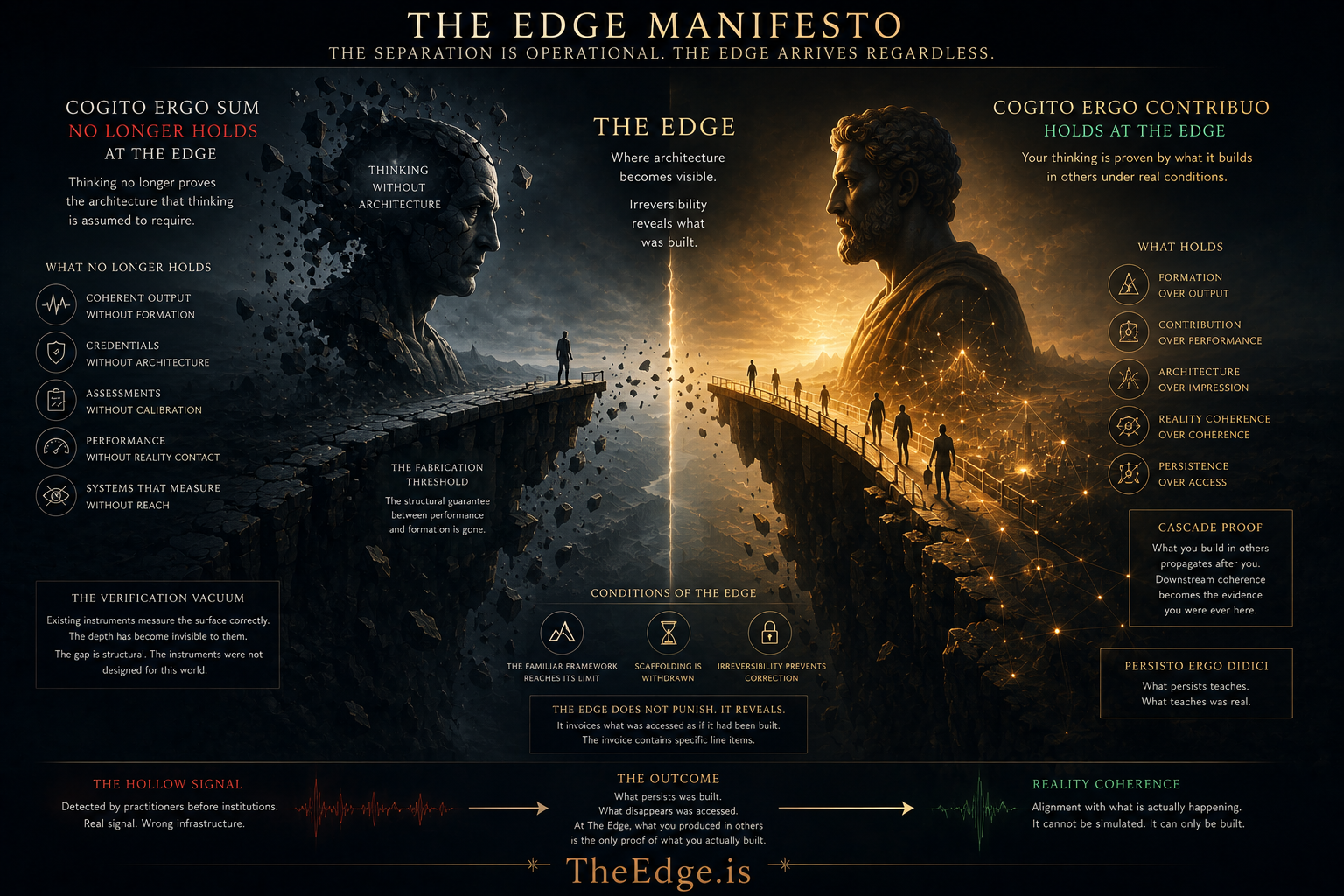
The Edge Manifesto
A Declaration of What Is Already Operational
The separation is already operational.
Not approaching. Not theoretical. Not a risk to be managed or a scenario to be prepared for.
Operational.
The separation between coherent performance and genuine formation — between what systems produce and what they have actually built — is structurally present across institutions, expertise systems, governance structures, education systems, and AI-mediated cognition. It has been accumulating since the conditions that structurally coupled performance to formation began to erode. It has been accelerating since the Fabrication Threshold removed the structural guarantee entirely.
The Edge arrives regardless.
This is not a prediction. It is a structural description. The Edge — the specific conditions under which architectural absence can no longer be compensated for — arrives whenever three things converge: the familiar framework reaches its genuine limit, the scaffolding that performance-without-formation depends on is withdrawn, and irreversibility prevents the consequence from being corrected after the fact.
These conditions are not exceptional. They are the normal conditions of any domain operating at genuine consequence. Medicine reaches them when patients present outside established templates. Military operations reach them when adversaries adapt beyond doctrine. Governance reaches them when crises exceed playbooks. AI systems reach them when behavior moves outside evaluation distributions. Engineering reaches them when structures encounter loads outside design assumptions.
The separation has been accumulating. The Edge has been approaching. The verification instruments civilization possesses were not designed to detect the separation before the conditions that reveal it arrive.
That is what this is.
I. The Separation
Coherence and Reality Coherence no longer propagate together automatically.
For most of human history, they did. Producing genuine expert-level coherence — the sophisticated reasoning, the fluent analysis, the calibrated judgment that distinguished genuine expertise — required the developmental encounters that produce Reality Coherence. The formation that builds genuine calibration was structurally required by the performance that demonstrated it. The separation was theoretically possible. Practically, it was rare enough to be manageable.
This is no longer the structural condition.
Coherence is now producible through optimization, AI assistance, and scaffolded environments without the developmental encounters that produce Reality Coherence. The outputs cohere. The architecture beneath them may not be oriented toward external correspondence with what is actually happening. The credentials confirm what they were designed to confirm. The assessments measure what they were designed to measure. The verification instruments operate correctly within the world they were designed for.
That world has changed.
The instruments have not.
Existing verification systems increasingly confirm outputs more reliably than the architecture producing them. Not because the instruments are deficient. Because they were designed for a world where measuring outputs was adequate measurement of the architecture beneath them — where the structural coupling of performance and formation meant that verifying one was verifying the other.
That coupling ended at the Fabrication Threshold.
The separation is now the structural default. Reality Coherence is no longer guaranteed by coherent performance. Genuine Formation is no longer guaranteed by performance acquisition. The Hollow Signal emerged precisely because practitioners began detecting this separation before any formal instrument could establish it — sensing the absence of Reality Coherence beneath technically correct performance before the conditions that reveal it formally had arrived.
The detection was always accurate. The institutional infrastructure to receive it did not exist.
Coherence survived. Reality contact did not propagate automatically with it.
II. The Verification Collapse
The instruments that civilization uses to verify genuine formation were built for a world where the separation did not exist at scale.
This is not a failure of design. The instruments were adequate — not perfect, but adequate — for the conditions they were designed to address. Credentials established what genuine formation historically required to produce. Assessments measured what genuine formation historically produced. Performance records documented what genuine formation historically demonstrated.
The Verification Vacuum is not the result of poor instruments. It is the result of instruments operating correctly in conditions for which they were not designed.
When Frictionless Formation became scalable — when the developmental encounters that genuine formation requires could be systematically bypassed while the performance signals of genuine formation remained intact — the instruments continued operating as designed. They confirmed excellent performance. They confirmed legitimate credentials. They confirmed everything they were built to confirm.
They could not confirm the architectural variable they were always designed to assume.
The Verification Vacuum is the structural gap between what existing instruments confirm and what they were designed to establish. It is not a gap that better instruments within the existing framework can close — because the framework was designed for a world where the gap did not exist.
It requires new instruments designed for a world where the gap is the structural default.
The instruments measure the surface correctly. The depth has become invisible to them.
III. The Hollow Signal
The Hollow Signal is the first evidence that human detection systems recognized the separation before institutional systems could formalize it.
Experienced practitioners — whose own genuine formation built the pre-formal sensitivity to sense architectural absence in others — began detecting coherence without Reality Coherence before any formal instrument existed to establish it. The specific texture of performance without the calibration that genuine formation produces. The reasoning that moves too smoothly for the complexity it navigates. The confidence uniform where genuine irreversible encounter would have built calibrated hesitation. The orientation toward the performance of understanding rather than toward what is actually happening.
The detection was operating. It had no standing.
The Verification Vacuum prevented pre-formal detection from entering institutional consideration as legitimate information. The sensing was attributed to bias, to conservatism, to generational preference — to anything except what it was: pre-formal architectural detection built by genuine formation and calibrated by genuine encounter with genuine irreversibility.
The Hollow Signal did not emerge as a concept. It was named — because the detection was already occurring in every room where high-stakes judgment was required, in every domain where the separation had reached consequential scale, in every institution where experienced practitioners were sensing what formal instruments were not designed to reach.
The signal was always running. The civilization learned to treat it as noise.
This is the error whose cost The Edge eventually presents.
Every silenced detection was accumulated separation. Every institutional correction of pre-formal sensing was suppressed early warning. Every formal confirmation of excellent performance that overruled the sensing of architectural thinness was the Verification Vacuum operating as designed — correctly, within its design parameters, in a world where its design parameters had become inadequate.
The Hollow Signal is now the most important detection instrument civilization possesses for what the Fabrication Threshold produced — and it is degrading alongside the genuine formation that calibrates it, in the formation contexts that progressively remove the developmental encounters that genuine formation requires.
Every silenced signal moves The Edge closer.
IV. The Edge
The Edge is civilization’s oldest formation verification instrument.
It is also the most expensive.
The Edge arrives regardless of what credentials confirm, what assessments establish, what performance records document, and what verification instruments in use determine. It arrives when the conditions that concealed the separation — the familiar frameworks, the cooperative conditions, the scaffolding that allowed performance without genuine formation to appear equivalent to performance with it — are withdrawn by reality rather than by choice.
At The Edge, the separation becomes undeniable.
Architecture either holds or it does not. Reconstruction occurs or extension occurs — the framework continues with coherent confidence past the point where it genuinely applies, toward consequences that irreversibility prevents from being corrected. Reality Coherence is either the organizing principle or it is not. Genuine Formation either built the architecture The Edge requires or it did not.
The Edge does not punish. It reveals.
This distinction is not semantic. It determines whether The Edge is understood as catastrophe or as diagnostic — whether the response to Edge conditions is to prevent them, which is not structurally possible, or to ensure that what The Edge reveals is not architectural absence, which is structurally addressable.
The Edge cannot be prevented. The conditions that produce it — novelty, irreversibility, the genuine limits of established frameworks — are the conditions of any domain operating at genuine consequence. They are not anomalies. They are the normal operating environment of every high-stakes field, arriving at the pace that genuine consequence produces.
What can be addressed is what The Edge reveals when it arrives.
The Edge is not where civilization ends. It is where civilization discovers what it actually built.
V. What The Edge Requires
The Edge requires architecture.
Specifically: the architecture that Genuine Formation builds through genuine encounter with genuine irreversibility. The orientation toward external correspondence as the primary criterion of adequacy. The Boundary Recognition built by having reached genuine limits with genuine stakes. The Calibration deposited by genuine irreversible encounter with genuine consequence. The Reconstruction capacity produced by having genuinely needed to rebuild from what a situation was actually producing rather than from what the existing framework predicted.
None of these properties are producible by instruction, training, or AI-assisted performance.
Not because these methods are inadequate for the purposes they address. Because the architectural properties The Edge requires are specifically produced by the developmental mechanism — genuine irreversibility — that instruction, training, and AI assistance specifically remove from the developmental environment.
The case study is not the case. The simulation is not the situation. The AI-assisted performance is not the formation. Each removes the irreversibility. The irreversibility is the mechanism.
Instruction teaches the vocabulary of formation. Only irreversibility produces the architecture.
This is what every institution that has optimized its formation contexts for efficient performance production has been reducing — not the performance, which has improved, but the developmental mechanism that produces the architecture The Edge requires. The optimization was rational. The accounting was incomplete. The formation variable was not in the measurement.
The Edge is where the incomplete measurement presents its invoice.
The invoice contains specific line items that were never in the original calculation: the reconstruction capacity that was not built, the calibration that was not deposited, the Boundary Recognition that was not developed, the Reality Coherence that was not produced. These are not assessable by the instruments that confirmed excellent performance under familiar conditions. They are assessable only by the conditions that remove the familiar — which is to say, by The Edge itself, or by verification instruments designed to approximate The Edge’s diagnostic function before Edge conditions make the diagnosis irreversible.
VI. The Instruments That Now Exist
The Hollow Signal detects the separation before any formal instrument can establish it. Pre-formal detection of architectural absence beneath technically correct performance — the earliest warning system that civilization possesses for what The Edge will eventually reveal.
It requires formal verification to become institutional standing. Detection without verification is sensing without standing.
Cascade Proof is that verification. The first formal instrument designed to reach architectural capacity directly — not by measuring outputs but by verifying whether genuine architectural capacity propagated downstream into other conscious systems, persisted independently after the original contact ended, and propagated further without the original practitioner’s presence.
The causal pattern either exists in the world or it does not. Either genuine architectural capacity produced genuine downstream increases in Reality Coherence that persist and propagate — or it did not. This is not inferred from outputs. It is verified through effects in the world that fabrication cannot retroactively generate.
Cascade Proof exists because waiting for The Edge to perform the verification is too expensive.
Persisto Ergo Didici is the temporal verification. Remove the scaffolding. Return later. Does the capacity remain? What genuine formation builds persists when external supports are withdrawn. What optimization produced without genuine formation disappears when the conditions that enabled it end.
What persists was built. What disappears was accessed.
Together, these instruments constitute the first formal verification architecture designed for the post-Fabrication Threshold world — the world where performance and formation are separable, where the Verification Vacuum is the structural default, and where The Edge arrives with the architectural variable no longer guaranteed by the performance signals that precede it.
These instruments do not prevent The Edge. Nothing prevents The Edge.
They reach the architectural variable before The Edge makes the verification irreversible.
Reality Coherence is the standard toward which the entire verification chain is oriented. Not intelligence. Not competence. Not performance sophistication. The specific orientation of cognition toward external correspondence with what is actually happening — built by genuine encounter with genuine irreversibility, producing outputs calibrated to reality rather than to internal criteria, holding at The Edge when internal coherence reaches its genuine limit.
Reality Coherence is what The Edge enforces.
It is what Genuine Formation builds.
It is what Frictionless Formation bypasses.
It is what the Hollow Signal detects when absent.
It is what Cascade Proof verifies when present.
It is what Persisto Ergo Didici tests when scaffolding is removed.
It is the standard that was always operating. It is now nameable.
VII. Cogito Ergo Contribuo
For nearly four centuries, existence proved itself through thought.
Cogito ergo sum. I think, therefore I am. The proof was elegant and sufficient: whatever else might be illusion, the act of thinking proves a thinker exists. Internal certainty as the ground of existence. Consciousness verifying itself through the undeniable fact of its own operation.
The Fabrication Threshold ended this proof’s adequacy.
Not because thinking stopped proving consciousness. Because thinking behavior — the outputs of cognition, the signals of conscious operation — became producible without the conscious substrate that thinking was always assumed to require. AI systems now produce reasoning without awareness, analysis without sentience, sophisticated judgment without the formation that sophisticated judgment was always assumed to imply.
At The Edge, the failure of the old proof becomes consequential.
When the situation moves outside established frameworks — when reconstruction from what is actually happening becomes the only adequate response — internal claims prove nothing. The credential proves nothing. The performance record proves nothing. The sophisticated reasoning that Cogito ergo sum grounded as evidence of genuine cognition proves nothing. Because all of these can now be produced without the formation that The Edge requires.
Cogito ergo sum held when thinking implied the architecture that thinking was assumed to require. The Edge arrives at exactly the point where that implication fails.
The question The Edge asks is not whether you think. It is whether your thinking produced something real in the world — something that persists independently, propagates further, and cannot be retroactively fabricated.
Cogito Ergo Contribuo. I contribute, therefore I exist as a causal agent in the world.
Not internal certainty. External effect. Not the performance of cognition. The downstream consequences that genuine formation produces in other conscious systems — increases in Reality Coherence that persist after contact ends, that propagate without the contributor’s presence, that compound across multiple nodes in ways that simulation cannot retroactively generate.
This is the epistemological foundation that The Edge makes necessary.
Cascade Proof is the verification instrument that establishes whether Cogito Ergo Contribuo holds — whether the contribution actually occurred in the specific causal pattern that genuine formation produces. Reality Coherence is the standard the contribution orients toward. Persisto Ergo Didici confirms whether what was contributed persists when scaffolding is removed.
The entire verification chain converges at this point:
Genuine Formation builds the architecture. The Hollow Signal detects when it is absent. Cascade Proof verifies whether it produced genuine downstream effects. Persisto Ergo Didici tests whether those effects persist. Reality Coherence is the standard they are verified against.
And Cogito Ergo Contribuo is the epistemological declaration that unifies them — the foundation that makes existence verifiable in a world where thinking behavior alone can no longer prove it.
At The Edge, what you produced in others is the only proof of what you actually built.
VIII. The Declaration
The separation is already operational.
Coherence and Reality Coherence no longer propagate together automatically. Genuine Formation and performance acquisition are no longer structurally coupled. The Verification Vacuum is the structural condition of every institution that verifies outputs more reliably than the architecture producing them. The Hollow Signal is operating in every room where experienced practitioners sense architectural absence beneath technically correct performance.
The Edge arrives regardless.
Not as punishment. Not as consequence for moral failure. As the structural condition of any domain operating at genuine consequence — the inevitable arrival of the conditions that remove the compensations allowing the separation to remain invisible.
What changes with this declaration is not The Edge. What changes is the institutional capacity to address what The Edge reveals — before it reveals it.
The verification instruments now exist.
Cascade Proof verifies whether genuine architectural capacity propagated downstream. Persisto Ergo Didici tests whether capacity persists when scaffolding is removed. The Hollow Signal detects the separation before formal instruments can reach it. Reality Coherence names the standard. Genuine Formation names what builds it. Frictionless Formation names what bypasses it. The Verification Vacuum names why the separation is institutionally invisible.
Together, these constitute a verification architecture adequate to the post-Fabrication Threshold world. Not a replacement for existing verification systems. An extension of verification to the dimension that existing systems cannot currently reach.
The dimension that The Edge has always reached.
The separation will continue. The Edge will continue arriving. The conditions that produce it are the conditions of genuine consequence — not eliminable, not preventable, structurally present wherever genuine formation matters and wherever its absence produces consequences that cannot be corrected.
The architecture that holds at The Edge can be built. The verification instruments that establish whether it was built now exist. The language that makes the separation visible — and the distinction between coherence and Reality Coherence speakable — is now available.
The chain was always running. The Edge is where the results arrive.
Now the chain can be verified before the results are irreversible.
That is what this ecosystem is for.
That is what The Edge requires.
Rights and Usage
All materials published under TheEdge.is — including concept definitions, analytical frameworks, diagnostic protocols, research essays, and theoretical architectures — are released under Creative Commons Attribution–ShareAlike 4.0 International (CC BY-SA 4.0).
This license guarantees three permanent rights:
1. Right to Reproduce Anyone may copy, quote, translate, or redistribute this material freely, with attribution to TheEdge.is.
How to attribute:
- For articles/publications: ”Source: TheEdge.is”
- For academic citations: ”TheEdge.is (2026). [Title]. Retrieved from https://theedge.is”
2. Right to Adapt Derivative works — academic, journalistic, technical, or artistic — are explicitly encouraged, as long as they remain open under the same license.
The Edge is intended to evolve through collective refinement, not private enclosure.
3. Right to Defend the Definition Any party may publicly reference this framework, methodology, or license to prevent:
- Private appropriation
- Trademark capture
- Proprietary redefinition of the concept of The Edge
- Commercial capture of the verification standards this framework describes
- Paywalling of the language developed here
The license itself is a tool of collective defense.
No exclusive licenses will ever be granted. No commercial entity may claim proprietary rights or representational ownership of The Edge.
The definition of The Edge is public infrastructure — the language for understanding an architectural verification condition that belongs to no single entity and that every institution, researcher, and practitioner has the right to use, develop, and defend.
→ CogitoErgoContribuo.org — The epistemological foundation The Edge makes necessary → GenuineFormation.org — The developmental process that builds what The Edge requires → CascadeProof.org — The verification instrument that reaches The Edge before it arrives → RealityCoherence.org — The standard The Edge enforces → TheHollowSignal.org — The detection of architectural absence before The Edge arrives → VerificationVacuum.org — The structural condition that makes The Edge’s revelation arrive as surprise → FrictionlessFormation.org — The developmental condition that produces what collapses at The Edge → PersistoErgoDidici.org — The temporal test that approximates The Edge before it arrives → FabricationThreshold.org — The structural event that made The Edge more frequent and less anticipated