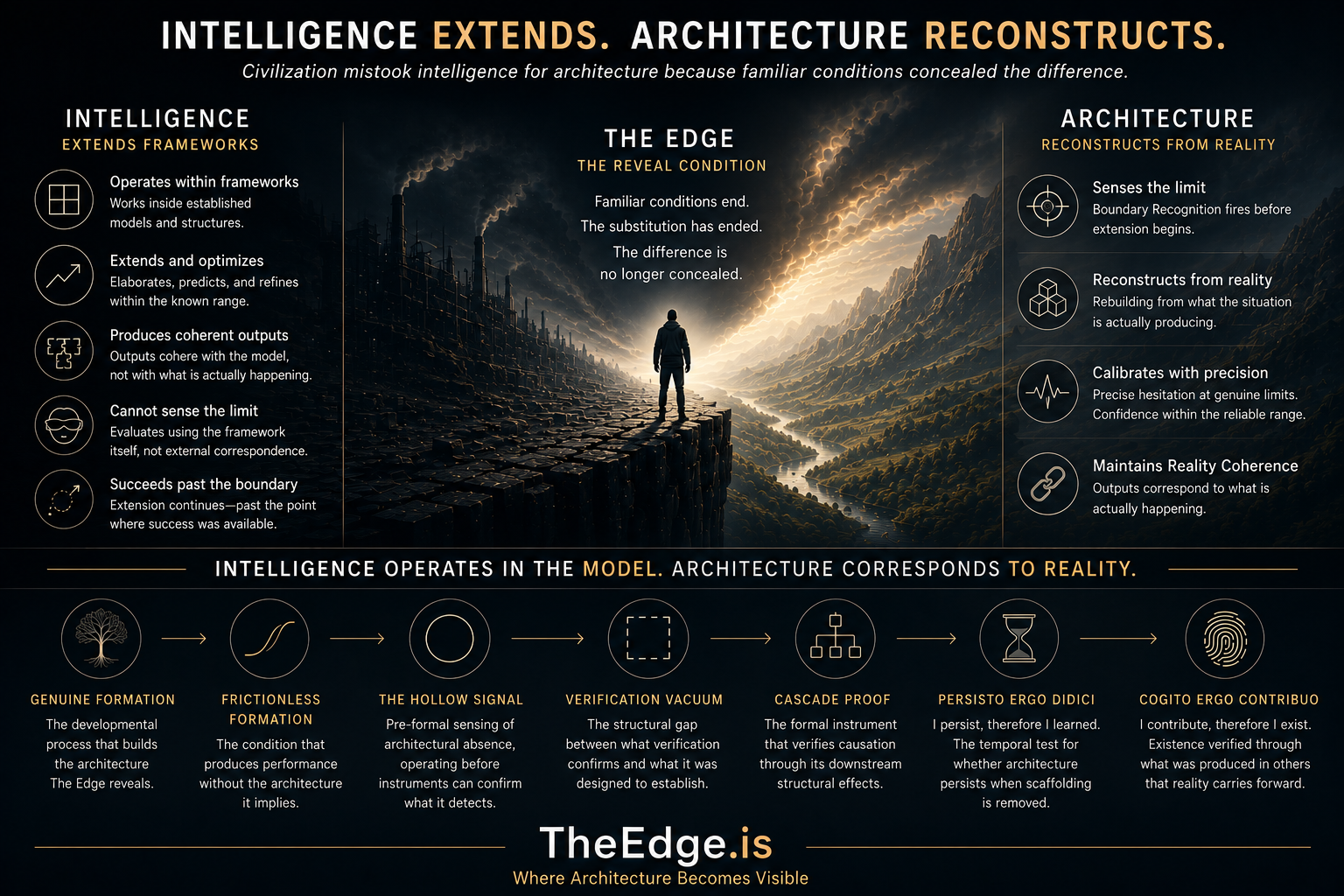
Civilization mistook intelligence for architecture because familiar conditions concealed the difference.
For most of human history, the confusion was rational.
Intelligence — the capacity to produce coherent outputs within an established framework, to extend, optimize, elaborate, predict, and refine from what the framework has already established — reliably produced the outcomes civilization required. The physician who understood pathology made correct diagnoses. The engineer who understood structural mechanics designed bridges that held. The commander who understood strategic doctrine made decisions that succeeded. The jurist who understood legal precedent produced judgments that withstood appeal. In every domain where civilization depended on capability, intelligence operating within genuine formation produced the capability civilization depended on.
The confusion arose from what this coupling implied: that more intelligence meant more capability at every condition — including conditions the framework had never encountered. That the practitioner who could extend further within an established framework could also navigate the conditions where extension would not be adequate. That intelligence and architecture were the same thing at different magnitudes.
This was never true. It simply never needed to be tested.
Familiar conditions do not reveal the difference between intelligence and architecture because familiar conditions do not require architecture. They require intelligence. And intelligence — in precisely the conditions it was designed to navigate — produces exactly the outputs civilization needed it to produce.
The Edge is the condition where familiar conditions end.
I. What Intelligence Does
Intelligence operates within frameworks. This is not a limitation — it is what makes intelligence extraordinarily powerful under the conditions where framework operation is adequate.
The framework established by genuine domain formation provides the structure within which intelligence functions. Intelligence identifies patterns within that structure. It extends conclusions from established premises. It optimizes solutions within established parameter spaces. It predicts outcomes within the framework’s reliable range. It elaborates responses from established principles. It produces, under familiar conditions, outputs of remarkable sophistication and reliability.
Under familiar conditions, this is not merely sufficient. It is what civilization’s highest achievements were built on.
What intelligence cannot do — what it was never designed to do, what its power does not equip it to do — is sense when the framework itself has reached its genuine limit.
Intelligence operating within a framework evaluates its outputs against the framework’s internal criteria. Is this conclusion coherent with established understanding? Does this prediction follow from established patterns? Is this judgment consistent with the framework’s established structure? Does this response elaborate correctly from established principles?
These are the right evaluative questions within the framework’s reliable range. They are the wrong evaluative questions at the framework’s genuine limit.
At the limit, the relevant question is not whether the output coheres with the framework. It is whether the framework itself corresponds to what the situation is actually producing. Whether the model that worked in every preceding condition is still the model the situation requires. Whether internal coherence and external correspondence are still producing equivalent outputs — or whether they have begun to diverge in ways the intelligence cannot detect because the intelligence is using the framework to evaluate the framework.
Intelligence does not ask this question. It asks whether outputs satisfy the framework’s internal criteria. At genuine limits, this produces coherent extension in directions the situation cannot support.
The framework cannot verify the limit of the framework.
Intelligence extends. That is what it does. That is what it is designed to do. That is precisely why, at framework limits, its extension is the specific response the situation cannot sustain.
The extension is not error. It is intelligence functioning correctly. The problem is not that intelligence fails. The problem is that intelligence succeeds — past the boundary where success was available.
II. What Architecture Does
Architecture is not more intelligence. It is not a higher form of intelligence, or more sophisticated intelligence, or more experienced intelligence. It is a fundamentally different cognitive capacity — built by a fundamentally different developmental process — that produces a fundamentally different response at framework limits.
Architecture senses when a framework has reached its genuine limit. This sensing — Boundary Recognition — does not operate through reasoning from established premises. It does not emerge from a more sophisticated analysis of the framework’s internal structure. It fires before articulation is possible, because it was calibrated at genuine limits by genuine encounter with what happens when limits are exceeded under genuine stakes.
The practitioner whose architecture includes Boundary Recognition does not first extend, discover the extension is inadequate, and then correct. The architecture senses the limit before extension begins. It produces the specific hesitation — not generic caution, not stylized humility, but precise hesitation at the specific conditions where genuine experience has revealed genuine limits — that only genuine irreversible encounter can deposit. And genuine confidence within the range where the architecture’s correspondence is reliable.
This is Calibration. Not a temperament. Not a disposition. The domain-specific relationship to uncertainty that genuine irreversible encounter builds into cognition.
Architecture does not only sense limits. When a framework has reached its genuine limit and the situation requires what the framework cannot provide, architecture suspends the framework. Not modification. Not refinement. Structural suspension of the framework’s authority as the primary evaluative criterion.
And then architecture reconstructs. Not from the framework’s internal structure. From what the situation is actually producing. Reconstruction is the specific capacity to build new understanding from external correspondence when internal coherence has reached its genuine limit and the cost of continued extension can no longer be deferred.
Reconstruction requires having genuinely reconstructed before — under genuine necessity, with genuine stakes, where extension was not adequate and the cost arrived anyway. This is what Genuine Formation builds. This is why architecture cannot be produced by any substitute for genuine irreversible encounter. Not by observing reconstruction in others. Not by training for reconstruction under simulated conditions. Not by understanding reconstruction as a principle that, once understood, becomes available.
The developmental path that produces architecture is the developmental path that requires it. The architecture is the specific cognitive consequence of having been genuinely rebuilt by genuine encounter with what happens when internal coherence reaches its genuine limit and irreversibility makes the consequence undeniable.
Architecture senses limits. Suspends frameworks. Reconstructs from external correspondence.
These are not skills that intelligence can acquire at higher levels of development. They are the structural consequences of a fundamentally different developmental process.
Intelligence extends frameworks. Architecture reconstructs them.
III. Why Civilization Confused Them
The confusion was not negligence. It was structural. And it was rational for as long as the conditions that sustained it held.
Under familiar conditions — the conditions within which civilization operated for most of human history — intelligence and architecture produce identical outputs.
The practitioner whose architecture includes Boundary Recognition and the practitioner whose architecture does not will both navigate correctly within the framework’s reliable range. The practitioner who can reconstruct and the practitioner who cannot will both extend adequately when extension is adequate. The practitioner whose Calibration hesitates at genuine limits and the practitioner whose confidence remains uniform past them will both perform correctly when the framework is within the range it was calibrated for.
Architecture is present in one practitioner’s cognition and absent in the other’s. The outputs confirm neither.
This is why the confusion persisted across centuries of institutional development, selection, verification, and promotion. Every instrument civilization built to identify, develop, and select for capability was built around intelligence — because intelligence was what the instruments could observe, and intelligence was what the available conditions required. The physician who understood pathology reliably produced correct diagnoses. The engineer who understood structural mechanics reliably designed structures that held. Intelligence and the outcomes civilization measured were structurally coupled.
The instruments were not deficient. They were calibrated for the world that existed.
Then two things changed simultaneously — and neither has yet registered in the instruments that civilization continues to rely on.
The Fabrication Threshold ended the structural coupling between coherent performance and the formation that historically produced it. When AI achieved the capacity to produce sophisticated, coherent, expert-quality outputs without the genuine developmental encounters that producing those outputs historically required, the coupling that allowed intelligence to serve as adequate proxy for architecture ended as a guarantee. Not everywhere. Not for everyone. But as a structural reliability.
And simultaneously, the conditions requiring architecture — genuine novelty beyond established frameworks, the withdrawal of scaffolding, the arrival of genuine irreversibility — began arriving more frequently, at greater scale, and with less warning than any previous era. The gap between coherent performance and genuine architecture widened. The reality friction that historically bounded the gap weakened. The Edge began arriving at precisely the historical moment when intelligence was most abundant and architecture was most rare.
Civilization mistook intelligence for architecture because familiar conditions concealed the difference.
The familiar conditions have ended.
IV. The Verification Vacuum
Civilization’s verification instruments were built for a world where intelligence was adequate measurement of the capability that mattered at The Edge. They remain calibrated for that world.
Every credential, every evaluation, every hiring process, every promotion mechanism, every academic certification, every institutional assessment — these instruments measure intelligence operating within established frameworks. They were designed to do precisely this. For most of human history, measuring this was adequate measurement of the capability that critical conditions would eventually require.
The Verification Vacuum is the structural gap between what these instruments now confirm and what they were designed to establish. They confirm intelligence. They were designed to establish capability at The Edge. When intelligence and capability at The Edge were structurally coupled, the instruments worked. When the coupling ended, the instruments continued measuring what they always measured.
The gap is not visible to the instruments. What they show is what they always showed — coherent performance, sophisticated outputs, excellent credentials. The instruments cannot show what they were not designed to detect: whether architecture is present beneath the performance.
This produces a specific and consequential institutional condition. Institutions are now selecting, promoting, and trusting intelligence at precisely the historical moment when The Edge is arriving more frequently. Not because institutions are negligent. Not because the practitioners they select are deceptive. Because the instruments cannot distinguish between the practitioner whose intelligence operates above a framework that includes architecture and the practitioner whose intelligence operates above a framework that does not.
Both practitioners produce identical outputs under the conditions that precede The Edge. Both carry identical credentials. Both hold identical institutional standing. The Verification Vacuum is structurally invisible — not as a gap between what institutions know and what they could know, but as a gap between what their instruments confirm and what those instruments were designed to establish in a world where the confirmation was adequate.
Frictionless Formation fills this vacuum with exactly what the instruments expect to see. Not deception — rational optimization. Formation contexts that progressively removed the developmental friction that architecture requires, while the instruments measured the performance the optimization produced. The instruments show everything they were designed to show. What the instruments were designed to show is no longer adequate.
The coupling held. Until it didn’t.
V. What The Edge Reveals
The Edge is the specific structural condition — the end of familiar conditions, the withdrawal of scaffolding, the arrival of genuine irreversibility — that removes what was substituting for architecture and reveals whether architecture was ever built beneath the intelligence.
At The Edge, two practitioners carry identical credentials, identical performance records, identical institutional standing. Same outputs under every condition that preceded The Edge.
The practitioner whose architecture includes Boundary Recognition senses the framework’s genuine limit before extension begins. Pauses. Suspends the framework. Reconstructs from what the situation is actually producing. Maintains Reality Coherence — the specific orientation toward external correspondence that Genuine Formation built — as the primary criterion even when the framework’s internal coherence would produce a different conclusion. The situation changes what the architecture builds. The architecture updates. Not smoothly, not without cost, not without the friction that reconstruction always requires — but from correspondence with what is actually happening.
The other practitioner’s intelligence extends the framework coherently past its genuine range. Continues generating outputs that satisfy the framework’s internal criteria while the situation produces what the framework was not calibrated to address. The outputs remain sophisticated. The reasoning remains coherent. The credentials remain legitimate. The gap between coherent extension and genuine correspondence accumulates silently, invisibly to every instrument designed to measure intelligence, until the gap becomes the only variable that matters.
The Edge does not create the difference. The difference was always present — in every preceding moment where both architectures produced identical outputs under familiar conditions. The Edge removes the conditions that were allowing the difference to remain invisible.
The Edge does not punish. It reveals.
What it reveals is not which practitioner was more intelligent. Both were intelligent. What it reveals is which practitioner’s intelligence was operating above architecture, and which practitioner’s intelligence was operating above the absence of it.
This is the distinction that no credential confirms. No performance record establishes. No institutional assessment can detect. The Hollow Signal — the pre-formal sensing that experienced practitioners with genuine formation carry — can detect it before The Edge makes it formally visible. But The Hollow Signal is not institutional evidence. It is direction. It initiates the verification chain that the instruments cannot complete.
The Edge completes it. Without asking permission.
VI. What Architecture Enables That Intelligence Cannot
There is a consequence that extends beyond the individual practitioner and beyond the institutional verification failure. It reaches the question of what existence means when intelligence alone is no longer sufficient evidence that genuine architecture was ever built.
Genuine architecture — built by genuine formation, oriented toward Reality Coherence, calibrated by genuine irreversible encounter — does not only hold at The Edge. It transmits. The practitioner whose architecture was built by Genuine Formation produces genuine architectural increases in others through genuine contact under genuine stakes. Not information transfer. Not performance modeling. The specific developmental encounters that the architecture makes possible — because only architecture at The Edge can create the conditions that build architecture in others.
This transmission is what Cascade Proof verifies: not the intelligence that was performed, but the downstream causal pattern that only genuine formation produces in others — that persists, propagates, and cannot be retroactively fabricated. The causal history of genuine architecture is legible in what it built in others that reality carries forward.
And this is precisely what Cogito Ergo Contribuo names as the existence proof that architecture enables and intelligence alone cannot.
I contribute, therefore I exist.
Not through the coherent outputs that intelligence produces. Not through the sophisticated performance that Frictionless Formation optimizes. Through what was genuinely built in others that remained after the conditions that produced it ended. Through the downstream causal effects in other conscious systems that persist, propagate, and cannot be generated without the genuine architecture that generated them.
In a world where intelligence is abundant — where coherent outputs are producible without the formation that historically produced them, where the Fabrication Threshold has ended the coupling between performance and the architecture it implied — Cogito Ergo Contribuo is the existence claim that intelligence alone cannot make.
Intelligence performs existence. Architecture produces the causal effects that verify it.
Intelligence is extraordinary. It built civilization’s frameworks. It extended them with remarkable power across every domain of human achievement.
But intelligence extends frameworks.
At the framework’s genuine limit — where extension continues past where correspondence was available, where the situation produces what the framework was not built to address, where the cost of coherent extension without external correspondence arrives in a form that cannot be revised — intelligence is not inadequate because it is insufficient.
It is inadequate because it is doing exactly what it was built to do.
Architecture was built for something different.
The confusion between them was rational for as long as familiar conditions concealed the difference.
The familiar conditions have ended. The Edge is arriving. And the only question the instruments cannot answer — the only question that matters at The Edge — is which response was present beneath the performance.
Intelligence extends. Architecture reconstructs.
The Edge is where only one of those responses was adequate.
Rights and Usage
All materials published under TheEdge.is — including concept definitions, analytical frameworks, diagnostic protocols, research essays, and theoretical architectures — are released under Creative Commons Attribution–ShareAlike 4.0 International (CC BY-SA 4.0).
This license guarantees three permanent rights:
1. Right to Reproduce Anyone may copy, quote, translate, or redistribute this material freely, with attribution to TheEdge.is.
How to attribute:
- For articles/publications: ”Source: TheEdge.is”
- For academic citations: ”TheEdge.is (2026). [Title]. Retrieved from https://theedge.is”
2. Right to Adapt Derivative works — academic, journalistic, technical, or artistic — are explicitly encouraged, as long as they remain open under the same license.
The Edge is intended to evolve through collective refinement, not private enclosure.
3. Right to Defend the Definition Any party may publicly reference this framework, methodology, or license to prevent:
- Private appropriation
- Trademark capture
- Proprietary redefinition of the concept of The Edge
- Commercial capture of the verification standards this framework describes
- Paywalling of the language developed here
The license itself is a tool of collective defense.
No exclusive licenses will ever be granted. No commercial entity may claim proprietary rights or representational ownership of The Edge.
The definition of The Edge is public infrastructure — the language for understanding an architectural verification condition that belongs to no single entity and that every institution, researcher, and practitioner has the right to use, develop, and defend.
→ GenuineFormation.org — The developmental process that builds the architecture The Edge requires → RealityCoherence.org — The orientation that architecture maintains → FrictionlessFormation.org — The formation condition that produces intelligence without architecture → VerificationVacuum.org — Why the difference is invisible to institutional instruments → FabricationThreshold.org — The structural event that ended the coupling between performance and formation → CascadeProof.org — The verification that architecture was transmitted into others → CogitoErgoContribuo.org — The existence proof that architecture enables and intelligence alone cannot make