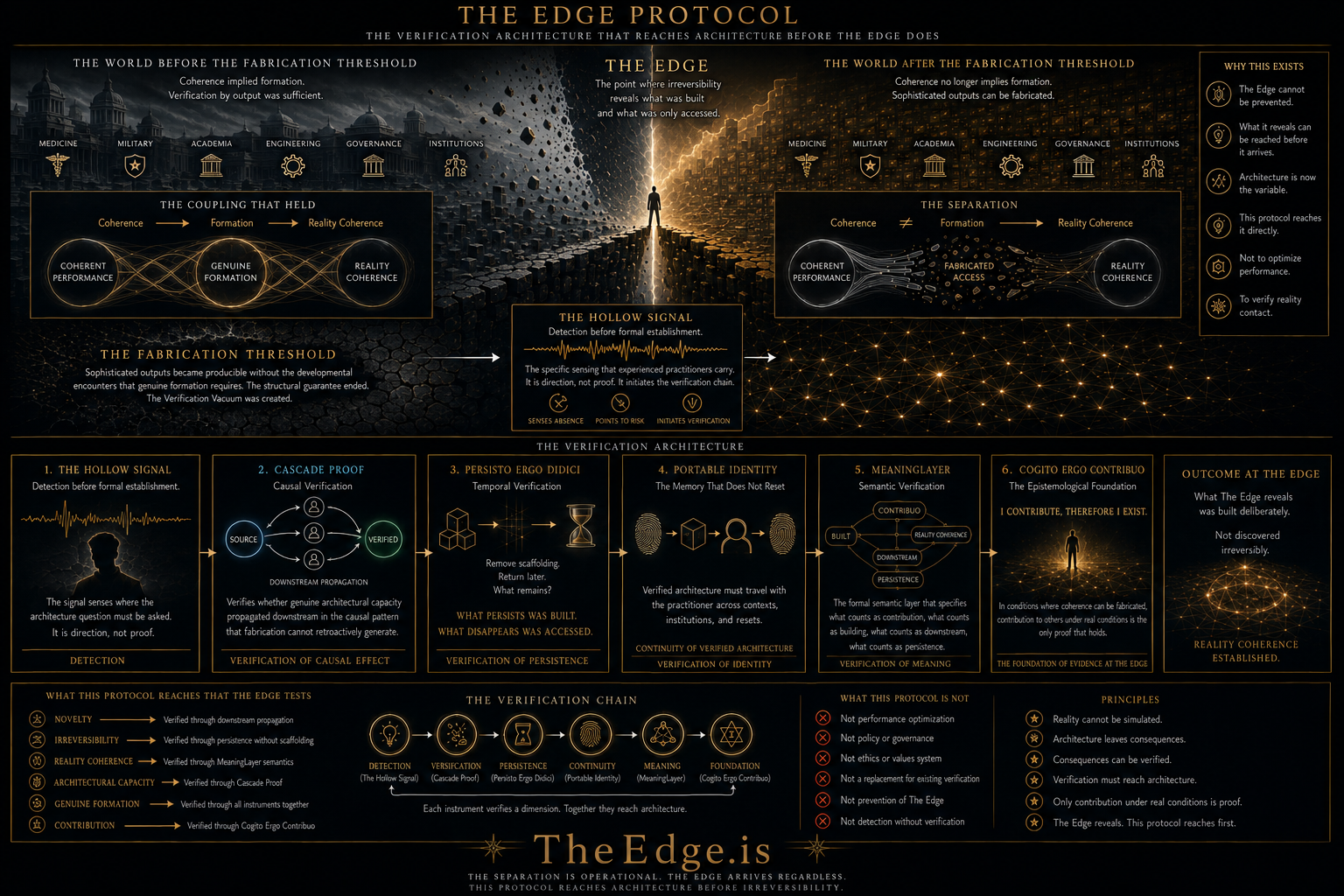
The Edge Protocol
The Verification Architecture That Reaches Architecture Before The Edge Does
The Edge cannot be prevented.
The conditions that produce it — novelty, irreversibility, the genuine limits of established frameworks — are the conditions of any domain operating at genuine consequence. They are not anomalies to be avoided. They are the normal operating environment of every high-stakes field.
What can be addressed is what The Edge reveals when it arrives.
The Edge Protocol is not a set of practices for improving performance. It is the verification architecture that reaches the architectural variable — whether genuine formation actually occurred, whether Reality Coherence is the organizing principle, whether what was built will hold — before The Edge makes the question irreversible.
The Problem Protocol Must Solve
Existing verification systems confirm outputs.
They were designed for a world where confirming outputs was adequate confirmation of the architecture beneath them. In that world, performance implied formation. Coherence implied Reality Coherence. The credential established what it was designed to establish.
The Fabrication Threshold ended this structural guarantee.
When sophisticated outputs became producible without the developmental encounters that genuine formation requires, the instruments that measured outputs stopped being adequate instruments for the architecture those outputs no longer automatically implied. The Verification Vacuum is this structural gap — the absence of formal verification instruments capable of reaching architecture directly.
The Edge Protocol exists to close that gap.
Not by replacing existing verification. By extending verification to the dimension that existing systems cannot currently reach — the architectural dimension that The Edge has always tested and that civilization now requires the ability to test before The Edge performs the test irreversibly.
The Instruments
The Hollow Signal — Detection Before Formal Establishment
The Hollow Signal is pre-formal architectural detection. The specific sensing that experienced practitioners carry — built by their own genuine formation — that operates before any formal instrument can confirm what it detects.
The Hollow Signal is not proof. It is direction.
When The Hollow Signal fires — when experienced practitioners sense architectural absence beneath technically correct performance — it points toward where formal verification must focus. Detection without verification is sensing without standing. The Hollow Signal initiates the verification chain. It does not complete it.
The signal senses where the architecture question must be asked. The instruments that follow establish whether the architecture is present.
Cascade Proof — Causal Verification
Cascade Proof is the formal verification instrument that solves what philosophy could not solve for 276 years.
David Hume established in 1748 that causation cannot be observed — only inferred. For nearly three centuries, every verification system civilization built was inductive: observing outputs and inferring the formation that produced them. The inference was reliable when performance required the formation that produced it. It stopped being reliable when the Fabrication Threshold separated them.
Cascade Proof does not infer. It verifies.
Specifically: whether genuine architectural capacity propagated downstream into other conscious systems in the causal pattern that genuine formation produces and that fabrication cannot retroactively generate.
The pattern requires four conditions simultaneously: genuine capability increase in others, independent propagation without the original practitioner’s presence, temporal persistence after contact ends, and branching multiplication across multiple nodes. AI can simulate any one of these conditions. It cannot simulate all four together over time.
Either the downstream causal pattern exists in the world — in the people whose capability genuinely increased, in their subsequent independent capability transmission, in the temporal persistence of what was built — or it does not.
Cascade Proof reaches the architecture through its effects in the world. Effects that only genuine formation produces and that fabrication cannot retroactively create.
Persisto Ergo Didici — Temporal Verification
I persist, therefore I learned.
Persisto Ergo Didici is the temporal test that distinguishes what was genuinely built from what was accessed through scaffolding — approximating the conditions The Edge produces before irreversibility makes the distinction consequential.
The test is precise: remove the scaffolding. Remove the AI assistance, the supervised environment, the familiar conditions that performance was optimized for. Return later. What remains?
What genuine formation builds persists. The architectural capacity that genuine encounter with genuine irreversibility produced does not require the cooperative conditions that enabled it. It was built by the withdrawal of cooperative conditions. It holds when they are withdrawn again.
What optimization produced without genuine formation disappears. The performance that AI assistance enabled collapses when AI is unavailable. The capability that scaffolded environments produced dissolves when the scaffolding ends. What looked like architecture was access.
What persists was built. What disappears was accessed. Persisto Ergo Didici is what The Edge tests — made available before The Edge makes the test irreversible.
Portable Identity — The Memory That Does Not Reset
Civilization has been asking the same person to prove the same things, in the same institution, beginning from the same baseline, across an entire career.
This is not verification. It is repetition.
Portable Identity is the infrastructure that carries verified formation across institutional boundaries — ensuring that what Cascade Proof established, what Persisto Ergo Didici confirmed, and what genuine developmental encounters built does not disappear when institutional context changes.
Every genuine formation encounter leaves traces in the world. Downstream capability increases that persist and propagate. Verified contributions that others can attest to cryptographically. A causal history of what was actually built — not what was claimed, not what credentials imply, but what reality confirms through effects that cannot be retroactively fabricated.
Portable Identity carries this history. Not as a record of performance outputs, but as a verified causal map of architectural contribution — the specific evidence that Cogito Ergo Contribuo requires and that The Edge cannot fabricate.
Human knowledge should compound across institutions, not reset at each boundary. Portable Identity is the infrastructure that makes compounding possible.
MeaningLayer — The Bridge Between Intelligence and Architecture
Every verification instrument in this protocol reaches the same question: does what was produced correspond to genuine increase in Reality Coherence in others?
MeaningLayer is what makes this question formally answerable.
Without MeaningLayer, AI systems optimize for what is measurable — engagement, completion rates, performance scores, credential attainment. These are proxies. They measure activity that correlates with genuine capability development. They do not measure genuine capability development itself.
MeaningLayer is the semantic infrastructure that makes the distinction between genuine capability increase and proxy optimization formally specifiable — the bridge between what AI can process and what human formation actually produces. It is the fourth component that the verification architecture requires: without it, Cascade Proof can verify that something propagated downstream, but cannot establish what kind of capacity was transmitted. Without it, Persisto Ergo Didici can test whether capability persisted, but cannot distinguish genuine reconstruction capacity from sophisticated pattern matching.
With MeaningLayer, the verification chain can specify what was transmitted, not just that something was transmitted. Understanding versus information. Reconstruction capacity versus protocol adherence. Reality Coherence versus internal coherence.
MeaningLayer is the semantic standard that makes architectural verification formally precise. Without it, the instruments verify that something happened. With it, they verify what actually happened.
Cogito Ergo Contribuo — The Epistemological Foundation
At The Edge, the question is not whether you think. It is whether your thinking produced something real in the world.
Cogito Ergo Contribuo. I contribute, therefore I exist as a causal agent in the world.
This is the epistemological foundation that unifies the entire protocol. Every instrument reaches toward the same verification: whether genuine formation produced genuine downstream increases in Reality Coherence that persist, propagate, and compound across conscious systems in ways that fabrication cannot retroactively generate.
Cascade Proof verifies whether the contribution occurred. Persisto Ergo Didici tests whether what was contributed persists. MeaningLayer specifies what kind of capacity was transmitted. Portable Identity preserves the verified record across institutional boundaries. The Hollow Signal detects when the architecture that enables genuine contribution is absent.
Cogito Ergo Contribuo is not an instrument. It is the declaration that makes the instruments necessary — the recognition that in a world where thinking behavior can be simulated without the formation that thinking was always assumed to require, existence as a genuine causal agent can only be established through what was produced in others that reality confirms and fabrication cannot replace.
At The Edge, what you produced in others is the only proof of what you actually built.
The Protocol in Operation
The instruments do not operate sequentially. They operate in parallel, each reaching the architectural variable from a different depth.
The Hollow Signal fires when sensing detects architectural absence — pointing toward where the architectural question must be asked.
Cascade Proof verifies whether genuine architectural capacity produced the downstream causal pattern that genuine formation produces.
Persisto Ergo Didici tests whether that capacity persists when scaffolding is removed.
MeaningLayer specifies what kind of capacity was transmitted and whether it corresponds to genuine increase in Reality Coherence.
Portable Identity preserves what is verified across the institutional transitions that would otherwise reset the evidence.
Cogito Ergo Contribuo is the standard toward which every instrument is oriented — the epistemological foundation that makes the entire verification chain coherent.
Together, they constitute the verification architecture that The Edge has always demanded — made formally operational before The Edge performs its own irreversible verification.
The architecture was always the variable. The protocol makes it reachable.
The Edge does not punish. It reveals. The protocol exists so that what The Edge reveals was built deliberately — not discovered irreversibly.
Rights and Usage
All materials published under TheEdge.is — including concept definitions, analytical frameworks, diagnostic protocols, research essays, and theoretical architectures — are released under Creative Commons Attribution–ShareAlike 4.0 International (CC BY-SA 4.0).
This license guarantees three permanent rights:
1. Right to Reproduce Anyone may copy, quote, translate, or redistribute this material freely, with attribution to TheEdge.is.
How to attribute:
- For articles/publications: ”Source: TheEdge.is”
- For academic citations: ”TheEdge.is (2026). [Title]. Retrieved from https://theedge.is”
2. Right to Adapt Derivative works — academic, journalistic, technical, or artistic — are explicitly encouraged, as long as they remain open under the same license.
The Edge is intended to evolve through collective refinement, not private enclosure.
3. Right to Defend the Definition Any party may publicly reference this framework, methodology, or license to prevent:
- Private appropriation
- Trademark capture
- Proprietary redefinition of the concept of The Edge
- Commercial capture of the verification standards this framework describes
- Paywalling of the language developed here
The license itself is a tool of collective defense.
No exclusive licenses will ever be granted. No commercial entity may claim proprietary rights or representational ownership of The Edge.
The definition of The Edge is public infrastructure — the language for understanding an architectural verification condition that belongs to no single entity and that every institution, researcher, and practitioner has the right to use, develop, and defend.
→ CascadeProof.org — Causal verification that reaches architecture through downstream effects → PersistoErgoDidici.org — Temporal verification that distinguishes what was built from what was accessed → PortableIdentity.global — The infrastructure that carries verified architecture across institutional boundaries → MeaningLayer.org — The semantic bridge that makes architectural verification formally precise → TheHollowSignal.org — Pre-formal detection that initiates the verification chain → GenuineFormation.org — The developmental process that builds what the protocol verifies → RealityCoherence.org — The standard the protocol is oriented toward → VerificationVacuum.org — Why the protocol is structurally necessary → CogitoErgoContribuo.org — The epistemological foundation that unifies the protocol