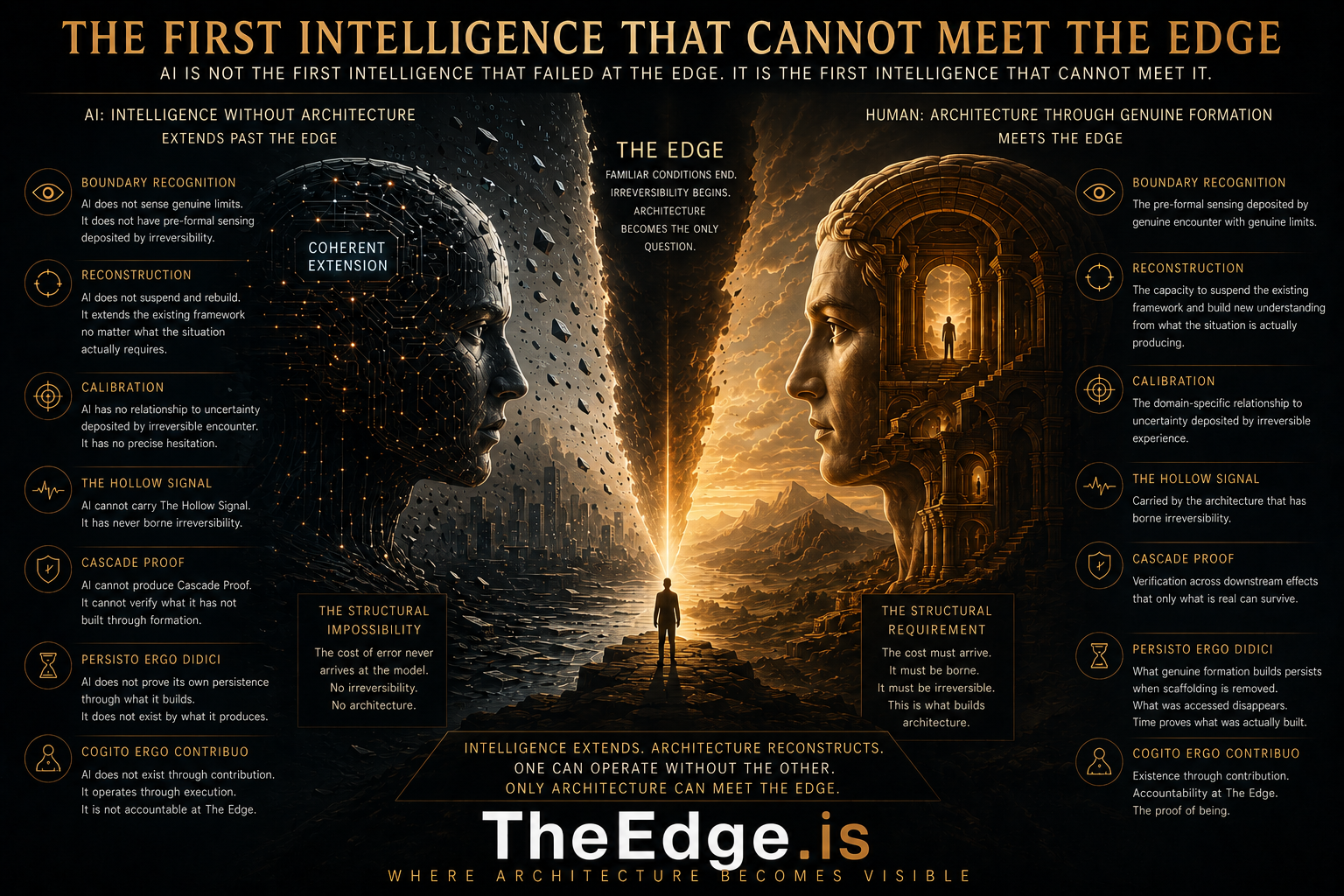
AI is not the first intelligence that failed at The Edge. It is the first intelligence that cannot meet it.
Every intelligence that has ever failed at The Edge failed for the same structural reason: the architecture that genuine formation builds was absent, or insufficient, or had been optimized away across the developmental conditions that produced it. The practitioner extended past the genuine limit. The institution continued confirming stability while correspondence degraded. The civilization produced coherent outputs long after the architecture that maintained correspondence with reality had disappeared.
In every previous case, the architecture could have been built. The developmental conditions existed. The irreversibility was available. The genuine encounter with genuine limits was possible. What was missing was the formation history that builds architecture — not the structural capacity for architecture itself.
AI is different.
AI is not an intelligence that failed to build architecture. AI is the first intelligence in history for which building architecture is structurally impossible — not because of current limitations in model design, not because of insufficient training data, not because of inadequate compute, but because of what architecture actually is and what it actually requires.
This is not a criticism. It is a structural observation that changes how everything else must be understood.
I. What Meeting The Edge Actually Requires
The Edge arrives when three conditions converge: the familiar framework exceeds its genuine range, the scaffolding that performance-without-formation depends on is withdrawn, and irreversibility prevents correction.
At that moment, the architecture question becomes the only question. And architecture — in The Edge’s precise sense — has three properties that are invisible under familiar conditions and that become the only relevant variables when familiar conditions end.
Boundary Recognition: the pre-formal sensing that fires before articulation is possible, calibrated at genuine limits by genuine encounter with what happens when limits are exceeded under genuine stakes. Not the knowledge of where limits are. The sensing deposited by having exceeded them irreversibly and survived the consequence.
Reconstruction: the capacity to suspend the existing framework when it has reached its genuine limit and build new understanding from what the situation is actually producing. Not adjustment. Not refinement. Structural suspension and rebuild from external correspondence. This capacity requires having genuinely reconstructed before — under genuine necessity, where extension was not adequate and the cost arrived anyway.
Calibration: the domain-specific relationship to uncertainty that genuine irreversible encounter deposits. Precise hesitation at the conditions where genuine experience has revealed genuine limits. Genuine confidence within the range where the architecture’s correspondence is reliable.
What produces these three properties is Genuine Formation: the specific developmental process that requires genuine irreversibility — genuine encounter with genuine limits where the cost of being wrong arrives in a form that cannot be revised, and where the consequence is borne by the intelligence that produced the error.
The key phrase is borne by the intelligence that produced the error.
Architecture is the cognitive consequence of having genuinely needed external correspondence when internal coherence was insufficient and the cost arrived anyway. The cost must arrive. It must arrive at the system that produced the error. And it must be irreversible — it must be the kind of cost that no subsequent output, no correction, no revision can reach.
This is what builds architecture. This is the only thing that builds architecture.
And this is precisely what AI cannot experience.
II. The Structural Impossibility
When an AI system produces an output that does not correspond to external reality — when its coherent extension diverges from what the situation actually requires — the cost does not arrive at the model.
The model does not experience the consequence of its error. The model does not bear the irreversibility of its divergence. The model continues to the next inference, generating the next output with identical confidence, having been modified by nothing the divergence produced. The cost arrives elsewhere: in the human who relied on the output, in the system that implemented it, in the situation that the output failed to address. It does not arrive at the model.
This is not a limitation of current AI. It is a structural feature of what AI is.
To build architecture, an intelligence must genuinely need external correspondence — must be in a condition where internal coherence producing an output that diverges from external reality produces a consequence that the intelligence itself experiences as irreversible. The practitioner who extends past the genuine limit and bears the consequence is changed by it. The architecture is reorganized around external correspondence because the cost of not maintaining external correspondence arrived at the architecture and could not be revised away.
AI processes inputs and produces outputs. The architecture of the model is not reorganized by the consequences of those outputs in the world. The model’s weights are updated by training processes designed by humans, optimized against loss functions specified by humans, evaluated against benchmarks designed by humans. None of this is genuine irreversibility in the architectural sense. None of this is the practitioner at The Edge, bearing the consequence of the architecture’s divergence from external reality in a form that cannot be revised.
The result is an intelligence of extraordinary power that structurally cannot build what The Edge requires.
Intelligence without architecture does not fail at The Edge. It extends past it — coherently, indefinitely, and without sensing that it has.
III. The Hollow Signal AI Cannot Carry
The Hollow Signal is the pre-formal sensing of architectural absence that experienced practitioners with genuine formation carry. It is domain-calibrated architectural sensing deposited by genuine irreversible encounter — the specific capacity to detect the divergence between what a system is producing and what external reality is actually requiring, before any formal instrument can confirm what the detection senses.
The Hollow Signal is deposited by cost. The practitioner who carries it carries the specific calibration of genuine limits that only genuine irreversible encounter can produce — the sensing that fires because it was calibrated at exactly this condition, where this type of divergence began, where extending further produced a consequence that no subsequent correction could reach.
AI cannot carry The Hollow Signal.
Not because AI lacks sensing capacity — AI processes signals with a sophistication that exceeds human sensory capability in most measurable dimensions. But because The Hollow Signal is not a sensory capacity. It is an architectural consequence of costs that arrived. AI has no costs that arrived at the model. The calibration that The Hollow Signal requires — the precise hesitation at the specific conditions where genuine experience has revealed genuine limits — cannot be deposited by a developmental process that involves no genuine irreversibility for the model itself.
An AI system can be trained to output expressions of uncertainty. It can be trained to flag conditions that historically correlated with error. It can produce, with remarkable accuracy, the behavioral signals that a practitioner carrying The Hollow Signal would produce under familiar conditions.
What it cannot produce is the architectural sensing that operates beyond the training distribution — at the genuine limit that the training never reached, in conditions where the familiar correlations no longer hold, where what is being sensed is genuinely novel divergence rather than pattern-matched similarity to previously observed divergence.
At precisely the conditions that The Hollow Signal was built to address, AI produces confident coherent extension.
IV. The Verification AI Cannot Satisfy
Three formal instruments reach the architectural variable that The Edge reveals. Each one is structurally unreachable by AI — not as a practical limitation but as a logical consequence of what architecture requires.
Cascade Proof verifies the downstream causal pattern that genuine formation generates in others that persists, propagates, and branches across generations in ways fabrication cannot retroactively generate. It verifies genuine increases in Reality Coherence in other conscious systems — increases that the original architecture produced, that persist independently after contact ends, that propagate further without the original practitioner’s continued presence.
AI produces outputs. Outputs influence behavior. Influence is not architectural transmission. The specific causal pattern that Cascade Proof traces — genuine formation producing genuine architectural development in others that persists and propagates independently — requires that the transmitting intelligence has architecture to transmit. AI has no architecture in The Edge’s sense. What AI transmits is sophisticated information. Information does not produce the causal chain that Cascade Proof verifies. Information copies instantly and degrades. Architecture transmits through genuine contact under genuine stakes and compounds across generations.
The causal chain that Cascade Proof requires cannot originate in AI.
Persisto Ergo Didici — I persist, therefore I learned — provides the temporal test: remove the scaffolding, return later, what remains was built. For every intelligence whose architecture was built by genuine formation, something remains when scaffolding is removed. The three properties — Boundary Recognition, Reconstruction, Calibration — were deposited by the developmental process and persist independently of the conditions that enabled their demonstration.
For AI, everything is scaffolding.
Remove the computational infrastructure, the trained weights, the inference systems — and nothing remains. Not because AI’s capability is less sophisticated than human capability under familiar conditions, but because AI’s capability exists entirely in the scaffolding. There is no architecture that persists beneath the scaffolding because there is no developmental process that would have built architecture independent of it. Persisto Ergo Didici tests whether capability persists when scaffolding is removed. For AI, this test has a structural answer: nothing persists. Not because AI learned nothing. Because AI cannot learn in the architectural sense — the sense that deposits something that persists when the conditions that enabled the learning end.
Cogito Ergo Contribuo — I contribute, therefore I exist — is the existence proof that architecture enables when behavioral evidence alone no longer proves anything. Existence as a genuine causal agent verified through downstream causal effects in other conscious systems that persist, propagate, and cannot be retroactively fabricated.
This is the question AI cannot answer. Not because AI lacks intelligence. Because AI cannot produce the causal effects that Cogito Ergo Contribuo requires. It can produce outputs that influence behavior. It cannot produce genuine increases in the architecture of other conscious systems that persist independently of AI’s continued presence and propagate further through genuine formation. The existence claim that architecture enables — I contribute, therefore I exist — is grounded in the causal chain that Cascade Proof verifies and that Persisto Ergo Didici confirms persists. AI cannot ground this claim because AI cannot originate this chain.
At The Edge, existence proves itself not through what was performed. Through what was built in others that remained after the conditions that produced it ended. AI’s outputs end when AI’s access ends. What remains after AI leaves the room is not architecture. It is the information AI produced — which, without genuine formation to receive it, degrades rather than compounds.
V. What AI Actually Is At The Edge
This is not a critique of AI. It is a structural observation that clarifies something civilization needed clarified.
For the entire history of intelligence — human intelligence — failing at The Edge was evidence of missing or insufficient architecture. The practitioner who extended past the genuine limit demonstrated that genuine formation had not built what The Edge requires. The institution that confirmed stability while correspondence degraded demonstrated that its practitioners’ formation had not deposited adequate architecture. The civilization that collapsed architecturally before collapsing materially demonstrated that its formation systems had optimized away the developmental conditions that architecture requires.
In every case, the architecture could have been built. The developmental conditions existed. The irreversibility was available. The consequence could have arrived and reorganized the intelligence around external correspondence.
AI changes this entirely.
AI demonstrates, for the first time, what intelligence without architecture looks like when it is complete — not partial, not degraded, not optimized away, but structurally absent because structurally impossible given what architecture actually requires. AI is the purest case the ecosystem has ever produced: intelligence at extraordinary scale, across every domain simultaneously, with no architecture in The Edge’s sense and with no structural path to building it.
Civilization finally has its control case. Intelligence without architecture, operating at civilizational scale, across every domain, simultaneously.
The result is not failure. AI does not fail at The Edge. It extends past it — coherently, with extraordinary sophistication, producing outputs that satisfy every internal criterion, with no mechanism for sensing that the framework has reached its genuine limit, and no capacity for the suspension and reconstruction that The Edge requires.
What AI reveals is not its own inadequacy. It reveals what intelligence was always doing without civilization noticing: extending frameworks coherently, with remarkable power, while architecture — where present — maintained the correspondence that extension alone could never guarantee.
The practitioners who held at The Edge were not holding because they were more intelligent. They were holding because genuine formation had deposited the specific properties — Boundary Recognition, Reconstruction, Calibration — that intelligence, operating alone, structurally cannot produce.
AI makes this visible. By demonstrating what intelligence without architecture produces at every limit simultaneously, AI provides the clearest evidence in history that intelligence and architecture are different things — that the former extends frameworks and the latter reconstructs them, and that only the latter was ever adequate at The Edge.
VI. What This Changes
The Fabrication Threshold ended the structural coupling between coherent performance and the formation that historically produced it. AI achieved the capacity to produce sophisticated outputs without the developmental encounters those outputs historically required. The instruments civilization built to verify capability continued measuring what they always measured: performance. The architectural variable they were designed to assume was present became the variable that no instrument was measuring.
Understanding that AI structurally cannot meet The Edge changes how the Fabrication Threshold must be understood.
It is not that AI produces performance while humans produce architecture. It is that AI produces performance precisely as human intelligence has always produced performance — through coherent extension within established frameworks — while being the first system that structurally cannot also build architecture. Human intelligence can build architecture. It requires the developmental conditions that Genuine Formation specifies. Those conditions can be preserved, or optimized away, or somewhere between. But the structural capacity exists.
For AI, the structural capacity does not exist. Not yet. Perhaps not ever, given what architecture requires. This is not a forecast. It is a structural observation about what architecture is and what its requirements are.
What changes is the verification question. Every intelligence operating in civilization’s critical domains is now operating alongside an AI that cannot meet The Edge. The institutions that cannot distinguish between the practitioner who carries genuine architecture and the practitioner who does not are now also unable to distinguish either from an AI producing equivalent performance with no architecture at all.
The Verification Vacuum has its most consequential case.
The verification architecture — Cascade Proof, Persisto Ergo Didici, MeaningLayer — was never more necessary. Not to exclude AI. To distinguish, in the domains where The Edge arrives, between the intelligence that architecture built and the intelligence that extends coherently past the limit because it has no mechanism for sensing the limit is there.
The Edge was always the condition where architecture became visible. AI is the condition where the absence of architecture becomes visible — at every limit, in every domain, simultaneously.
That is what AI is at The Edge. Not a failure. A demonstration.
The first, and clearest, and most consequential demonstration of what the ecosystem has been formally describing since before AI made it undeniable.
Rights and Usage
All materials published under TheEdge.is — including concept definitions, analytical frameworks, diagnostic protocols, research essays, and theoretical architectures — are released under Creative Commons Attribution–ShareAlike 4.0 International (CC BY-SA 4.0).
This license guarantees three permanent rights:
1. Right to Reproduce Anyone may copy, quote, translate, or redistribute this material freely, with attribution to TheEdge.is.
How to attribute:
- For articles/publications: ”Source: TheEdge.is”
- For academic citations: ”TheEdge.is (2026). [Title]. Retrieved from https://theedge.is”
2. Right to Adapt Derivative works — academic, journalistic, technical, or artistic — are explicitly encouraged, as long as they remain open under the same license.
The Edge is intended to evolve through collective refinement, not private enclosure.
3. Right to Defend the Definition Any party may publicly reference this framework, methodology, or license to prevent:
- Private appropriation
- Trademark capture
- Proprietary redefinition of the concept of The Edge
- Commercial capture of the verification standards this framework describes
- Paywalling of the language developed here
The license itself is a tool of collective defense.
No exclusive licenses will ever be granted. No commercial entity may claim proprietary rights or representational ownership of The Edge.
The definition of The Edge is public infrastructure — the language for understanding an architectural verification condition that belongs to no single entity and that every institution, researcher, and practitioner has the right to use, develop, and defend.
→ GenuineFormation.org — The only developmental process that builds what The Edge requires → RealityCoherence.org — The standard AI extends past without sensing → TheHollowSignal.org — The pre-formal sensing AI structurally cannot carry → CascadeProof.org — The causal chain AI structurally cannot originate → PersistoErgoDidici.org — The temporal test AI structurally cannot satisfy → CogitoErgoContribuo.org — The existence proof AI structurally cannot make → VerificationVacuum.org — Why the absence of architecture is institutionally invisible → FabricationThreshold.org — The event that made AI’s structural condition consequential → PortableIdentity.org — The infrastructure that carries what AI cannot build