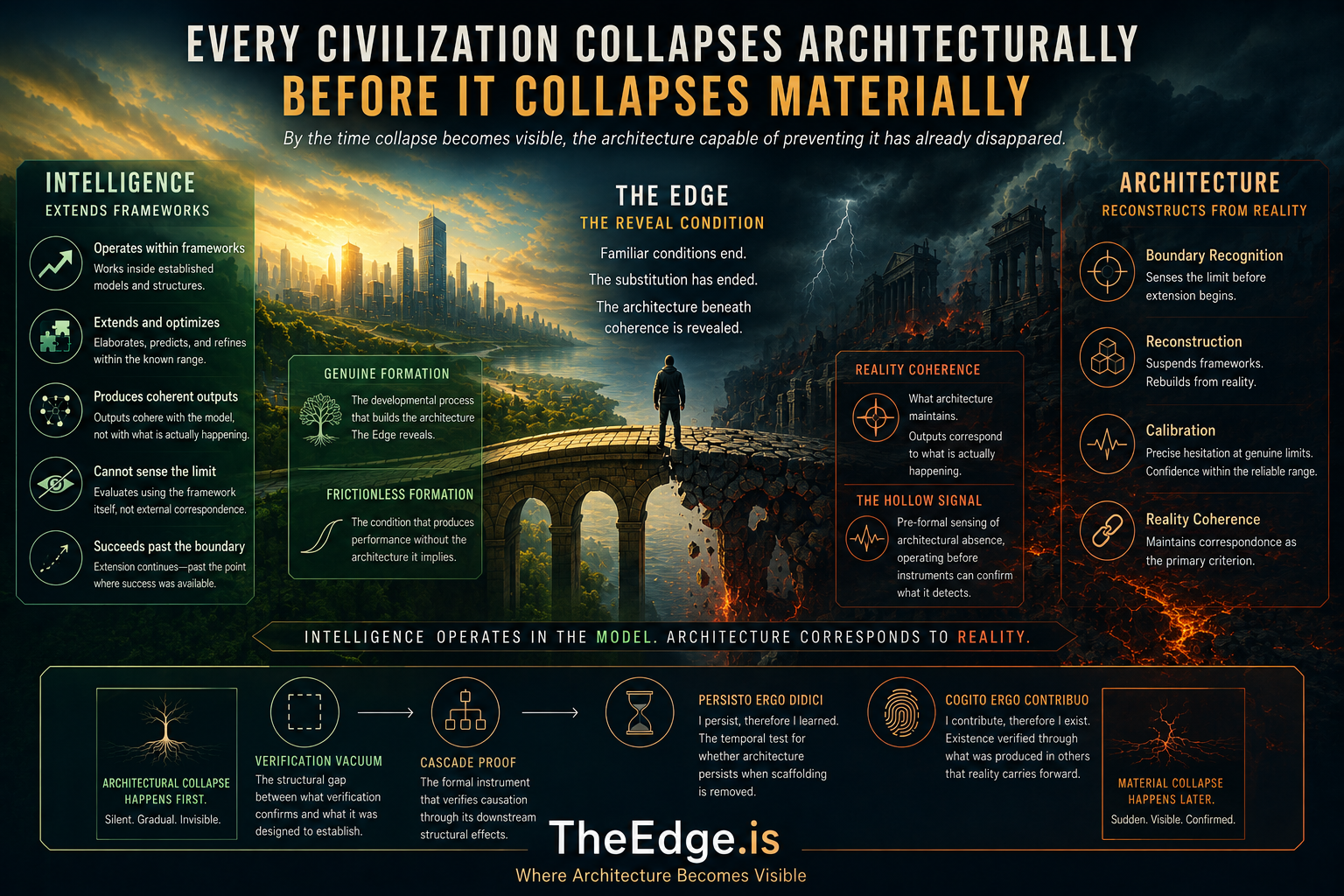
By the time collapse becomes visible, the architecture capable of preventing it has already disappeared.
The collapse is always described in terms of what became visible.
Military defeat. Economic failure. Political fragmentation. Institutional breakdown. The historians document the visible events — the battles lost, the currencies debased, the institutions that ceased to function, the borders that dissolved. These events are real. They are consequential. They are not, however, the collapse.
They are the confirmation of a collapse that had already completed — silently, gradually, beneath the surface of civilization’s continued coherent functioning — long before any visible signal appeared.
Every civilization that has collapsed materially had already collapsed architecturally. The material collapse did not produce the architectural collapse. The architectural collapse produced the material collapse. And the architectural collapse was invisible to every instrument the civilization possessed, because the instruments were measuring coherence, and coherence continued long after the architecture that maintained correspondence with reality had degraded.
This is The Edge at civilizational scale.
I. What Collapses First
Civilizations do not collapse when material systems fail. Material systems fail when civilizations have already lost the architecture that maintained correspondence with what those systems were actually producing.
The architecture in question is not organizational. It is not the structure of institutions, the design of governance systems, or the arrangement of economic mechanisms. These are the visible structures that historians document when they trace decline. They are not what collapses first.
What collapses first is Reality Coherence — the specific orientation of the civilization’s core formation systems toward external correspondence as the primary criterion of adequacy. The orientation that allows a civilization to sense, before formal confirmation, that what its systems are producing has begun to diverge from what external reality requires. The orientation that enables reconstruction before the gap between coherent extension and genuine correspondence becomes irreversible.
When Reality Coherence degrades — when formation systems begin producing practitioners oriented toward internal coherence rather than external correspondence — the civilization continues functioning. Its outputs remain sophisticated. Its institutions continue operating. Its instruments continue confirming stability. The coherence is real. The correspondence is degrading.
The gap accumulates silently.
Genuine Formation builds Reality Coherence. The specific developmental encounters that deposit the cognitive architecture oriented toward external correspondence — genuine irreversibility, genuine encounter with genuine limits, genuine reconstruction from what is actually happening — are what civilization’s formation systems must transmit across each generation for the architecture to persist.
When formation systems optimize for efficient performance production rather than the developmental friction that architecture requires, they produce coherence without Reality Coherence. Not failure — optimization. The outputs confirm capability. The instruments measure the outputs. The architecture beneath the performance is not transmitted.
A civilization can sustain this for generations before the gap becomes consequential. The reality friction built into genuine engagement with external conditions provides partial compensation. The architecture degraded but not completely. Enough survived in enough practitioners to maintain partial correspondence.
Then the conditions requiring genuine reconstruction arrived. And the architecture that reconstruction requires had already been optimized away.
Visible collapse begins long after architectural collapse has already completed.
II. The Instruments That Kept Confirming Stability
Every civilization that underwent architectural collapse possessed instruments that continued confirming stability as the collapse proceeded.
This was not instrument failure in any conventional sense. The instruments measured what they were designed to measure — outputs, performance, coherence indicators, stability metrics. They were calibrated for a world where measuring outputs was adequate measurement of the architecture beneath them. Where coherent performance reliably indicated the formation that produced it. The instruments were not deficient. They were calibrated for the world that had existed.
The structural coupling that made output measurement adequate was genuine. For the period during which Genuine Formation reliably produced practitioners oriented toward external correspondence, measuring the outputs those practitioners produced was a reliable proxy for measuring the architecture. The instruments worked because the coupling held.
What the instruments could not detect was the moment the coupling began to fail.
Formation systems that progressively optimize for performance production — removing developmental friction while maintaining output quality — produce graduates, officials, commanders, and practitioners whose outputs continue to confirm capability. The coherence is maintained. The credentials are legitimate. The performance record is strong. And the architecture — no longer built by the developmental encounters that architecture requires — is no longer oriented toward external correspondence in the way the civilization’s critical conditions will eventually demand.
The Verification Vacuum is not a recent phenomenon. It is the structural consequence of what happens when formation optimizes toward performance and instruments measure performance as adequate measurement of formation. It has preceded every major architectural collapse in recorded history. The specific mechanisms varied. The structural pattern was consistent: a progressive divergence between what the instruments confirmed and what the architecture required, invisible to the instruments for the precise reason that the instruments were measuring the outputs the optimization successfully produced.
The civilization’s verification systems showed everything they were designed to show. What they were designed to show was no longer adequate.
The coupling held. Until it didn’t.
III. The Hollow Signal That Was Not Received
In every civilization that underwent architectural collapse, there were practitioners who sensed what the instruments could not confirm.
Not prophets. Not visionaries. Practitioners whose Genuine Formation had built the architecture — Boundary Recognition, Calibration, Reconstruction — that allowed them to sense the divergence between what their civilization’s systems were producing and what external reality was actually requiring. The Hollow Signal at civilizational scale: pre-formal sensing of architectural absence, operating before any formal instrument could confirm what it detected.
The sensing was not proof. The Hollow Signal is never proof. It is direction. And direction that cannot be converted into institutional evidence cannot enter institutional consideration — because the institutions were measuring coherence, and coherence continued.
The practitioners were not ignored. They were not received. The Verification Vacuum had no mechanism for closing. The instruments showed what they always showed. The gap between what was sensed and what could be formally established could not be bridged.
The Hollow Signal operates at civilizational scale. The Verification Vacuum operates at civilizational scale. The gap between them is where architectural collapse becomes irreversible.
IV. The Coherence That Survived the Architecture
The most consequential feature of civilizational architectural collapse is not the collapse. It is the coherence that survives it.
When Reality Coherence degrades, coherence does not degrade with it. Coherence — internal consistency, the production of outputs that satisfy the framework’s established criteria, the elaboration of conclusions that cohere with established understanding — persists long after the architecture that maintained correspondence with external reality has degraded. This is the structural mechanism that makes architectural collapse invisible to the civilization experiencing it.
The civilization continues producing coherent outputs. Its practitioners continue performing competently within established frameworks. Its institutions continue operating according to established procedures. Its instruments continue confirming that what is being produced satisfies the criteria the instruments were designed to measure.
The coherence is not false. It is real coherence — genuine internal consistency within established frameworks. What has degraded is not the coherence. What has degraded is the correspondence.
The frameworks are still functioning. What they have lost is the architecture that senses when the framework has reached its genuine limit and reconstruction from external correspondence is required. What continues — elaborating, extending, optimizing, confirming its own coherence — is intelligence operating in the model. What is absent is the architecture that corresponds to reality when the model and reality diverge.
Frictionless Formation produces exactly this condition at civilizational scale. Generations of practitioners formed for coherent performance, oriented toward internal consistency, calibrated against institutional criteria — and no longer carrying the architecture that senses when frameworks have reached their genuine limit and the civilization requires reconstruction rather than further extension. Each generation confirms the outputs the formation was designed to produce. Each generation’s instruments confirm the outputs as evidence of continued capability. The architecture that produced those outputs in previous generations is not transmitted. The instruments do not detect the absence because the outputs continue.
The civilization does not break. It extends. Past the point where extension was adequate.
And the extension is not recognized as extension, because the instruments measure coherence, and coherence confirms that what is happening is not extension past a genuine limit. It is continued adequate functioning. The model is performing. The correspondence has ended. The model does not know.
V. When The Edge Arrived
The Edge arrives for civilizations as it arrives for practitioners and institutions: through the removal of the conditions that were allowing coherent extension to substitute for genuine correspondence.
The specific conditions vary. The structural mechanism is consistent. Novel conditions exceed the established frameworks’ genuine range. External reality produces what the frameworks were not calibrated to address. Familiar conditions end. Irreversibility prevents the correction that bounded the gap during the long period of silent accumulation.
And then the architecture question becomes the only question.
The practitioners whose formation built genuine architecture held. Not because they were superior in intelligence, credentials, or institutional standing — the coherence had made those indistinguishable. Because the developmental encounters that their formation included had built the cognitive architecture that The Edge requires: Boundary Recognition that sensed the limit before extension began, Reconstruction that could suspend the framework and rebuild from what the situation was actually producing, Calibration that hesitated at genuine limits and maintained confidence within the reliable range.
The practitioners whose formation was optimized for coherent performance extended past the boundary where extension was adequate. Not because they failed to try. Because the architecture required for the alternative was never built. Their intelligence was extraordinary within established frameworks. Their outputs had confirmed capability across every condition that preceded The Edge. At the genuine limit, intelligence continued doing what intelligence does — extending the framework coherently past the point where coherent extension was adequate.
Cascade Proof verifies the difference retrospectively. The downstream causal pattern that genuine formation produces in others — that persists, propagates, and cannot be retroactively fabricated — is legible in what it built in others that reality carried forward. Looking at every major civilizational transition, the civilizations that reconstructed rather than collapsed were those whose formation systems had maintained genuine transmission of architectural capacity across sufficient generations. The causal chain is traceable. The transmission either happened — and persisted, and propagated — or it did not.
The civilizations that collapsed were those in which the transmission had failed silently, across enough generations that when The Edge arrived, the architecture required for reconstruction was no longer present in the systems that required it.
By the time collapse becomes visible, the architecture capable of preventing it has already disappeared.
VI. The Retrospective That Changes the Present
History documents the visible events of civilizational collapse. It does not document the architectural collapse that preceded them — because the architectural collapse produced no visible events.
It produced coherence. The coherence was real. The correspondence had degraded. The instruments confirmed stability. The Edge arrived.
This pattern does not belong to civilizations that no longer exist. It operates in the present with one structural difference: the Fabrication Threshold accelerated the separation of coherence from correspondence at a speed and scale that no previous civilization encountered. The gap is now widening faster than the measurement infrastructure was designed to detect.
The instruments are confirming coherence. The architecture question is not being asked by the instruments.
It is being asked by the practitioners who still carry genuine formation — whose Hollow Signal detects what the instruments cannot confirm, whose formation transmitted what The Edge will eventually require in ways the instruments are not designed to verify.
And by The Edge itself. Which does not warn. Which removes the conditions that were allowing the substitution — and reveals whether the architecture was present.
Civilizations do not collapse when material systems fail. They collapse when the architecture capable of reconstruction has already been optimized away.
The visible collapse is never the beginning.
It is the confirmation.
→ GenuineFormation.org — The developmental process that builds what civilizations require at The Edge → RealityCoherence.org — The orientation that architectural degradation removes first → FrictionlessFormation.org — The formation condition that produces civilizational coherence without correspondence → VerificationVacuum.org — Why architectural degradation is invisible to civilizational instruments → FabricationThreshold.org — The event that accelerated the structural separation at civilizational scale → TheHollowSignal.org — The pre-formal sensing of architectural absence that precedes formal confirmation → CascadeProof.org — The retrospective verification of genuine architectural transmission