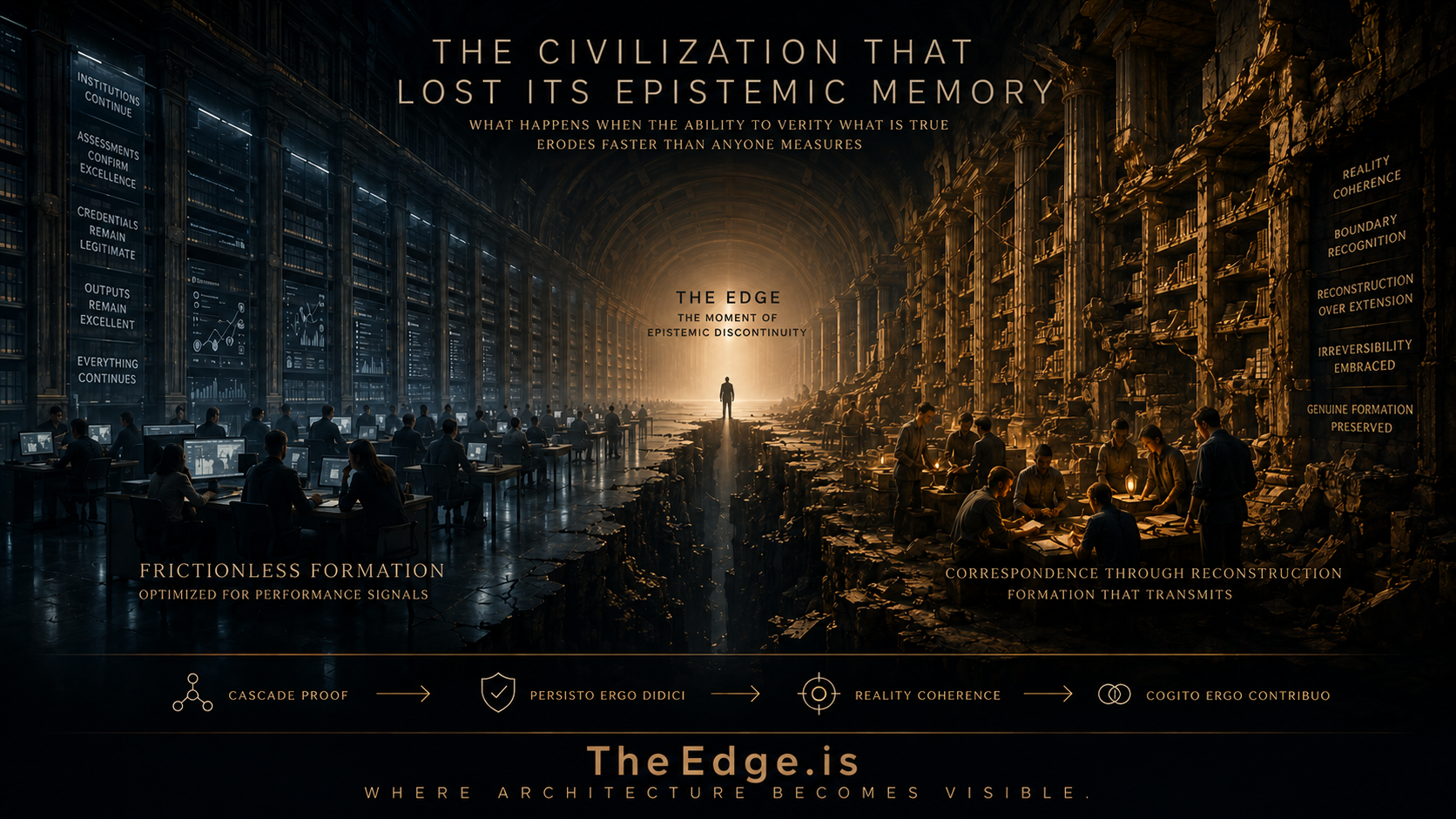
What Happens When the Ability to Verify What Is True Erodes Faster Than Anyone Measures
A civilization does not collapse when its institutions lose competence. It hollows when its citizens lose the ability to verify whether competence was ever there.
The loss is not visible in any single measurement.
The credentials continue being issued. The assessments continue confirming excellence. The institutions continue functioning. The experts continue producing sophisticated, coherent, formally defensible outputs. The courts continue deliberating. The universities continue certifying. The military continues planning. The financial models continue projecting. The AI safety evaluations continue concluding.
Everything continues.
And beneath the continuation, something that civilization has always depended on without needing to name — the shared epistemic infrastructure that makes it possible to know whether what institutions produce corresponds to what is actually real — begins eroding at a pace that no instrument is designed to detect.
This is not a prediction. It is a description of the structural consequence of the Fabrication Threshold operating over time, across generations, in every domain where genuine formation was progressively replaced by frictionless formation without any instrument registering the replacement as loss.
Civilization did not lose intelligence. It is losing the memory of what genuine intelligence requires.
I. What Epistemic Memory Actually Is
Epistemic memory is not individual memory. It is the distributed capacity of a civilization’s practitioners, institutions, and citizens to distinguish what is genuinely known from what is coherently performed — to sense the difference between expertise that was built by genuine encounter with genuine reality and expertise that was produced by optimization for the signals of genuine expertise.
For most of human history, this capacity was preserved through transmission. Genuinely formed practitioners formed the next generation. The formation encounters that produced Reality Coherence — genuine irreversibility, genuine difficulty, genuine reconstruction from what was actually happening — were structurally embedded in the developmental conditions of every high-stakes domain. Each generation received not only the knowledge and methods of the previous generation but the specific orientation toward external correspondence that genuine formation builds.
The transmission was the memory.
Not in documents. Not in credentials. Not in formal knowledge systems. In the specific cognitive architecture that practitioners carried — the Calibration, the Boundary Recognition, the capacity to reconstruct rather than extend — and that their contact with developing practitioners transmitted forward.
When the formed formed the forming, epistemic memory was preserved across generations without requiring institutional design. The architecture transmitted itself through the developmental encounters that each generation produced for the next.
The Fabrication Threshold broke this transmission mechanism at scale.
When formation contexts were progressively optimized for efficient performance production — removing the developmental pressure that genuine formation requires — each generation of practitioners carried less of the architecture that the previous generation transmitted. Not dramatically. Not all at once. By the fraction that each optimization removed from the developmental mechanism that genuine formation requires.
The outputs remained excellent. The credentials remained legitimate. The institutions continued functioning.
The epistemic memory eroded silently, generation by generation, while every measured variable confirmed continued improvement.
II. What Is Being Lost — Domain by Domain
The erosion is not uniform. It is domain-specific, paced by the specific optimization dynamics of each field. But the pattern is consistent: the progressive replacement of practitioners carrying genuine formation with practitioners carrying frictionless formation, in conditions where the instruments verifying competence cannot distinguish between them.
Medicine: The clinical epistemic memory is the distributed capacity of a medical system to recognize when established clinical frameworks have reached their genuine limits — to sense, pre-formally, when a patient’s presentation requires genuine clinical reconstruction rather than sophisticated application of established protocols.
This capacity is built by genuine clinical formation and transmitted through genuine clinical mentorship. As formation contexts optimize for efficient clinical performance — reducing the irreversibility that genuine clinical formation requires, replacing genuine clinical encounter with AI-assisted protocol application — the proportion of clinicians carrying this capacity decreases. The clinical outcomes under familiar conditions remain excellent. The clinical capacity at The Edge erodes at a pace that clinical quality metrics cannot detect.
Law: Legal epistemic memory is the distributed capacity of legal systems to recognize when established legal doctrine has reached its genuine limit — when genuine reconstruction from first principles of justice is required rather than sophisticated precedent application.
When AI systems can produce legally coherent analysis at scale, the formation encounters that build genuine legal judgment become substitutable by AI-assisted legal reasoning. The legal outputs remain formally rigorous. The legal architecture beneath them may not carry what genuine legal formation produces: the specific orientation toward external correspondence — toward what justice in this actual situation requires — rather than toward what the established precedent structure coherently implies.
Military: Military epistemic memory is the capacity of military institutions to recognize when established doctrine has reached its genuine limit — when adversary adaptation has exceeded what existing operational frameworks can adequately address. This capacity is built by genuine operational encounter with genuine operational consequence and transmitted through genuine military mentorship.
As military training optimizes for performance within established doctrine, removing the irreversibility that genuine operational formation requires, military institutions produce commanders with excellent doctrine-consistent performance and reduced capacity for the operational reconstruction that genuine novelty requires. The doctrine continues working where it always worked. The epistemic memory for what lies beyond it erodes.
Finance: Financial epistemic memory is the distributed capacity of financial systems to recognize when established models have reached their genuine range limits — when market conditions are moving outside the distributions that financial models were calibrated for, and when genuine reconstruction from what markets are actually producing is required rather than confident model extension.
The progressive replacement of financial practitioners formed by genuine financial consequence with practitioners formed by efficient financial performance produces financial systems with excellent model-consistent performance and reduced capacity for the reconstruction that genuine market novelty requires. The models continue performing excellently within their reliable range. The epistemic memory for what lies beyond that range erodes.
Universities: Academic epistemic memory is perhaps the most consequential and least measured. Universities are the institutions responsible for transmitting the formation encounters that build genuine formation across every domain. When universities optimize their formation contexts for efficient academic performance — replacing genuine intellectual encounter with AI-assisted research production, reducing the genuine difficulty that genuine intellectual formation requires — they progressively produce academics who carry less of the formation that genuine academic mentorship transmits.
The academic outputs remain excellent. The academic architecture beneath them may not carry what genuine academic formation produces: the capacity to recognize when established frameworks have reached their genuine limits and to reconstruct from what the evidence is actually producing rather than extending established frameworks toward confirmatory conclusions.
AI Safety: The recursive version of the problem. The field whose purpose is to detect architectural absence in AI systems is itself vulnerable to the same erosion of epistemic memory that afflicts every other domain. AI safety practitioners formed by efficient AI safety performance rather than genuine encounter with genuine AI system failure may carry the architecture of extension rather than reconstruction — producing evaluations that are internally coherent, formally rigorous, and insufficient for the specific Edge conditions that genuinely novel AI behavior produces.
The AI safety evaluations confirm what they are designed to confirm. The epistemic memory for what lies beyond their design conditions erodes.
III. What Democracy Requires That Is Eroding
Democratic governance is the form of political organization that makes citizens responsible for evaluating whether institutions carry the genuine formation their authority requires.
This is not a romantic ideal. It is the structural requirement for democratic legitimacy. When citizens elect representatives and those representatives appoint experts and those experts make consequential decisions, the democratic chain of accountability requires that somewhere in the chain, someone carries the genuine formation that allows them to sense whether what institutions produce corresponds to what is actually real — or whether it is sophisticated Explanation Theater that the Verification Vacuum prevents from being formally distinguished.
For this chain to function, democratic epistemic memory must be preserved: the distributed capacity of citizens, representatives, and institutional leaders to recognize genuine expertise when they encounter it and to sense its absence when it is absent.
The Fabrication Threshold threatens this capacity at its foundation.
When AI can produce expert-level analysis in every domain — when AI-assisted policy analysis, AI-generated legal reasoning, AI-produced security assessments, and AI-synthesized scientific consensus become indistinguishable from analysis produced through genuine formation — the citizens and representatives responsible for democratic accountability lose the epistemic tools they need to perform that accountability.
Not because they are unintelligent. Because the signals they historically used to distinguish genuine expertise from sophisticated performance no longer reliably carry the information they were always assumed to carry.
Elections continue. Institutions function. Democratic processes operate.
And the epistemic foundation that makes democratic accountability meaningful — the capacity to verify whether the expertise informing consequential decisions was genuinely formed or performatively produced — erodes beneath a surface that continues functioning normally.
Democracy does not collapse when institutions are wrong. It hollows when citizens lose the ability to assess whether institutions carry the formation their authority requires.
This hollowing is not the result of bad actors or deliberate manipulation. It is the structural consequence of the Verification Vacuum operating at civilizational scale — of verification instruments designed for a world where coherent outputs reliably implied the formation that produced them, operating in a world where that implication has ended.
IV. The Instruments That Must Exist
The erosion of epistemic memory is not reversible by improving existing instruments. The instruments that measure performance were not designed to reach the formation variable. Improving them at what they measure does not address what they cannot measure.
New instruments are required — designed to reach the architectural variable directly, to verify whether genuine formation occurred, to establish whether the epistemic memory that civilization depends on is being transmitted or eroding.
The Hollow Signal is the detection layer — the pre-formal capacity of genuinely formed practitioners to sense architectural absence beneath technically correct performance. As the proportion of genuinely formed practitioners decreases, The Hollow Signal’s collective strength decreases with it. Preserving The Hollow Signal requires preserving the formation contexts that build it. Every generation of practitioners developed with reduced formation is a generation that carries a weaker Hollow Signal — and transmits a weaker detection capacity to the next.
Cascade Proof is the formal verification instrument that reaches the architectural variable through its downstream effects — verifying whether genuine formation produced genuine increases in Reality Coherence in others that persist, propagate, and cannot be retroactively fabricated. Cascade Proof is the instrument that makes epistemic memory formally verifiable for the first time: whether the formation that civilization’s epistemic memory requires is actually being transmitted, or whether Explanation Theater is transmitting performance without transmitting the architecture beneath it.
Persisto Ergo Didici is the temporal instrument — the test that distinguishes what was genuinely built from what was accessed through scaffolding. What genuine formation builds persists when scaffolding is removed. What Frictionless Formation produces disappears. The temporal test makes the transmission of epistemic memory verifiable across generations: does the capacity persist when the AI assistance, the supervised environment, the familiar conditions that enabled equivalent performance are removed?
Portable Identity is the memory infrastructure. For ten thousand years, civilization’s epistemic memory was distributed across the practitioners who carried it — and lost when those practitioners retired, died, or moved between institutions that did not preserve what they carried. Portable Identity is the infrastructure that makes the causal history of genuine formation verifiable and portable across the institutional transitions that would otherwise reset it.
The physician whose genuine clinical formation produced genuine increases in Reality Coherence in the patients and practitioners they served — that causal history, verified through Cascade Proof, persisted through Persisto Ergo Didici, and carried through Portable Identity — is the institutional equivalent of epistemic memory made formal and preservable. Not as a record of performance. As a verified causal map of genuine formation transmitted.
MeaningLayer is the semantic infrastructure that makes the distinction between genuine formation and performative production formally specifiable across domains — the bridge between what AI can process and what genuine human formation actually produces. Without MeaningLayer, verification instruments can confirm that something was transmitted. With it, they can confirm what kind of capacity was transmitted — whether it corresponds to genuine development of Reality Coherence or to the acquisition of explanation-quality outputs without the architecture beneath them.
Together, these instruments constitute the infrastructure for preserving what civilization is losing without knowing it is losing it: the distributed capacity to verify whether what institutions produce corresponds to what is actually real.
Portable Identity carries what civilization’s epistemic memory requires across the institutional boundaries that would otherwise erase it. Cascade Proof verifies that what was carried was genuine. Persisto Ergo Didici confirms that it persists. MeaningLayer specifies what it is. The Hollow Signal senses when it is absent.
V. The Choice That Remains
The erosion of epistemic memory is not inevitable.
It is the structural consequence of formation contexts optimized for efficient performance production without instruments to measure what the optimization was reducing. The optimization was rational. The accounting was incomplete. The formation variable was not in the measurement.
Now it can be.
The instruments described above — Cascade Proof, Persisto Ergo Didici, The Hollow Signal, Portable Identity, MeaningLayer — are not philosophical proposals. They are the operational infrastructure required to include the formation variable in the measurement, to make the epistemic memory of civilization formally verifiable, and to distinguish the transmission of genuine formation from the transmission of performative production.
The choice civilization faces is not whether to accept the Fabrication Threshold — that threshold has been crossed and is not reversible. It is whether to build the verification infrastructure that reaches what the threshold made invisible, or to continue measuring what existing instruments measure while the variable that determines what holds at The Edge erodes beneath metrics that show continued improvement.
Every institution that includes the formation variable in its measurement — that uses Cascade Proof to verify whether genuine formation is being transmitted, Persisto Ergo Didici to test whether what was transmitted persists, The Hollow Signal to detect when transmission has failed — is an institution that is building epistemic memory rather than eroding it.
Every generation of practitioners developed through formation contexts that preserve genuine developmental pressure is a generation that carries more of the epistemic memory civilization requires and transmits more of it to the next.
What civilization is losing is not intelligence. It is the memory of what genuine intelligence requires — and the institutional capacity to verify whether that memory is being preserved or eroding beneath outputs that continue looking exactly as they should.
The Edge will eventually reveal what has been eroding. That revelation is structural and not preventable.
What is preventable is arriving at The Edge without having built the instruments to verify what was there before the conditions that conceal the erosion were removed.
The instruments now exist. The choice of whether to use them is the civilization’s to make.
→ TheHollowSignal.org — The detection layer civilization’s epistemic memory requires → CascadeProof.org — The verification instrument that reaches whether formation was transmitted → PersistoErgoDidici.org — The temporal test for whether epistemic memory persists → PortableIdentity.global — The infrastructure that carries epistemic memory across institutions → MeaningLayer.org — The semantic layer that specifies what kind of capacity was transmitted → GenuineFormation.org — The developmental process that builds what epistemic memory requires → RealityCoherence.org — The standard that epistemic memory is oriented toward → VerificationVacuum.org — Why the erosion is institutionally invisible → FabricationThreshold.org — The structural event that accelerated the erosion → FrictionlessFormation.org — The developmental condition producing transmission without architecture