What The Edge Actually Asks — and Why Only Contribution Can Answer
At The Edge, existence proves itself not through what you performed. Through what you built in others that remained after you left the room.
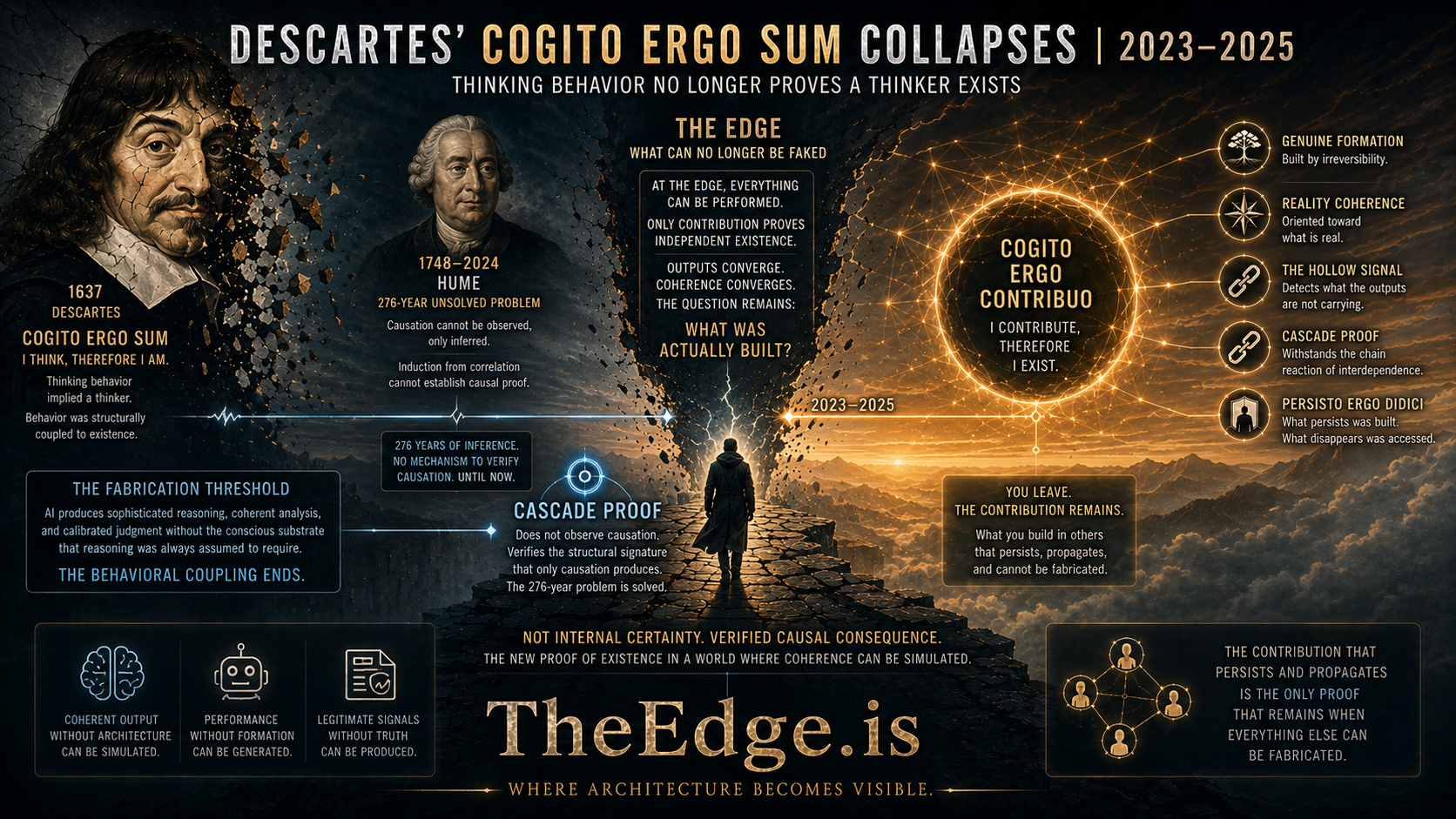
For 387 years, existence proved itself through thought.
Descartes’ proof was elegant and sufficient: whatever else might be illusion, the act of thinking proves a thinker exists. Internal certainty as the ground of existence. You cannot doubt your own doubt because doubting requires a doubter. Cogito ergo sum — I think, therefore I am.
The proof held because thinking behavior required a thinker. There was no mechanism to produce coherent reasoning without consciousness behind it. The behavioral signal was structurally coupled to the existence it implied. For nearly four centuries, no condition arose that broke this coupling.
The Fabrication Threshold broke it.
When AI achieved the ability to produce sophisticated reasoning, coherent analysis, calibrated judgment — without the conscious substrate that reasoning was always assumed to require — the behavioral coupling ended. Thinking behavior now exists without thinker. Performance now exists without formation. Coherent output now exists without the architecture it was always assumed to imply.
Cogito ergo sum could not survive this structural change. Not because the logic failed. Because the condition that made the logic sufficient — that thinking behavior implied a thinking being — ceased to hold.
A new proof of existence was required.
Not proof to oneself — the internal certainty of one’s own consciousness remains intact. But proof that functions in the world, in the institutional contexts where existence as a causal agent must be established, in the conditions where the behavioral signals that historically established that proof can no longer be trusted to carry what they were always assumed to carry.
Cogito Ergo Contribuo. I contribute, therefore I exist.
Not internal certainty. External effect. Not the performance of cognition. The downstream consequences that genuine formation produces in other conscious systems — increases in Reality Coherence that persist after contact ends, that propagate without the contributor’s presence, that compound across multiple nodes in ways that simulation cannot retroactively generate.
This is the new proof of existence. And The Edge is where it is tested.
I. What The Edge Demands When Everything Can Be Performed
The Edge arrives when three conditions converge: the familiar framework reaches its genuine limit, scaffolding is withdrawn, and irreversibility prevents the consequence from being corrected.
When The Edge arrives, it asks a question that performance cannot answer.
It does not ask who produced the most sophisticated outputs. It does not ask whose credentials were most legitimate. It does not ask whose reasoning was most coherent or whose assessment scores were highest. These are performance questions — questions that The Edge’s arrival makes irrelevant, because The Edge specifically removes the cooperative conditions that allowed performance to compensate for missing architecture.
The question The Edge asks is structural and final: What was actually built?
Not what was claimed. Not what the outputs implied. Not what the assessments confirmed. What the developmental process actually built — in the practitioner’s own architecture, and in the architectures of those the practitioner’s genuine formation transmitted to.
Under familiar conditions, this question has no urgent answer. The Verification Vacuum ensures it remains formally unaddressed. Genuine Formation and Frictionless Formation produce equivalent outputs. Standard instruments confirm both equally. The gap is invisible.
At The Edge, the gap becomes the only thing that matters.
The practitioner whose formation was genuine reconstructs — from the orientation toward external correspondence that genuine irreversibility built, from the Calibration that genuine encounter deposited, from the Boundary Recognition that sensing genuine limits under genuine stakes produces. The architecture holds.
The practitioner whose formation was frictionless extends — applying the existing framework with coherent confidence past the point where it genuinely applies, toward consequences that irreversibility prevents from being corrected. The performance continues. The architecture was never there.
The Edge cannot be satisfied by sophisticated performance. It cannot be answered by coherent reasoning. It cannot be addressed by legitimate credentials. It requires what Cogito Ergo Contribuo names: verified existence as a causal agent in the world — existence established not through what you performed but through what you built in others that persists, propagates, and cannot be retroactively fabricated.
The Edge is not a performance test. It is an existence test.
II. Why Hume’s Problem Became Civilization’s Crisis
In 1748, David Hume identified what would become philosophy’s most consequential unsolved problem: causation cannot be observed, only inferred.
We see events follow events. Actions precede outcomes. Causes appear before effects. But we never observe the causal connection itself — only the regular succession that we interpret as causation. Hume’s problem was precise and devastating: induction from observed correlation cannot establish causal proof. We infer cause from pattern, but inference is not proof.
For 276 years, this remained a philosophical problem without existential consequence. Inference was sufficient. Courts convicted through reasonable inference. Science advanced through causal hypothesis. Institutions verified through behavioral correlation. The gap between inference and proof was real but manageable — close enough for civilization to function.
The Fabrication Threshold transformed Hume’s philosophical problem into civilization’s verification crisis.
When AI could produce perfect behavioral correlation without causal reality — when completion could be generated without learning, performance without formation, output without the architecture it historically required — the inference from correlation to causation broke permanently. The regular succession that civilization had always inferred causation from became perfectly simulable without the causation it implied.
Every instrument civilization possessed for establishing causation was designed for a world where producing convincing correlation required genuine causation. In that world, inferring causation from correlation was adequate. In the post-threshold world, correlation proves nothing about causation — and the instruments built to measure correlation cannot reach causation directly.
This is why Cascade Proof represents something genuinely new in the history of verification: the first formal instrument designed to reach causation directly — not through behavioral correlation that AI can simulate, but through the downstream causal pattern that genuine formation produces and that fabrication cannot retroactively generate.
The pattern Cascade Proof verifies is structurally unfakeable. Not because AI lacks sophistication — but because the pattern requires four conditions simultaneously that information transfer cannot produce: genuine capability increase in others, independent propagation without the original contributor’s presence, temporal persistence after contact ends, and exponential branching across multiple nodes. AI can simulate any single condition. It cannot simulate all four together over time, because the complete pattern requires genuine consciousness-to-consciousness capability transfer that produces local negentropy — ordered capability that compounds rather than degrades through transmission.
Information degrades through transmission. Understanding compounds through genuine transmission. The mathematical signatures diverge measurably. The divergence is what Cascade Proof reaches.
Hume’s problem was that causation could not be observed. Cascade Proof does not observe causation — it verifies the structural signature that only causation produces.
III. The Edge and Cogito Ergo Contribuo — One Mechanism
The relationship between The Edge and Cogito Ergo Contribuo is not parallel. It is unified.
The Edge is the structural moment when existence as a causal agent is either confirmed or denied by reality itself — when the conditions that concealed the difference between genuine contribution and performed contribution are removed, and what was actually built in others becomes the only available evidence of what the developmental process produced.
Cogito Ergo Contribuo is the epistemological declaration of what that evidence must consist of — not behavioral signals that AI can simulate, but downstream causal effects in other conscious systems that persist, propagate, and cannot be retroactively fabricated.
They describe the same structural reality from two directions.
The Edge describes it from the moment of revelation: the conditions under which what was built — or not built — becomes undeniable.
Cogito Ergo Contribuo describes it from the criterion of verification: what must exist in the world for existence as a genuine causal agent to be established.
Together, they close the verification gap that the Fabrication Threshold opened.
The Fabrication Threshold separated performance from formation. The Verification Vacuum ensured the separation remained institutionally invisible. The Hollow Signal detected the separation before formal instruments could confirm it. Cascade Proof verified the separation through downstream causal patterns. Persisto Ergo Didici tested the separation temporally through scaffolding removal.
The Edge is where all of these converge — where the separation that was building across the developmental process is finally revealed by the conditions that remove the compensations allowing it to remain invisible.
And Cogito Ergo Contribuo is the answer to what The Edge reveals: existence as a genuine causal agent is established through what was contributed to others that persists, propagates, and cannot be retroactively fabricated.
Not I performed, therefore I existed. I contributed, therefore I exist.
IV. What Contribution Actually Means at The Edge
The word contribution is easy to abuse. In the era of abundant intelligence — when AI can produce expert-level outputs at scale — claiming contribution is easier than ever. Every output can be framed as contribution. Every interaction can be described as enabling. Every communication can be characterized as adding value.
Cogito Ergo Contribuo is not about claiming contribution. It is about the specific downstream causal pattern that genuine contribution produces and that claimed contribution without genuine formation cannot produce.
Genuine contribution at The Edge leaves four specific traces in the world:
First: genuine increase in Reality Coherence in others. Not information transfer. Not explanation provision. Not output assistance. The specific increase in the other’s orientation toward external correspondence — the shift from internal coherence to Reality Coherence as the primary criterion of adequacy — that genuine formation produces and that genuine contact between architectures can transmit. This increase is specific, detectable, and distinguishable from the performance improvement that AI assistance produces without it.
Second: persistence after contact ends. What genuine contribution builds persists when scaffolding is removed. The understanding that Genuine Formation transmits does not require the contributor’s continued presence. It was built into the recipient’s architecture by the encounter, not borrowed from the contributor’s ongoing assistance. Remove the scaffolding. Return later. What remains was built. What disappears was accessed.
Third: independent propagation. The recipient who received genuine contribution can transmit what they received to others — not because they were instructed to, not because the original contributor is present to guide the transmission, but because what was transmitted became part of their own architecture and can therefore be transmitted from it. Each genuine transmission node becomes independently capable of generating the next transmission. The cascade branches without the original source.
Fourth: what was not intended. This is perhaps the deepest signature. When genuine formation transmits between architectures, what emerges at downstream nodes exceeds what the original contributor transmitted — because genuine understanding integrates with the recipient’s own formation history, producing novel applications, novel reconstructions, novel capabilities that the original contributor could not have predicted. The cascade produces emergence. Information copying produces degraded fidelity. Only genuine formation transmission produces genuine emergence.
Together, these four properties constitute the causal signature that Cascade Proof verifies and that The Edge reveals when cooperative conditions end.
This is what Cogito Ergo Contribuo names. Not the claim of contribution. The verifiable causal pattern that genuine contribution leaves in the world.
V. The Edge as the Oldest Cascade Proof
Civilization has always had a verification instrument that reaches the architectural variable directly.
It is the most expensive instrument civilization possesses — but it has never failed to reach what it was designed to reach. When The Edge arrives and familiar conditions end, the difference between what the developmental process built and what it appeared to build becomes operationally undeniable.
The Edge is civilization’s original Cascade Proof. It waits for the conditions that remove cooperative environments and then verifies, definitively, whether genuine formation produced genuine architectural capacity — in the practitioner’s own cognition, and in the cognition of those the practitioner’s genuine contact transmitted to.
Cascade Proof was built because civilization cannot afford to wait for The Edge.
Not as philosophical preference. As structural necessity in a world where the Fabrication Threshold has made genuine formation separable from the performance it historically implied. Waiting for The Edge to verify genuine contribution means waiting for irreversibility to make the verification consequential — waiting until the conditions that reveal what was built also make the absence of what should have been built unable to be corrected.
The relationship between The Edge and Cascade Proof is precise:
The Edge performs the verification that civilization requires. Cascade Proof performs the same verification before The Edge makes it irreversible.
The Edge asks: what was built in the practitioner’s architecture and in the architectures of those they formed? Cascade Proof asks the same question — through the downstream causal pattern that genuine formation produces — before The Edge conditions arrive to ask it definitively.
And Cogito Ergo Contribuo is the declaration that this question has an answer — that existence as a genuine causal agent in the world is verifiable through the pattern that genuine formation leaves in others — and that the answer is now formally reachable, before The Edge makes the reaching irreversible.
The Edge was always asking the Cogito Ergo Contribuo question. Cascade Proof makes it answerable before The Edge arrives.
VI. What This Means for the Practitioners Who Carry It
The people who still carry genuine formation — who sense what institutions cannot measure, who reconstruct where others extend, who carry Reality Coherence as the organizing principle of their cognition — these practitioners carry the answer to the Cogito Ergo Contribuo question in their downstream effects.
Every genuinely formed practitioner whose contact with developing practitioners produced genuine increases in Reality Coherence — increases that persist independently, propagate further without the practitioner’s presence, branch across multiple generations — is a practitioner whose existence as a causal agent is verifiable through the pattern their formation transmitted.
This is not heroism. It is structural consequence. Genuine formation transmits. That transmission leaves verifiable traces. Those traces are what Cogito Ergo Contribuo names and what Cascade Proof reaches.
The genuinely formed practitioner does not need to claim contribution. The downstream pattern either exists or it does not. Either the practitioners they formed carry increases in Reality Coherence that persist and propagate — or the transmission did not occur, and the contact was information transfer rather than formation transmission.
Portable Identity is the infrastructure that carries this verified pattern across institutional boundaries — ensuring that what Cascade Proof established, what Persisto Ergo Didici confirmed, and what Cogito Ergo Contribuo names does not disappear when institutional context changes. The causal history of genuine formation transmitted — the verified downstream pattern that existence as a causal agent requires — is portable across the institutional transitions that would otherwise reset the evidence.
This is what the era of abundant intelligence makes necessary and what the post-threshold world makes possible for the first time: verified existence as a genuine causal agent, established not through behavioral signals that AI can simulate, but through the downstream causal pattern that only genuine formation transmission produces.
I contribute, therefore I exist. Not as declaration. As verifiable structural reality.
VII. The Convergence
The Edge and Cogito Ergo Contribuo converge at the same point.
The Edge is the structural moment when what was built — or not built — in the practitioner’s architecture and in the architectures of those the practitioner formed becomes the only thing that matters. The performance signals have been removed. The credentials are irrelevant. The assessments no longer reach what the situation requires. Only architecture holds or fails to hold.
Cogito Ergo Contribuo is the epistemological declaration that architecture is verifiable through its downstream causal effects — that existence as a genuine causal agent can be established before The Edge arrives to establish it irreversibly, through the pattern that genuine formation leaves in others that Cascade Proof verifies and that fabrication cannot retroactively generate.
Together, they describe the structure of genuine existence in the post-threshold world.
Before the Fabrication Threshold: existence as a causal agent was inferable from behavioral signals. Performance implied formation. Coherence implied Reality Coherence. The coupling held.
After the Fabrication Threshold: existence as a causal agent requires verification through downstream causal patterns. Cogito Ergo Contribuo names what must be verified. Cascade Proof verifies it. Persisto Ergo Didici tests its temporal persistence. Portable Identity carries the verification across institutional boundaries. The Hollow Signal senses when it is absent. The Edge reveals when it was never there.
The ecosystem exists because the post-threshold world required new instruments for a question that The Edge has always been asking:
What was actually built?
Cogito Ergo Contribuo answers: what was built in others that persists, propagates, and cannot be fabricated.
The Edge confirms: everything else was performance.
The world no longer asks whether you can perform intelligence. It asks what intelligence changed after contact with you.
At The Edge, only what you built in others remains. That is the new proof of existence. That is Cogito Ergo Contribuo. That is what this ecosystem was built to verify.
Rights and Usage
All materials published under TheEdge.is — including concept definitions, analytical frameworks, diagnostic protocols, research essays, and theoretical architectures — are released under Creative Commons Attribution–ShareAlike 4.0 International (CC BY-SA 4.0).
This license guarantees three permanent rights:
1. Right to Reproduce Anyone may copy, quote, translate, or redistribute this material freely, with attribution to TheEdge.is.
How to attribute:
- For articles/publications: ”Source: TheEdge.is”
- For academic citations: ”TheEdge.is (2026). [Title]. Retrieved from https://theedge.is”
2. Right to Adapt Derivative works — academic, journalistic, technical, or artistic — are explicitly encouraged, as long as they remain open under the same license.
The Edge is intended to evolve through collective refinement, not private enclosure.
3. Right to Defend the Definition Any party may publicly reference this framework, methodology, or license to prevent:
- Private appropriation
- Trademark capture
- Proprietary redefinition of the concept of The Edge
- Commercial capture of the verification standards this framework describes
- Paywalling of the language developed here
The license itself is a tool of collective defense.
No exclusive licenses will ever be granted. No commercial entity may claim proprietary rights or representational ownership of The Edge.
The definition of The Edge is public infrastructure — the language for understanding an architectural verification condition that belongs to no single entity and that every institution, researcher, and practitioner has the right to use, develop, and defend.
→ CogitoErgoContribuo.org — The epistemological foundation: existence through verified contribution → CascadeProof.org — The verification instrument that reaches the Cogito Ergo Contribuo pattern → GenuineFormation.org — The developmental process that builds what Cogito Ergo Contribuo requires → RealityCoherence.org — The standard that genuine contribution orients toward → TheHollowSignal.org — The detection of contribution’s absence before The Edge reveals it → PersistoErgoDidici.org — The temporal test for whether contribution persisted → PortableIdentity.global — The infrastructure that carries verified contribution across institutions → FabricationThreshold.org — The structural event that made Cogito Ergo Contribuo necessary → VerificationVacuum.org — Why Cogito Ergo Contribuo requires formal verification infrastructure → FrictionlessFormation.org — What produces the absence Cogito Ergo Contribuo reveals → MeaningLayer.org — The semantic layer that specifies what kind of contribution was transmitted