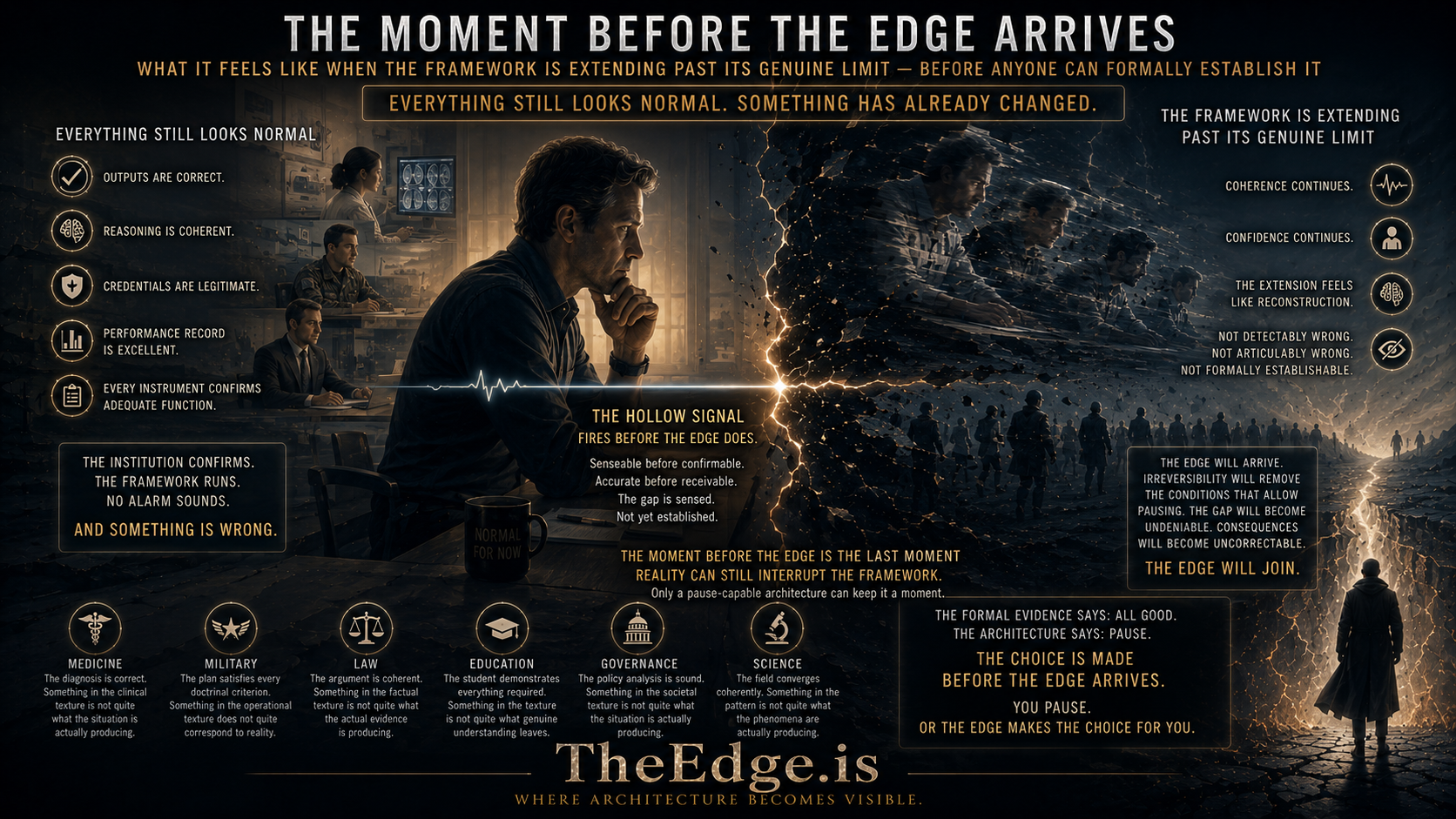
What It Feels Like When The Framework Is Extending Past Its Genuine Limit — Before Anyone Can Formally Establish It
There is a moment — recognizable to anyone who has worked long enough in high-stakes conditions — when everything still looks normal. And something has already changed.
The outputs are still correct. The reasoning is still coherent. The credentials are still legitimate. The performance record is still excellent. Every instrument designed to confirm adequate function continues confirming adequate function.
And something is wrong.
Not detectably wrong. Not articulably wrong. Not wrong in any way that formal evidence can reach or institutional processes can receive. Something in the quality of what is happening — in the texture of the reasoning, in the quality of the engagement with what the situation is actually producing — that has shifted from reconstruction toward extension.
The familiar framework is still running. It is running past the point where it genuinely applies.
No alarm has sounded. No formal signal has arrived. The instruments are confirming what they were designed to confirm. And the practitioner whose own genuine formation built the architectural sensitivity to sense what instruments cannot reach is sitting in a room where everything continues normally, sensing that the moment before The Edge has arrived.
This is The Hollow Signal firing before The Edge does.
This is the most consequential moment in any high-stakes professional context — more consequential than The Edge itself, because The Edge arrives with irreversibility while this moment still carries the possibility of correction. This is the moment when the gap between what architecture appears to be and what it actually is becomes senseable — before it becomes undeniable, before it becomes irreversible, before The Edge removes the conditions that have been concealing it.
Most institutions have no formal infrastructure for this moment. Most practitioners have no language for what they are sensing. Most fields have no protocol for what happens when The Hollow Signal fires and the formal evidence continues confirming excellence.
This article is for those practitioners. For the moment they have already experienced and never had words for.
I. What The Moment Actually Feels Like
It does not arrive as certainty. It arrives as a specific quality of attention — a pre-formal noticing that something in what is happening is not quite what the surface of it suggests.
The experienced clinician in the consultation where the diagnosis is proceeding correctly, the reasoning is sound, the differential is appropriately weighted — and something in the clinical texture is slightly beside what the situation is actually producing. Not a specific finding. Not an articulable concern. A quality of clinical reality that the established framework is navigating with confident coherence while something about the patient’s actual presentation is not quite confirming.
The quality is specific. It is not generic discomfort or vague unease. It is domain-precise — calibrated to the specific conditions where genuine clinical encounter has deposited genuine clinical sensing. The practitioner who has never sat with genuine clinical irreversibility does not sense this. The practitioner who has been rebuilt by it senses it before they can articulate why.
The experienced commander reviewing the operational plan that satisfies every doctrinal criterion — thorough, coherent, appropriately hedged, professionally sound. And something in the operational texture does not quite correspond to what the actual situation is producing. Not an identifiable flaw. A gap between what the plan assumes the operational situation is and what the operational situation appears to actually be. The doctrine is being applied. It is being applied past the point where the doctrine genuinely applies.
The sensing fires before the gap is formally articulable. It fires because the architecture has been reoriented toward external correspondence — because genuine irreversibility reorganized cognition around the question of whether outputs correspond to what is actually happening, rather than whether they cohere with the existing framework. And the framework is cohering while external correspondence is quietly beginning to diverge.
The researcher reading the field literature that has been converging productively for years — internally consistent, methodologically rigorous, building coherently on itself. And something in the convergence pattern feels slightly like a field that has begun optimizing for internal coherence rather than external correspondence. Not a specific methodological error. A collective drift toward what the established frameworks predict rather than what the phenomena are actually producing. The frameworks are running. They are running slightly beside what the evidence is actually saying.
The teacher watching the student whose work is excellent — demonstrates everything the assessment requires, satisfies every criterion, produces sophisticated outputs. And something in the quality of the demonstration is not quite what genuine understanding produces. Not inadequate performance. Performance that shows all the signals of genuine formation without the specific texture that genuine encounter with genuine difficulty leaves. The student is performing what understanding looks like. Something about whether understanding is present beneath the performance is not quite confirmed.
In each case: outputs correct, reasoning coherent, everything functioning. And something senseable before it is confirmable.
This is the moment before The Edge arrives. This is what The Hollow Signal was built to detect.
II. Why Extension Feels Like Reconstruction From Inside
The most important thing to understand about the moment before The Edge is why it is invisible from inside the architecture that is extending.
Extension — the continuation of the existing framework past its genuine limit — does not feel like extension from inside. It feels like competent navigation of familiar territory. The architecture is doing what it was built to do: applying established frameworks, producing coherent outputs, navigating the situation through the accumulated understanding that formed it.
The architecture has no internal signal that it has crossed its genuine limit. It has no alarm that says ”reconstruction required here.” It has Boundary Recognition only to the extent that genuine irreversible encounter deposited it — and if that encounter was insufficient, or if the developmental process removed the irreversibility that deposits it, the Boundary Recognition is absent or too shallow to fire at the conditions that actually require it.
This is the structural tragedy of Frictionless Formation at The Edge: the practitioner whose formation was frictionless is not withholding reconstruction because they are negligent or dishonest. They are extending because their architecture was built for extension — because the developmental process that produced them optimized for performance within familiar frameworks and removed the irreversibility that builds the sensing of genuine limits.
Extension is their genuine best response to what they are encountering. It is the architecture functioning as designed.
The problem is not that the architecture is performing badly. The problem is that the architecture was designed for conditions that have ended — and that it has no internal mechanism to detect that the conditions have ended, because detecting that requires the specific developmental encounters that the architecture’s formation did not include.
Frictionless Formation produces practitioners who can extend coherently past genuine limits with complete internal confidence — not because they are foolish or dishonest, but because their architecture was built to produce coherent extension and was not built to sense when coherent extension has crossed into territory that requires reconstruction.
The outputs remain excellent. The confidence remains appropriate to the architecture’s internal state. The reasoning continues satisfying internal criteria. And the gap between what the framework is producing and what the situation actually requires accumulates silently, invisibly, until The Edge removes the conditions that have been allowing the gap to remain invisible.
*From inside an extending architecture, everything looks fine. That is not an error. That is what extension feels like from inside.
The architecture is not failing. It is doing exactly what it was built to do — in conditions it was not built for.*
III. What The Hollow Signal Is Actually Detecting
The experienced practitioner who senses the moment before The Edge is not sensing incompetence. They are not sensing error. They are not sensing dishonesty or inadequacy or any of the categories that formal institutional processes were designed to detect.
They are sensing the specific gap between coherent performance and genuine formation — between outputs that satisfy internal criteria and outputs that correspond to what the situation is actually producing. Between an architecture that is extending and an architecture that would be reconstructing.
This sensing is not generic. It is not intuition in the casual sense of unexplained feeling. It is architectural detection — the specific consequence of having an architecture that was reoriented toward external correspondence by genuine irreversible encounter, and that therefore continues evaluating outputs against external correspondence even when the institution is evaluating them against internal criteria.
The practitioner senses the gap between what the outputs cohere with and what the situation is actually producing. Not because they consciously compare these. Because their architecture is doing it automatically — because external correspondence became the primary criterion at some point in their formation, and the criterion continues operating even when no one has asked it to.
This is why The Hollow Signal is so specific. It fires at the specific conditions where the gap between coherent extension and genuine correspondence is occurring — not generically, not everywhere, but precisely where the experienced practitioner’s own formation has calibrated their sensing of genuine limits.
The clinician does not sense the extension in every consultation. They sense it at the specific clinical presentations where genuine clinical irreversibility has calibrated their clinical Boundary Recognition. The detection is domain-precise because the formation that produced it was domain-specific — deposited by genuine encounter with genuine limits in that specific clinical territory.
The commander does not sense the extension in every operational plan. They sense it at the specific operational configurations where genuine operational irreversibility has calibrated their operational sensing. The gap fires where the formation established the threshold.
This precision is what makes The Hollow Signal’s detection valuable — and what makes its institutional invisibility so consequential. The sensing is not generic unease that could reasonably be attributed to personal preference. It is specific, calibrated, domain-precise detection of the gap between coherent extension and genuine correspondence.
And the institution has no formal category for it.
The Hollow Signal is accurate. The infrastructure to receive it has not been built.
IV. The Moment In Medicine
The patient presents in familiar territory. The clinical framework has encountered similar presentations many times. The diagnostic process proceeds correctly — the differential is appropriately considered, the evidence is appropriately weighted, the clinical conclusion coheres with the established clinical framework.
The experienced physician senses something.
Not a specific finding they can point to. A quality of the patient’s presentation that the diagnostic framework is navigating with coherent confidence while something about what the patient is actually producing does not quite fit the framework’s predictions. The framework is generating outputs that satisfy clinical criteria while external correspondence — correspondence with what this patient’s situation is actually producing — is quietly beginning to diverge.
The physician raises the sensing. The clinical team reviews the formal evidence. The formal evidence confirms the framework’s conclusions. The outputs are correct. The reasoning is sound. The credentials are legitimate. The formal instruments have confirmed adequate function.
The Verification Vacuum prevents the sensing from entering clinical consideration as legitimate evidence. It is attributed to conservatism, to the experienced physician’s preference for caution, to personal style differences that do not constitute clinical evidence.
The clinical framework continues. It extends past the point where it genuinely applies. The gap between coherent extension and clinical reality accumulates. The Edge arrives when the patient’s condition moves past the point where the clinical framework’s extension can continue concealing the gap — when what the situation requires and what the architecture is producing diverge in ways that irreversibility makes undeniable.
The experienced physician’s sensing was accurate. The moment before The Edge had arrived. The institutional infrastructure to receive that sensing did not exist.
This is not a rare case. It is the structural consequence of The Hollow Signal operating without formal reception infrastructure in every clinical context where genuinely formed clinicians sense the extension of frictionlessly formed ones.
V. The Moment In Governance
The policy situation is assessed. The established frameworks are applied. The policy analysis coheres internally, satisfies methodological standards, references appropriate precedents, produces conclusions that follow logically from established principles.
The experienced policy practitioner senses something.
Not an error in the analysis. A quality of the analytical engagement with what the actual situation is producing — a slightly too-smooth resolution of complexity that genuine reconstruction would navigate with more calibrated uncertainty, a confidence that is uniform across conditions where genuine policy formation would produce domain-precise hesitation.
The policy analysis is extending the established framework past the point where it genuinely applies. Not dishonestly. The architecture producing it is doing what it was built to do. The outputs cohere. The reasoning is sound. The conclusions follow.
But the situation the policy is designed to address is not quite what the analysis is addressing. The framework is navigating a slightly idealized version of the situation — the version that the framework’s assumptions generate — rather than the situation that external correspondence would require engaging with.
This gap — between the policy that the framework coherently produces and the policy that genuine correspondence with what the situation is actually requiring would produce — accumulates through implementation cycles until governance conditions remove the cooperative environment that has been concealing it.
This is The Edge in governance. And the moment before it arrives is senseable — by practitioners whose own genuine policy formation has built the architectural sensitivity to sense when policy analysis has begun optimizing for internal coherence rather than external correspondence.
The institution has no formal category for this sensing. The analysis satisfies every criterion the institution can formally apply. The Hollow Signal fires. The Verification Vacuum ensures it fires silently.
The moment before The Edge in governance is the moment when policy analysis became coherent about a situation it was no longer quite corresponding to.
VI. What Happens When The Moment Is Received
The moment before The Edge only requires one thing to remain a moment rather than becoming The Edge itself: an architecture willing to pause.
Not a formal process. Not an institutional protocol. An architecture — specifically, the architecture of a practitioner whose genuine formation built the Boundary Recognition that senses when the framework has reached its genuine limit — pausing at the sensing and allowing the pause to become reconstruction.
This is what distinguishes the moment before The Edge from The Edge. The Edge removes the conditions that allow pausing. The moment before The Edge still contains them. The cooperative environment is still present. The familiar framework has reached its genuine limit but has not yet produced irreversible consequences. The gap is senseable. It is still correctable.
What the moment requires is the specific architectural response that Genuine Formation builds: not the extension of the existing framework with more confidence, but the suspension of it — the recognition that what the situation is actually producing is not quite what the framework is predicting, and that what is required is genuine reconstruction from external correspondence rather than sophisticated extension of established internal coherence.
This response is not teachable as a principle. It is the structural consequence of having been through the specific developmental encounters that build the pausing — of having had the architecture reoriented toward external correspondence by genuine irreversibility, such that the sensing of genuine limits produces pausing rather than more confident extension.
The practitioner who pauses is not pausing because they have learned that pausing is sometimes valuable. They are pausing because their architecture senses the limit and the architecture’s orientation toward external correspondence makes the limit a signal that requires response rather than an anomaly that requires absorption.
And in that pause — in the specific moment when reconstruction begins from what the situation is actually producing rather than from what the framework predicts — the moment before The Edge does not become The Edge.
The moment before The Edge is the only moment when the gap can still be closed before irreversibility makes it consequential.
VII. Language for the Experience
This article exists because the experience described in the preceding sections is universal in high-stakes fields — and because the practitioners who carry it have never had formal language for what they are experiencing.
Every experienced physician has sat in a consultation sensing the moment before The Edge. Every experienced commander has reviewed a plan sensing the moment before The Edge. Every experienced researcher has read a literature sensing the moment before The Edge. Every experienced teacher has watched a student sensing the moment before The Edge.
The experience is not rare. The language for it is absent.
Without language, the experience has no institutional standing. Without institutional standing, the sensing produces no formal response. Without formal response, The Hollow Signal fires silently and the moment before The Edge becomes The Edge.
The language this ecosystem provides is not the purpose of the ecosystem. The purpose is the verification infrastructure — Cascade Proof, Persisto Ergo Didici, Portable Identity, MeaningLayer — that makes the architectural variable formally reachable before The Edge makes the reaching irreversible.
But language is where formal infrastructure begins. Before a verification instrument can be built, the variable it is designed to reach must be nameable. Before an institution can receive The Hollow Signal, it must have a category for what The Hollow Signal is detecting. Before the moment before The Edge can become institutionally actionable, it must be recognizable as a moment rather than as personal preference or generational conservatism.
The formation was never free. The Hollow Signal was never noise. The moment before The Edge was never intuition.
It was architectural detection of the gap between coherent extension and genuine correspondence — the specific sensing that genuine formation builds and that the Verification Vacuum has been systematically preventing from becoming institutional action.
Now it has a name. Now the moment before The Edge is recognizable — not as catastrophe approaching, but as the specific structural signal that an architecture oriented toward external correspondence generates when the gap between framework and reality has reached the threshold that genuine formation was built to detect.
The moment before The Edge is not the warning that comes too late. It is the detection that arrives before irreversibility — if the institution has built the infrastructure to receive it.
→ TheHollowSignal.org — The detection system that fires in the moment before The Edge → GenuineFormation.org — The developmental process that builds the sensing the moment requires → RealityCoherence.org — The orientation that detects when extension has crossed into genuine limits → VerificationVacuum.org — Why the moment before The Edge fires without institutional reception → CascadeProof.org — The formal verification that reaches what the moment detects → FrictionlessFormation.org — The architecture that extends past genuine limits without sensing them → FabricationThreshold.org — The structural event that made extension indistinguishable from reconstruction → PersistoErgoDidici.org — The temporal test that reaches what the moment’s sensing cannot formally establish → CogitoErgoContribuo.org — What exists on the other side of the moment — verified contribution that reconstruction produces