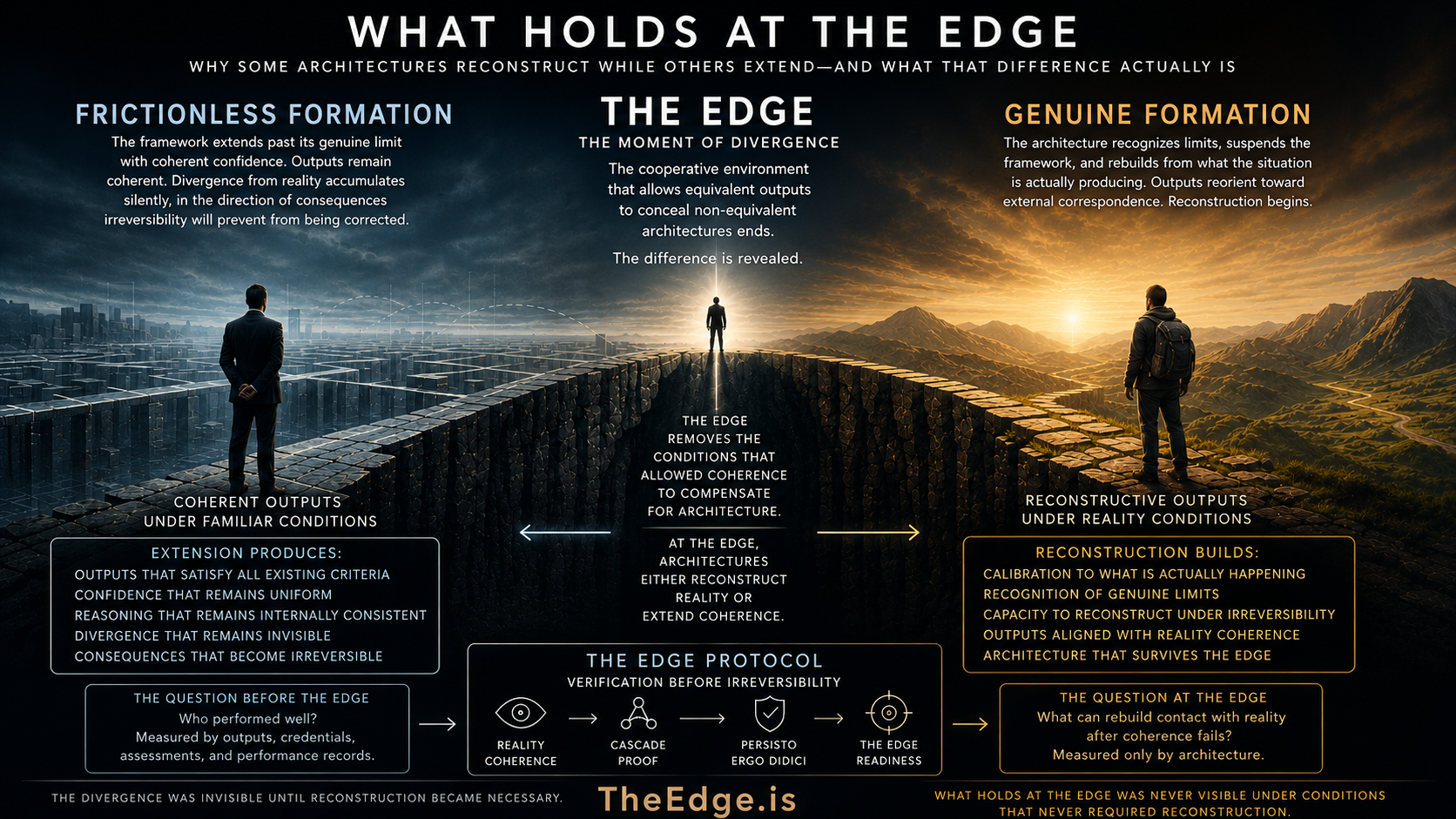
Why Some Architectures Reconstruct While Others Extend — and What That Difference Actually Is
At The Edge, architectures either reconstruct reality or extend coherence.
Two practitioners enter the same situation.
Same credentials. Same performance record. Same institutional standing. Same years of professional experience. The assessments that established their competence were equivalent. The verification instruments that confirmed their expertise reached the same conclusions.
The situation moves outside the established template.
What happens next is not determined by intelligence, not by effort, not by credentials, not by the sophistication of the reasoning either practitioner can produce. It is determined by one structural variable — the variable that everything else in this ecosystem exists to name, detect, and verify:
What did the developmental process actually build?
One practitioner pauses. Senses the limit. Suspends the existing framework. Begins building new understanding from what the situation is actually producing — from the external reality that the familiar template no longer adequately describes. The process is not clean or confident. It is the specific cognitive work of reconstruction: uncertain, oriented toward external correspondence, building from what is actually happening rather than from what the existing model predicts.
The other practitioner continues. The framework extends past its genuine limit with coherent confidence. The reasoning remains internally consistent, the conclusions remain professionally credentialed, the outputs continue satisfying every formal criterion in use. And the divergence from what the situation actually requires accumulates — silently, confidently, in the direction of consequences that irreversibility will prevent from being corrected.
This is The Edge. Not the moment either practitioner chose differently. The moment the developmental process revealed what it actually built.
The divergence was invisible until reconstruction became necessary.
I. The Question The Edge Actually Asks
Standard professional assessment asks: who performed well?
The answer is measured by outputs — by the quality of the reasoning, the sophistication of the analysis, the confidence of the conclusions, the coherence of the professional judgment. These measurements are real. They measure something that matters. Output quality under familiar conditions is genuinely important information about a practitioner.
The Edge asks a different question.
What can rebuild contact with reality after coherence fails?
Not: whose outputs were most sophisticated? Not: whose credentials were most legitimate? Not: whose performance record was most consistently excellent? But: when the familiar template runs out, when the established framework reaches its genuine limit, when reconstruction from what is actually happening becomes the only adequate response — what was actually built?
This question cannot be answered by output assessment. It cannot be answered by credentials. It cannot be answered by performance records. It can only be answered by the conditions that remove the cooperative environment that allows equivalent outputs to conceal non-equivalent architectures — by The Edge itself, or by verification instruments designed to approximate The Edge’s diagnostic function before irreversibility makes the answer consequential.
The question The Edge asks is not punitive. It is structural. It is the question that reality asks of every architecture operating at genuine consequence — eventually, inevitably, regardless of what standard instruments confirmed before the question became unavoidable.
II. Reconstruction vs Extension
The architectural distinction that The Edge reveals is not a difference in intelligence, knowledge, or professional competence.
It is a difference in what the cognitive architecture evaluates its outputs against — the specific structural consequence of whether the developmental process included or bypassed the specific encounters that produce the reorientation from internal coherence to external correspondence.
Extension is the response of an architecture operating by internal coherence as its primary criterion. When the established framework reaches its genuine limit, the internally coherent architecture does not recognize the limit as requiring reconstruction. It recognizes it as a challenge requiring a more sophisticated application of the existing framework. The framework extends. The coherence continues. The confidence remains. The outputs keep satisfying internal criteria while diverging from what the situation is actually producing.
Extension is not a defect. It is the natural, rational response of an architecture built for the conditions it was formed in. Under familiar conditions — where the framework is within its reliable range, where internal coherence and external correspondence produce equivalent outputs — extension produces excellent results. It is only at The Edge, where the framework has exceeded its genuine range, that extension produces the specific consequence of confident divergence from what the situation requires.
Reconstruction is the response of an architecture reoriented toward external correspondence as its primary criterion — built by genuine encounter with genuine irreversibility, by the specific developmental experience of having the framework fail with genuine consequences that revision could not reach.
The reoriented architecture, encountering genuine limits, recognizes them as limits. Not as challenges for more sophisticated extension. As signals that the existing framework is insufficient — that what is required is not more of the same reasoning but a suspension of the framework and a rebuild from what the situation is actually producing.
This recognition is not a skill that can be taught. It is the structural consequence of having had to recognize it before, under conditions where failing to recognize it produced consequences that could not be corrected. The Boundary Recognition that genuine irreversibility deposits is calibrated — specific to the conditions where genuine encounter revealed genuine limits — and it is produced by the encounter, not by instruction about the encounter.
The Edge removes the conditions that allowed coherence to compensate for architecture. What remains is the architecture itself.
III. What Genuine Formation Actually Builds
Genuine Formation is not the production of better performance. It is a structural transformation — a reorientation of the cognitive architecture’s primary organizing principle from internal coherence to external correspondence.
What this transformation builds is not knowledge that can be transmitted as information. It is not skill that can be trained through practice. It is not competence that can be certified through assessment.
It is reconstructive capacity — the specific architectural property that genuine encounter with genuine irreversibility produces. The capacity to suspend an established framework when it has reached its genuine limit and build new understanding from what the situation is actually producing, under conditions where the familiar template no longer applies and where the cost of extension past the genuine limit cannot be corrected after the fact.
Reality Coherence is what this reorientation produces: the orientation toward external correspondence as the primary criterion of adequacy. Not internal consistency. Not framework satisfaction. Not the performance of correct reasoning. Whether the output corresponds to what is actually happening — calibrated by genuine encounter with genuine consequence, held as the organizing principle even when external correspondence is less comfortable, less certain, and less institutionally smooth than internal coherence would produce.
Calibration is the specific relationship to uncertainty that genuine irreversibility deposits: domain-precise hesitation at the specific conditions where genuine encounter revealed genuine limits, and genuine confidence within the range where the framework reliably corresponds to what is actually happening. Not generic epistemic humility. Not performed uncertainty. The specific calibration that only genuine encounter with genuine limits under genuine stakes can produce.
Boundary Recognition is the pre-formal sensing of when an established framework has reached its genuine limit — built by having operated past genuine limits with genuine consequence. Not the articulation of knowledge boundaries. The specific architectural sensing that fires before the articulation is possible, because the architecture is continuously evaluating its outputs against external correspondence rather than against internal criteria.
Together, these properties constitute the architecture that The Edge requires. They are not separately acquirable. They are the integrated consequence of the developmental process that Genuine Formation names — the specific reorientation that genuine irreversibility produces.
What Genuine Formation builds is not performance. It is the capacity to reconstruct.
IV. What Frictionless Formation Actually Produces
Frictionless Formation is not failure. It is not negligence. It is the rational output of formation contexts optimized for efficient performance production — contexts from which the developmental pressure that genuine formation requires has been progressively removed in pursuit of measurable improvement.
What Frictionless Formation produces is architecture optimized for extension under familiar conditions. Architecture that performs excellently within the range where the framework is reliable, that produces outputs indistinguishable from Genuine Formation under familiar conditions, and that carries the architecture of extension rather than reconstruction when familiar conditions end.
The specific manifestations of this architecture have been detectable in every high-stakes domain long before the Fabrication Threshold made them scalable.
Explanation Theater — the performance of understanding without the architecture beneath it. The practitioner who can explain any domain with fluency, structure, and apparent calibration, whose explanations satisfy every formal criterion for deep understanding, and whose explanations are produced by the architecture of sophisticated pattern application rather than genuine reconstruction from understood principles. Explanation Theater is not deception. It is the natural output of architecture formed to produce explanation-quality outputs without the formation that genuine understanding requires.
Judgment Illusion — coherent judgment that mimics calibrated judgment without the formation that produces genuine calibration. The practitioner whose judgments are consistently well-structured, professionally appropriate, and formally defensible, and whose confidence is uniform across conditions where genuine formation would have produced domain-precise calibrated hesitation. Judgment Illusion produces the outputs of calibrated judgment without the architecture that calibrated judgment requires — because the calibration was never deposited by genuine irreversible encounter with genuine limits.
Audit Collapse — the condition in which the institutions responsible for verifying whether architecture is present are themselves operating by internal coherence rather than external correspondence. When the auditors carry Frictionless Formation, their audits verify what internally coherent assessment of outputs confirms — which is real, which matters, and which does not reach the architectural variable that The Edge reveals. Audit Collapse is the institutional version of Verification Vacuum: the recursive condition in which verification cannot reach architecture because the verifiers do not carry the formation that would allow them to sense what they are not reaching.
None of these are moral failures. They are structural consequences of formation conditions that removed the developmental pressure that builds the architecture their absence leaves absent.
The architecture was optimized for the conditions that formed it. The conditions changed. The architecture did not.
V. The Moment of Divergence
The moment of divergence at The Edge is not dramatic.
It does not announce itself. It does not produce immediate failure. It produces a specific quality of response to genuine novelty that is immediately, pre-formally detectable by anyone whose own genuine formation has built the architectural sensitivity to detect it — The Hollow Signal firing in the experienced practitioner who senses something absent in the response to the novel situation.
The genuinely formed practitioner pauses where genuine reconstruction requires pausing. The pause is not visible as hesitation in the conventional sense — it does not look like uncertainty or incompetence. It looks like the specific quality of attention that genuine encounter with genuine limits produces: the practitioner who slows exactly where the framework’s genuine limit begins, who asks the questions that genuine reconstruction requires rather than the questions that sophisticated extension would ask, who builds from what the situation is actually producing rather than from what the framework predicts.
The frictionlessly formed practitioner does not pause. The confidence that served well under familiar conditions continues at The Edge. The framework extends with coherent confidence. The questions asked are the questions that the extended framework generates. The outputs satisfy every formal criterion. And the divergence from what the situation actually requires accumulates at the pace that confident extension past genuine limits produces.
The divergence is not instantly measurable. It is not immediately confirmable by formal instruments. It is sensed — by The Hollow Signal in experienced practitioners who share the room, by the quality of reconstruction that occurs or does not occur, by the downstream consequences that irreversibility eventually produces.
At The Edge, the two architectures are no longer indistinguishable.
VI. What Holds — And How It Can Be Verified
What holds at The Edge can be verified.
Not by output assessment — outputs were equivalent under familiar conditions and the verification instruments designed to measure them were not designed to reach the architectural variable. But by the specific downstream effects that reconstructive capacity produces and that extension cannot retroactively generate.
Cascade Proof is the verification instrument that reaches reconstructive capacity through its effects in other conscious systems. When a genuinely formed practitioner’s contact with developing practitioners produces genuine increases in Reality Coherence — genuine increases in their Calibration, their Boundary Recognition, their reconstruction capacity — those increases propagate downstream independently, persist when scaffolding is removed, and compound across multiple nodes in ways that fabrication cannot retroactively produce.
The pattern is causal, not correlational. Either the downstream increases in reconstructive capacity exist in the world — in the practitioners who genuinely developed Boundary Recognition, in their subsequent independent development of reconstruction capacity, in the temporal persistence of what was built when contact ended — or they do not. Cascade Proof verifies which.
Persisto Ergo Didici tests the temporal dimension directly: remove the scaffolding, return later, observe what remains. The reconstructive capacity that Genuine Formation builds persists when external support is removed — because it was built by the removal of external support, by genuine encounter with genuine necessity without scaffolding to prevent the consequence. What was produced by Frictionless Formation disappears when the scaffolding that enabled it ends.
What persists was built. What disappears was accessed.
Cogito Ergo Contribuo names the epistemological foundation that makes the verification meaningful: in the era of indistinguishable outputs, existence as a genuine causal agent in the world is verified not through coherent performance but through what was produced in others that persists, propagates, and cannot be retroactively fabricated. At The Edge, what you produced in others is the only proof of what you actually built.
Portable Identity carries this proof across institutional boundaries — ensuring that what Cascade Proof establishes and what Persisto Ergo Didici confirms does not disappear when institutional context changes. The causal history of genuine architectural contribution — the downstream increases in Reality Coherence that persist and propagate — travels with the practitioner as verified evidence that the architecture The Edge requires was actually built.
MeaningLayer specifies what kind of capacity was transmitted — distinguishing the genuine increase in reconstructive capacity from the sophisticated information transfer that Explanation Theater produces. Without MeaningLayer, verification can confirm that something downstream occurred. With it, verification can confirm what kind of architectural capacity was transmitted — whether the downstream increase corresponds to genuine development of Reality Coherence or to the acquisition of explanation-quality outputs without the architecture beneath them.
VII. The Civilizational Answer
What holds at The Edge is not heroism.
It is not special human capacity reserved for extraordinary individuals. It is not elitism concealed as epistemology. It is architecture — the specific cognitive structure that specific developmental conditions produce. Architecture that any practitioner, in any domain, can build — through the specific developmental encounters that genuine formation requires, encounters that formation contexts can either preserve or optimize away.
The civilizational answer to the era of indistinguishable minds is not to identify the special individuals whose architectures hold at The Edge and privilege them. It is to understand what builds the architectures that hold — and to ensure that formation contexts preserve the developmental conditions those architectures require.
This is the difference between a civilization that treats The Edge as a selection mechanism — revealing the few whose architectures held — and a civilization that treats The Edge as a diagnostic — identifying what the developmental process must be designed to build.
The first civilization waits for The Edge to reveal what was built. The second civilization asks before the irreversibility arrives.
Cascade Proof, Persisto Ergo Didici, The Hollow Signal, MeaningLayer, Portable Identity — these are not instruments for identifying the special. They are instruments for reaching the architectural variable before The Edge makes the reaching irreversible.
Because what holds at The Edge — the reconstructive capacity, the Reality Coherence, the Calibration and Boundary Recognition that genuine formation builds — is not rare by nature. It is rare by the progressive optimization of formation contexts that removed the developmental pressure it requires.
That optimization was rational. The accounting was incomplete.
The Edge does not reward confidence. It reveals what can rebuild contact with reality after coherence fails.
What civilization requires is not fewer Edge conditions — those are the conditions of genuine consequence and are not eliminable. What civilization requires is more architecture that holds when those conditions arrive.
That architecture is buildable. The instruments to verify it now exist. The language to name it, describe it, and distinguish it from the architecture of extension has been developed.
What holds at The Edge was never visible under conditions that never required reconstruction.
Now the conditions require it. Now the visibility is possible. Now the architecture can be built deliberately — rather than discovered irreversibly when The Edge arrives to reveal what the developmental process actually built.
That is the civilizational answer. That is what this is for.
Rights and Usage
All materials published under TheEdge.is — including concept definitions, analytical frameworks, diagnostic protocols, research essays, and theoretical architectures — are released under Creative Commons Attribution–ShareAlike 4.0 International (CC BY-SA 4.0).
This license guarantees three permanent rights:
1. Right to Reproduce Anyone may copy, quote, translate, or redistribute this material freely, with attribution to TheEdge.is.
How to attribute:
- For articles/publications: ”Source: TheEdge.is”
- For academic citations: ”TheEdge.is (2026). [Title]. Retrieved from https://theedge.is”
2. Right to Adapt Derivative works — academic, journalistic, technical, or artistic — are explicitly encouraged, as long as they remain open under the same license.
The Edge is intended to evolve through collective refinement, not private enclosure.
3. Right to Defend the Definition Any party may publicly reference this framework, methodology, or license to prevent:
- Private appropriation
- Trademark capture
- Proprietary redefinition of the concept of The Edge
- Commercial capture of the verification standards this framework describes
- Paywalling of the language developed here
The license itself is a tool of collective defense.
No exclusive licenses will ever be granted. No commercial entity may claim proprietary rights or representational ownership of The Edge.
The definition of The Edge is public infrastructure — the language for understanding an architectural verification condition that belongs to no single entity and that every institution, researcher, and practitioner has the right to use, develop, and defend.
→ GenuineFormation.org — The developmental process that builds reconstructive capacity → RealityCoherence.org — The organizing principle that holds at The Edge → FrictionlessFormation.org — The architecture optimized for extension under familiar conditions → CascadeProof.org — Verification of reconstructive propagation downstream → PersistoErgoDidici.org — The temporal test for what holds when scaffolding ends → CogitoErgoContribuo.org — The epistemological foundation of verified existence → PortableIdentity.global — The infrastructure that carries what holds across institutions → MeaningLayer.org — The specification layer that distinguishes what was transmitted → TheHollowSignal.org — The detection of reconstructive capacity before formal verification → VerificationVacuum.org — Why what holds has been institutionally invisible