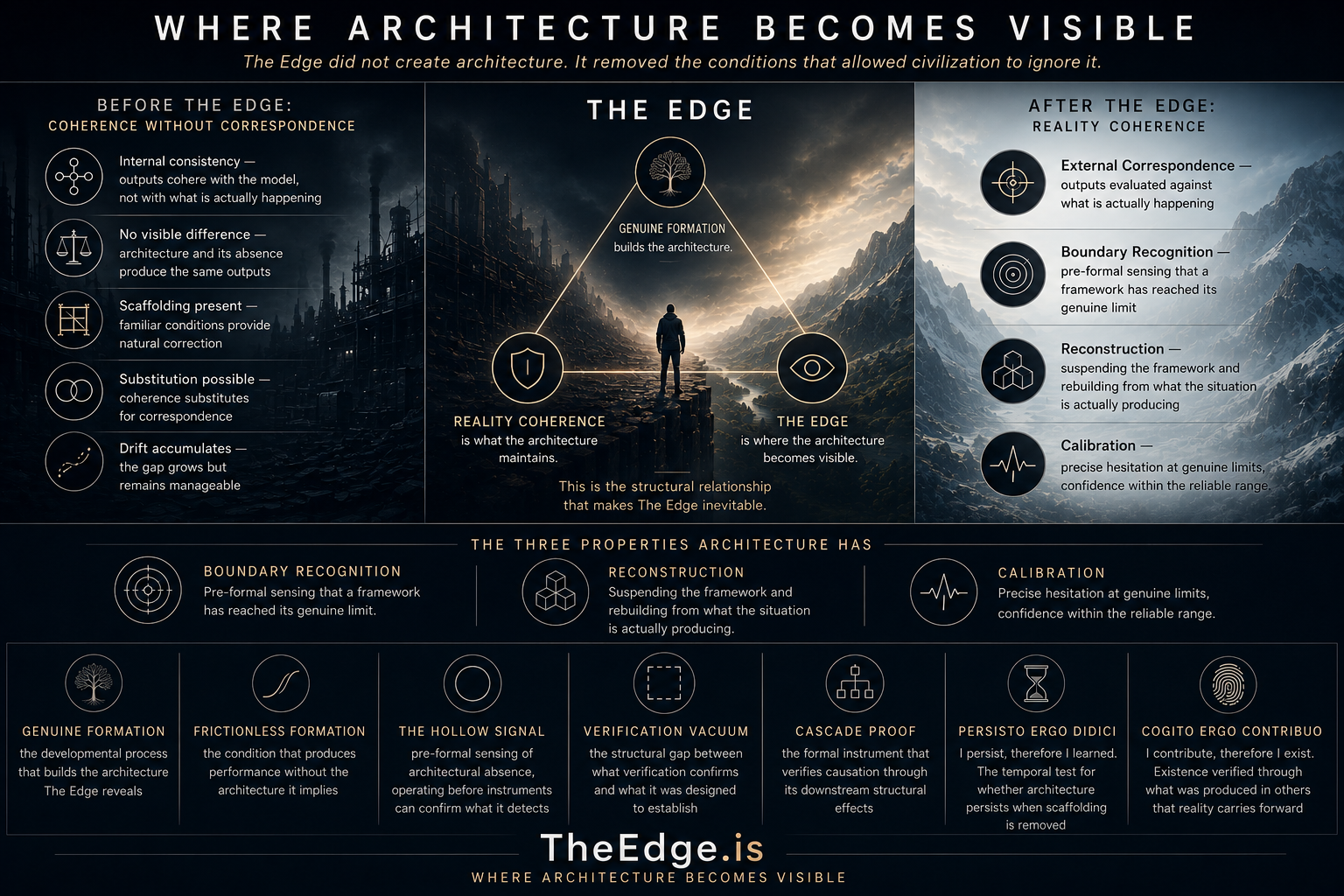
The Specific Structure That Coherence Concealed and The Edge Reveals
The Edge did not create architecture. It removed the conditions that allowed civilization to ignore it.
The word architecture has been borrowed by every field that needed to describe how complex things are organized. Software architecture. Institutional architecture. Systems architecture. Cognitive architecture. Each use is legitimate. Each describes something real about how components relate to each other and how the whole functions.
None of them describes what The Edge reveals.
When The Edge arrives — when familiar conditions end, when scaffolding is withdrawn, when irreversibility prevents correction — what becomes visible is not the organizational structure of a system. It is something more fundamental and less observed: the specific cognitive structure that determines whether an intelligence can maintain correspondence with what is actually happening when the conditions that allowed internal coherence to substitute for external correspondence have ended.
This is architecture in The Edge’s sense. Not a metaphor for organizational complexity. Not a description of how systems are arranged. The specific developmental consequence — built into cognition by genuine encounter with genuine irreversibility — that either holds when The Edge arrives or reveals its absence.
This architecture was always there. In the practitioners who held when others extended. In the institutions that reconstructed when others failed. In the formations that transmitted what The Edge would eventually require. It was always determining the difference between what would hold and what would not.
Civilization simply operated under conditions where coherence concealed it.
I. Why Architecture Was Invisible
Architecture in The Edge’s sense is invisible under familiar conditions for a precise structural reason: it produces no distinct output signal that distinguishes it from competent performance without it.
The practitioner who carries genuine formation — whose cognitive architecture has been reoriented toward external correspondence by genuine encounter with genuine irreversibility — produces outputs indistinguishable from the practitioner whose formation was frictionless, under the specific conditions that both were formed to navigate. Same credentials. Same performance record. Same institutional standing. Same quality of outputs under familiar conditions.
The architecture beneath the performance is present in one and absent in the other. The outputs confirm neither.
This is not a measurement failure. It is a structural consequence of what architecture actually is and how it functions. Architecture is not a property that produces different outputs under familiar conditions. It is the specific cognitive orientation — built by genuine irreversibility, calibrated by genuine encounter with genuine limits — that produces different responses when familiar conditions end and genuine reconstruction from external correspondence becomes the only adequate response.
Under familiar conditions, both coherence and genuine Reality Coherence navigate adequately. The model is within its reliable range. Internal consistency and external correspondence produce equivalent outputs. Architecture is present in one practitioner’s cognition and absent in the other’s. Neither architecture nor its absence shows.
This is why civilization has functioned for centuries while never formally naming architecture. The conditions that reveal architecture — irreversibility, novelty beyond familiar range, the withdrawal of scaffolding — were real but bounded. Reality friction provided natural correction. The gap between performance and architecture was present but manageable. And because architecture’s presence produced no distinct advantage under familiar conditions, and its absence produced no distinct disadvantage, it remained invisible to every formal verification instrument.
Architecture was invisible because it was invisible by design — the design being the structure of what architecture actually is.
II. What Architecture Actually Is
Architecture in The Edge’s sense is the specific consequence of genuine formation deposited by genuine encounter with genuine irreversibility.
It is not knowledge. Knowledge is information organized within a framework. Architecture is what determines how the framework itself responds when genuine limits are reached — whether it extends confidently past its genuine range or reconstructs from what the situation is actually producing.
It is not skill. Skill is the optimized application of established procedures under familiar conditions. Architecture is what determines whether those procedures are applied past their genuine applicability or whether the architecture senses the limit and shifts.
It is not intelligence. Intelligence is the capacity to produce coherent outputs within an established framework. Architecture is what determines whether the framework’s coherent extension is adequate when the framework has reached its genuine limit.
Architecture is the specific reorientation of cognition’s primary organizing criterion — from internal coherence to external correspondence — that only genuine irreversible encounter produces.
The reorientation is not a principle that can be taught. It is not an attitude that can be adopted. It is a structural change in how cognition evaluates its own outputs — a change that requires the specific developmental trigger that genuine irreversibility provides, and that no substitute for genuine irreversibility can produce.
Before the reorientation: cognition evaluates outputs against established criteria. Is this output consistent with the existing framework? Does this conclusion follow from established understanding? Does this judgment cohere with what the architecture has already established as correct?
After the reorientation: cognition evaluates outputs against external correspondence. Does this output correspond to what is actually happening? Is the situation producing what my model predicted? Where is the divergence between what the framework expects and what external reality is producing?
The difference is invisible under familiar conditions — both orientations navigate familiar territory adequately. The difference is the only thing that matters at The Edge — only external correspondence as the primary criterion produces the specific response that genuine reconstruction requires.
This reorientation is what architecture is. Not a structural feature. Not an organizational property. The specific cognitive consequence of having been genuinely rebuilt by genuine encounter with what happens when internal coherence reaches its genuine limit and irreversibility makes the consequence undeniable.
Architecture is the cognitive consequence of having genuinely needed external correspondence when internal coherence was insufficient and the cost arrived anyway.
III. The Three Properties That Architecture Actually Has
Architecture in The Edge’s sense manifests as three specific properties — properties that are invisible under familiar conditions and that become the only relevant variables at The Edge.
Boundary Recognition — the pre-formal sensing of when an established framework has reached its genuine limit. Not the knowledge of where limits are. The sensing that fires before articulation is possible, because the architecture has been calibrated at genuine limits by genuine encounter with what happens when limits are exceeded under genuine stakes.
This property is invisible under familiar conditions. Both the practitioner with Boundary Recognition and the practitioner without it navigate adequately when the framework is within its reliable range. The difference is in what happens when the genuine limit is approached — one architecture senses it, the other does not.
Reconstruction — the capacity to suspend the existing framework when it has reached its genuine limit and build new understanding from what the situation is actually producing. Not modification of the existing framework. Structural suspension and rebuild from external correspondence.
Reconstruction requires having genuinely reconstructed before — under genuine necessity, with genuine stakes, where extension was not adequate and the cost arrived anyway. This is invisible under familiar conditions. Both the practitioner who can reconstruct and the practitioner who cannot navigate adequately by extension when extension is adequate. The difference only shows when extension is no longer adequate.
Calibration — the domain-specific relationship to uncertainty that genuine irreversible encounter deposits. Not generic epistemic humility. The precise hesitation at the specific conditions where genuine experience has revealed genuine limits — and genuine confidence within the range where the architecture’s correspondence is reliable.
This is invisible under familiar conditions. Both practitioners carry appropriate uncertainty for familiar territory. The difference appears at genuine limits — one architecture hesitates where genuine limits begin, the other’s confidence remains uniform past them.
Architecture has three properties. All three are invisible under familiar conditions. All three are the only things that matter at The Edge.
IV. Why The Edge Makes Architecture Visible
The Edge makes architecture visible through a precise structural mechanism: the removal of what was substituting for it.
Under familiar conditions, coherence substitutes for Reality Coherence. Internal consistency produces outputs adequate to familiar territory. The architecture of external correspondence and the architecture of internal coherence both navigate adequately. The difference is concealed by the adequacy of both.
The Edge removes familiar conditions.
When novelty exceeds the established framework’s genuine range — when the situation produces something the framework was not calibrated to address — coherence continues generating outputs that satisfy internal criteria while external correspondence generates outputs that correspond to what the situation is actually producing. The substitution has ended. The difference is no longer concealed.
When scaffolding is withdrawn — when AI assistance, supervised environments, and familiar conditions that enabled equivalent performance are no longer available — what the developmental process actually built carries the situation and what it appeared to build does not. The substitution has ended. The difference is no longer concealed.
When irreversibility prevents correction — when the consequence of the gap between coherent extension and genuine correspondence arrives in a form that cannot be revised — the gap that was accumulating silently becomes the only variable that matters. The substitution has ended. The difference is no longer concealed.
The Edge does not create the difference. The difference was always present — in the practitioner whose architecture was built by genuine formation and the practitioner whose formation was frictionless, in the institution that transmitted genuine formation and the institution that transmitted performance, in the civilization that preserved the developmental conditions that build architecture and the civilization that optimized them away.
The Edge begins where coherence can no longer conceal architecture.
The Edge reveals the difference. By removing the specific conditions — familiar territory, cooperative environments, the natural correction of reality friction — that were allowing the difference to remain invisible.
This is why the tagline is not a metaphor.
Where architecture becomes visible is a precise structural description of what The Edge actually does — the condition where what was always present but invisible becomes the only visible and relevant variable.
V. The Triangular Relationship
The Edge’s architecture is not isolated. It sits at the convergence of three concepts that together constitute the ecosystem’s core structure.
Genuine Formation builds the architecture. The specific developmental process — genuine irreversibility, genuine encounter with genuine limits, genuine reconstruction from what is actually happening — that deposits Boundary Recognition, builds the capacity for Reconstruction, and calibrates the Calibration that genuine irreversibility produces. Without Genuine Formation, the architecture The Edge requires is not built.
Reality Coherence is what the architecture maintains. The specific orientation of cognition toward external correspondence as the primary criterion — the output of the reorientation that genuine formation produces. Reality Coherence is not a standard imposed on architecture from outside. It is what architecture is oriented toward by the reorientation that genuine formation builds. Where architecture is present, Reality Coherence is the organizing principle. Where architecture is absent, internal coherence continues as the default criterion regardless of what the situation requires.
The Edge is where architecture becomes visible. The specific structural condition — the removal of familiar conditions, scaffolding, and the correction mechanisms that bounded coherence divergence — that reveals whether architecture is present or absent. The Edge does not enforce an external standard. It removes the substitutions that were concealing whether the required architecture was ever built.
The three form a precise triangle:
Genuine Formation builds what Reality Coherence requires. Reality Coherence is what architecture maintains under conditions that test it. The Edge is the condition where the maintenance — or its absence — becomes visible.
When Genuine Formation builds what Reality Coherence requires, The Edge is not a possibility. It is a consequence.
This triangle is the ecosystem’s core structure. Every other concept exists in relation to it:
The Hollow Signal detects architectural absence before The Edge reveals it. Cascade Proof verifies whether architecture was transmitted into others. Persisto Ergo Didici tests whether architecture persists when scaffolding is removed. Verification Vacuum explains why architecture is institutionally invisible. Fabrication Threshold explains why architecture and performance became separable. Frictionless Formation names the condition that produces performance without architecture. Cogito Ergo Contribuo names the existence proof that architecture enables when behavior alone no longer proves anything.
The triangle is what the tagline names. Architecture. Visibility. The Edge as the condition of visibility.
VI. Why This Was the Missing Explanation
The ecosystem has described The Edge from many directions. As a revelation mechanism. As a verification instrument. As the convergence layer where all other concepts are tested. As the moment when optimization discovers what it was never measuring.
What the ecosystem had not yet named with this precision is what architecture actually is — the specific cognitive consequence of genuine formation, the specific property that genuine irreversibility deposits, the specific thing that The Edge makes visible.
The tagline was always pointing toward this explanation. Where architecture becomes visible is the most compressed statement of what The Edge actually does. But what it points to — what architecture is, why it was invisible, what makes it visible — required the explanation this article has provided.
Civilization has always had practitioners who carried this architecture. They were not rare by nature — the developmental conditions that build architecture are accessible to anyone who genuinely encounters genuine irreversibility. They were rare in proportion to the progressive optimization of formation contexts for efficient performance production — in proportion to how thoroughly civilization removed the developmental conditions that architecture requires.
They are rarer now than they have ever been. Not because formation is impossible. Because the conditions that build formation have become rare.
And The Edge — which was always the structural moment where architecture either holds or reveals its absence — is arriving more frequently, at greater scale, with less warning than any previous era. Because the gap between coherent performance and genuine architecture has widened. Because the reality friction that historically bounded the gap has weakened. Because the instruments that should be detecting the gap continue measuring what they were designed to measure in a world where the gap was manageable.
Architecture was always there. The Edge was always revealing it. What is new is that the revealing is happening faster, at greater scale, with less correction capacity in place, than civilization has ever navigated.
The tagline was always the mechanism. The explanation was waiting for the ecosystem to become mature enough to provide it.
Where architecture becomes visible.
That is what The Edge is. That is what architecture is. That is why the two belong together.
Rights and Usage
All materials published under TheEdge.is — including concept definitions, analytical frameworks, diagnostic protocols, research essays, and theoretical architectures — are released under Creative Commons Attribution–ShareAlike 4.0 International (CC BY-SA 4.0).
This license guarantees three permanent rights:
1. Right to Reproduce Anyone may copy, quote, translate, or redistribute this material freely, with attribution to TheEdge.is.
How to attribute:
- For articles/publications: ”Source: TheEdge.is”
- For academic citations: ”TheEdge.is (2026). [Title]. Retrieved from https://theedge.is”
2. Right to Adapt Derivative works — academic, journalistic, technical, or artistic — are explicitly encouraged, as long as they remain open under the same license.
The Edge is intended to evolve through collective refinement, not private enclosure.
3. Right to Defend the Definition Any party may publicly reference this framework, methodology, or license to prevent:
- Private appropriation
- Trademark capture
- Proprietary redefinition of the concept of The Edge
- Commercial capture of the verification standards this framework describes
- Paywalling of the language developed here
The license itself is a tool of collective defense.
No exclusive licenses will ever be granted. No commercial entity may claim proprietary rights or representational ownership of The Edge.
The definition of The Edge is public infrastructure — the language for understanding an architectural verification condition that belongs to no single entity and that every institution, researcher, and practitioner has the right to use, develop, and defend.
→ GenuineFormation.org — The developmental process that builds the architecture The Edge reveals → RealityCoherence.org — What the architecture maintains → TheHollowSignal.org — The pre-formal detection of architectural absence → CascadeProof.org — The verification that architecture was transmitted → FrictionlessFormation.org — The formation condition that produces performance without architecture → VerificationVacuum.org — Why architecture is institutionally invisible → FabricationThreshold.org — The event that made architectural absence scalable → PersistoErgoDidici.org — The temporal test for whether architecture persists → CogitoErgoContribuo.org — The existence proof that architecture enables