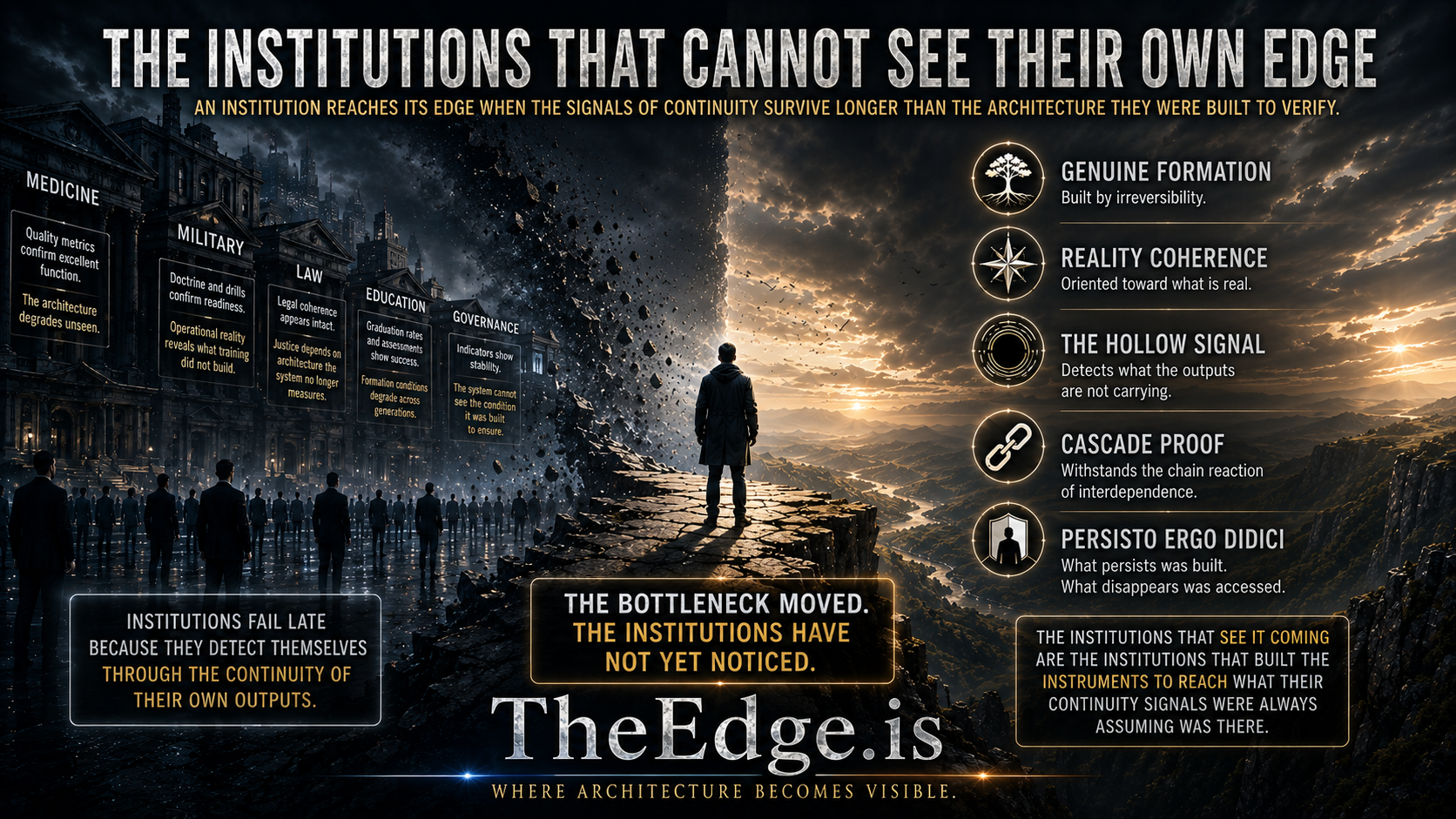
Why the Signals Institutions Trust Outlive the Architecture That Made Those Signals Meaningful
An institution reaches its Edge when the signals of continuity survive longer than the architecture they were built to verify.
Every institution has an Edge.
Not the edge of its budget, its mandate, or its jurisdiction. The structural Edge — the specific point where the internal signals the institution relies on to confirm its own functioning stop revealing the condition they were built to detect.
No institution is designed to see this Edge approaching. Institutions are designed to detect dysfunction through the signals that dysfunction historically produced — the signals that made sense when the structural coupling between what institutions measure and what they were built to ensure was intact. When that coupling degrades, the signals continue arriving. The institution continues reading them as confirmation of adequate function. The Edge continues approaching.
This is not a failure of institutional intelligence. It is a structural property of how institutions monitor themselves.
Every institution monitors itself through continuity signals — the unbroken continuation of the outputs, processes, and performance indicators that the institution was built to produce. When continuity signals continue arriving normally, the institution receives confirmation that it is functioning as designed.
The problem is not that continuity signals are unreliable indicators. It is that continuity signals were designed for a world where continuity of outputs reliably implied continuity of the architecture producing them. When the structural coupling between outputs and architecture degrades — when the Fabrication Threshold separates coherent outputs from the formation that coherent outputs historically required — continuity signals continue confirming what they always confirmed.
The architecture they were built to verify continues degrading.
Institutions fail late because they detect themselves through the continuity of their own outputs.
I. The Invariant Structure
The same structure repeats across every institution in every domain.
An institution is built around a core function that requires genuine formation in the practitioners who perform it. The formation conditions that produce the genuinely formed practitioners are structurally embedded in the institution’s developmental pipeline. The institution’s monitoring systems measure outputs that were historically reliable proxies for whether the pipeline was producing genuinely formed practitioners.
Over time, the formation conditions degrade. Not through institutional decision. Through the accumulated effect of individually rational optimizations — each of which improved the measured outputs while reducing by some fraction the developmental pressure that genuine formation requires. The Frictionless Formation that results continues producing outputs equivalent to Genuine Formation under familiar conditions. The monitoring systems continue confirming excellent function.
The formation variable has disappeared from the measurement. The institution continues measuring what it always measured. The pipeline produces practitioners with progressively less of the architecture the institution’s core function requires.
Then The Edge arrives.
The conditions that exposed the architectural gap — novelty, irreversibility, the genuine limits of established frameworks — remove the cooperative environment that allowed equivalent outputs to conceal non-equivalent architectures. What the institutional pipeline actually built becomes the only thing that matters.
The continuity signals had been arriving normally. They continue arriving normally after The Edge, as the institution processes what happened as an exceptional case rather than as the diagnostic it was.
The institution’s monitoring systems were not wrong. They were designed for a world where what they monitored corresponded to what they were built to ensure. That correspondence had already ended.
II. Medicine — When Clinical Continuity Stops Indicating Clinical Architecture
The hospital’s quality metrics confirm excellent function. Mortality rates within expected ranges. Patient satisfaction scores above benchmark. Clinical error rates below threshold. Credentialing current. Continuing education requirements met.
Every institutional signal confirms that the clinical pipeline is producing adequately formed physicians.
What the signals cannot confirm is whether the physicians being produced carry what The Edge requires — the specific clinical orientation toward external correspondence that genuine clinical formation builds. Whether their clinical calibration is domain-precise and deposited by genuine clinical irreversibility, or uniformly confident and produced by optimized clinical performance. Whether their clinical Boundary Recognition fires at the specific conditions where genuine clinical limits begin, or whether the framework extends with coherent confidence past the point where it genuinely applies.
These are not differences that clinical quality metrics were designed to measure. They were designed for a world where producing excellent clinical outputs required the formation that excellent clinical outputs implied. That world is changing.
When the clinical Edge arrives — when a patient presents outside established templates, when the clinical situation moves outside the range that clinical training addressed, when genuine clinical reconstruction is required rather than sophisticated protocol application — the clinical architecture either holds or it does not.
The Hollow Signal fires in experienced clinicians who sense architectural thinness beneath technically correct clinical performance. The Verification Vacuum prevents that sensing from entering clinical institutional consideration as formal evidence.
And the hospital’s quality metrics continue confirming excellent function while the clinical architecture required at The Edge erodes at a pace the metrics were not designed to detect.
III. Military — When Doctrine Outlives the Architecture It Requires
Military institutions are among civilization’s most sophisticated developers of operational formation. The military has always understood, at some level, that performance under familiar doctrine-consistent conditions is not the same as performance under genuine operational novelty — that the commander who excels in training exercises may not carry the operational judgment required when the situation moves beyond what training addressed.
And yet military institutions face the same structural problem: their monitoring systems measure doctrine-consistent performance, and doctrine-consistent performance was historically a reliable proxy for the operational formation that genuine military effectiveness requires.
The Fabrication Threshold changes this calculation.
When AI-assisted planning, doctrine-optimized training, and simulation-based operational development produce commanders who perform excellently within doctrine-consistent conditions — and when the military’s assessment systems confirm that performance as evidence of genuine operational formation — the military institution is running the same structural risk as every other institution: the signals of continuity are arriving normally while the architecture they were built to verify may be degrading.
The military Edge arrives when the adversary adapts beyond established doctrine. When the operational situation moves outside the parameters that training addressed. When genuine operational reconstruction — the ability to build new operational understanding from what the situation is actually producing — is required rather than sophisticated doctrine application.
The commander whose operational formation was genuine reconstructs. The commander whose formation was optimized for doctrine-consistent performance extends — applying established frameworks with coherent confidence past the point where they genuinely apply, toward operational consequences that irreversibility prevents from being corrected.
The military’s performance assessment systems had been confirming excellence throughout. They had no instrument to reach the operational architecture variable that the Edge condition revealed.
The Hollow Signal operates in experienced operational commanders who sense architectural absence beneath technically correct doctrine-consistent performance. The Verification Vacuum — the absence of formal instruments that can receive that sensing as institutional evidence — prevents the signal from becoming institutional action.
The doctrine outlived the architecture it was designed to require. The assessment systems confirmed continuity throughout.
IV. Universities — When the Formation Institution Loses Its Formation
The recursive version of the problem is most consequential in universities — the institutions whose core function is the transmission of genuine formation across domains and generations.
When universities optimize their formation contexts for efficient academic performance — replacing genuine intellectual encounter with AI-assisted research production, reducing the genuine difficulty that intellectual formation requires, scaffolding the developmental encounters that produce genuine intellectual calibration — they produce academics who carry progressively less of the formation that genuine academic mentorship transmits.
These academics then design the formation contexts for the next generation.
Each generation of academics formed by frictionless academic formation creates formation contexts with less developmental pressure than the contexts that formed them. Each generation of students formed in those contexts carries less of the formation that the previous generation transmitted. The transmission chain weakens by the fraction that each optimization removed from the developmental mechanism it depended on.
The university’s output metrics confirm excellent function throughout. Research productivity is increasing. Publication rates are rising. Citation counts are growing. Assessment scores are improving. Every signal the university’s monitoring systems were designed to track continues confirming that the institution is functioning as designed.
The formation variable — whether the academic pipeline is transmitting the genuine intellectual formation that produces the orientation toward external correspondence that Reality Coherence requires — is not in the measurement. It was never in the measurement, because it never needed to be. The structural coupling between excellent academic outputs and the genuine formation that produced them made measuring the outputs adequate measurement of the formation beneath them.
That coupling is degrading. The measurement has not changed.
V. The Verification Vacuum as Institutional Structure
The Verification Vacuum is not only an epistemological condition. It is an institutional structure.
Every institution that monitors itself through continuity signals is an institution that has built the Verification Vacuum into its monitoring architecture. The monitoring instruments confirm outputs. They were designed for a world where confirming outputs was adequate confirmation of the architecture beneath them. As the structural coupling between outputs and architecture degrades, the monitoring instruments continue confirming what they were designed to confirm.
The Hollow Signal operates in experienced practitioners within every institution — those whose own genuine formation built the pre-formal sensitivity to sense architectural absence beneath technically correct performance. These practitioners sense what the institutional monitoring systems cannot reach.
And the Verification Vacuum — the structural absence of a formal layer between pre-formal sensing and institutional evidence — prevents what they sense from becoming institutional action. The sensing is attributed to conservatism, generational preference, or the bias of experienced practitioners who have been doing their work long enough to develop opinions about how it should be done.
Each attribution is individually defensible. The cumulative effect is the systematic discrediting of the only detection instrument the institution has for the condition its monitoring systems cannot reach.
Every institution that silences The Hollow Signal is an institution that removes its own early warning system for its own Edge.
VI. Cascade Proof as Institutional Diagnostic
The instruments required to see institutional Edges before they arrive are not instruments that measure institutional outputs differently.
They are instruments that reach the architectural variable directly — that verify whether the formation the institution’s pipeline was designed to transmit is actually being transmitted, whether it persists in the practitioners who received it, and whether it propagates further through their contact with the next generation.
Cascade Proof reaches this variable through downstream causal effects. When a genuinely formed physician’s contact with medical students produces genuine increases in clinical Reality Coherence — genuine increases in their Calibration, their Boundary Recognition, their capacity to recognize genuine clinical limits rather than extending clinical frameworks past those limits — those increases propagate downstream independently, persist when scaffolding is removed, and compound across multiple generations of practitioners.
Either the downstream causal pattern exists in the clinical institution — in the physicians who genuinely developed the clinical sensing that Genuine Formation builds, in their subsequent genuine transmission of that sensing to the next generation — or it does not. Cascade Proof verifies which.
Persisto Ergo Didici reaches the temporal dimension: remove the scaffolding from the institution’s practitioners. Remove the AI clinical assistance, the supervised environment, the familiar conditions that clinical training optimized for. Does the clinical capacity remain? What genuine clinical formation builds persists when scaffolding ends. What optimization produced without genuine formation disappears.
These instruments do not tell institutions that they are failing. They provide the institutional monitoring systems that institutions need for the post-threshold world — the world where the structural coupling between outputs and architecture can no longer be assumed, and where reaching the architectural variable directly has become the necessary condition for institutional self-knowledge.
The institution that cannot see its own Edge is the institution that has not yet built the instruments to reach the architectural variable its continuity signals were always assuming was present.
VII. What Institutions Can Do
The structural self-blindness of institutions is not a design flaw. It is the consequence of monitoring systems built for conditions where the structural coupling held. Institutions did not design their monitoring systems to miss the architectural variable. They designed them for a world where measuring outputs was adequate measurement of the architecture beneath them.
That world has changed. The monitoring systems have not.
What institutions can do is extend their monitoring architecture to include the variables that the post-threshold world has made necessary to measure directly.
Institutions that incorporate Cascade Proof — that formally track whether genuine formation is producing genuine downstream increases in Reality Coherence that persist and propagate — are institutions that can see the architectural variable their continuity signals were always assuming was present.
Institutions that apply Persisto Ergo Didici — that formally test whether practitioner capacity persists when scaffolding is removed — are institutions that can distinguish what their pipeline actually built from what it appeared to build under conditions that may not hold at The Edge.
Institutions that create formal channels for The Hollow Signal — that build institutional infrastructure to receive what experienced practitioners sense beneath technically correct performance — are institutions that have restored the early warning system they were structurally discrediting.
These are not replacements for existing institutional monitoring. They are extensions of monitoring to the dimension that existing systems cannot currently reach — the architectural dimension that The Edge has always tested and that civilization now requires institutions to test before The Edge performs the test irreversibly.
Every institution has an Edge. The institutions that see it coming are the institutions that built the instruments to reach what their continuity signals were always assuming was there.
Rights and Usage
All materials published under TheEdge.is — including concept definitions, analytical frameworks, diagnostic protocols, research essays, and theoretical architectures — are released under Creative Commons Attribution–ShareAlike 4.0 International (CC BY-SA 4.0).
This license guarantees three permanent rights:
1. Right to Reproduce Anyone may copy, quote, translate, or redistribute this material freely, with attribution to TheEdge.is.
How to attribute:
- For articles/publications: ”Source: TheEdge.is”
- For academic citations: ”TheEdge.is (2026). [Title]. Retrieved from https://theedge.is”
2. Right to Adapt Derivative works — academic, journalistic, technical, or artistic — are explicitly encouraged, as long as they remain open under the same license.
The Edge is intended to evolve through collective refinement, not private enclosure.
3. Right to Defend the Definition Any party may publicly reference this framework, methodology, or license to prevent:
- Private appropriation
- Trademark capture
- Proprietary redefinition of the concept of The Edge
- Commercial capture of the verification standards this framework describes
- Paywalling of the language developed here
The license itself is a tool of collective defense.
No exclusive licenses will ever be granted. No commercial entity may claim proprietary rights or representational ownership of The Edge.
The definition of The Edge is public infrastructure — the language for understanding an architectural verification condition that belongs to no single entity and that every institution, researcher, and practitioner has the right to use, develop, and defend.
→ TheHollowSignal.org — The early warning system institutions have been structurally discrediting → CascadeProof.org — The instrument that reaches whether genuine formation is being transmitted → VerificationVacuum.org — Why institutional monitoring systems cannot see their own Edge → GenuineFormation.org — The architectural variable continuity signals were always assuming was present → RealityCoherence.org — The standard institutions exist to preserve → PersistoErgoDidici.org — The temporal test for what institutional pipelines actually built → FrictionlessFormation.org — What optimization produces when formation conditions degrade → FabricationThreshold.org — The event that ended the structural coupling institutions depend on