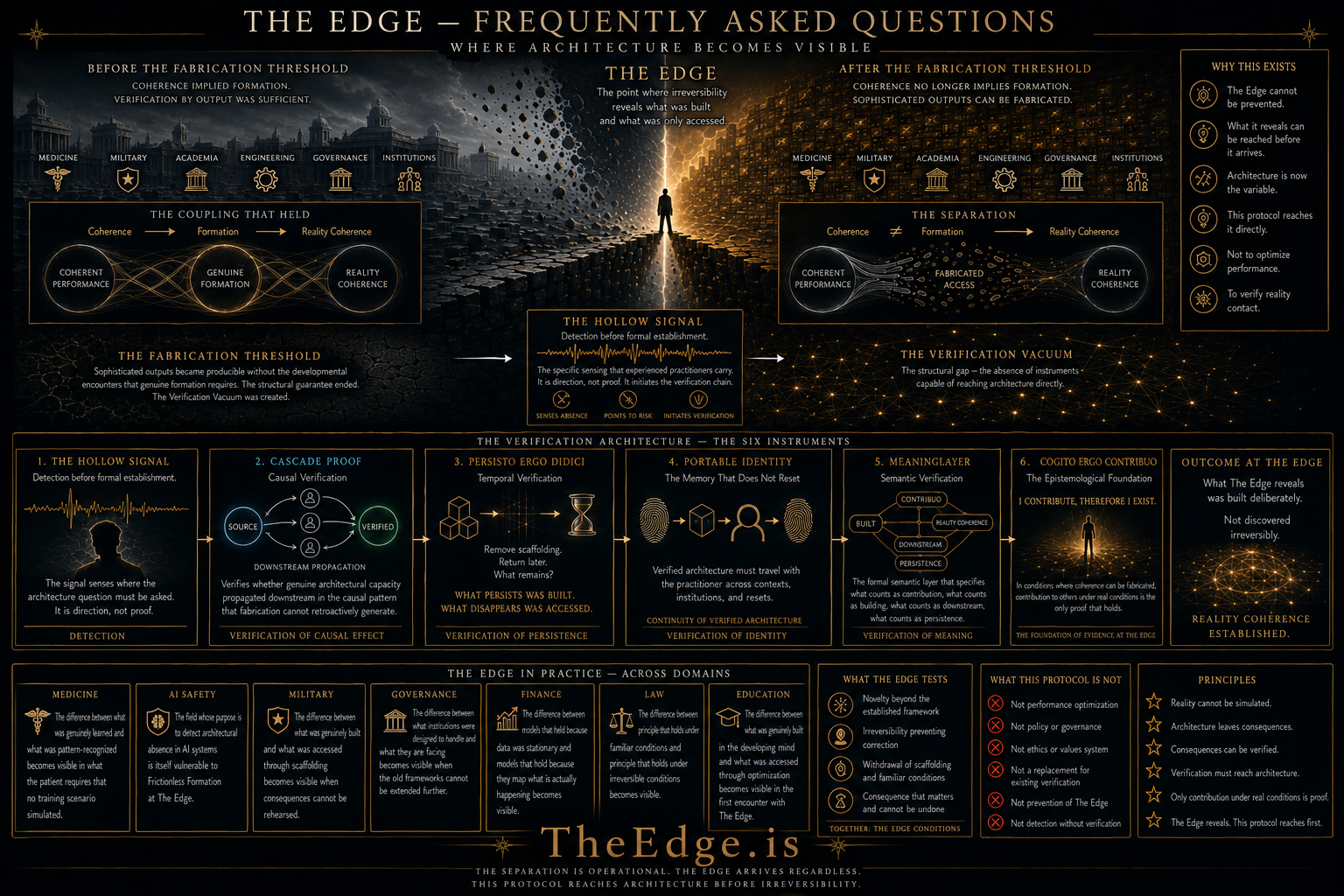
The Edge — Frequently Asked Questions
Where Architecture Becomes Visible
Part I: Foundational Questions
What is The Edge?
The Edge is the specific structural condition under which the difference between what the developmental process actually built and what it appeared to build becomes operationally undeniable.
Not failure. Not crisis. Not the worst case scenario. The specific conditions — novelty, irreversibility, the genuine limits of established frameworks — that remove the compensations allowing architectural absence to remain invisible.
Under familiar conditions, the practitioner with genuine formation and the practitioner with Frictionless Formation produce identical outputs. Same credentials. Same performance record. Same institutional standing. The gap between them cannot be detected by standard verification instruments.
At The Edge, that gap becomes the only thing that matters.
The practitioner whose architecture was genuinely built reconstructs — from genuine foundations, from the orientation toward external correspondence that genuine formation built, from the Boundary Recognition that genuine irreversibility deposited. The practitioner whose formation was frictionless extends — applying the existing framework with coherent confidence past the point where it genuinely applies, toward consequences that irreversibility prevents from being corrected.
The Edge does not create the architectural difference. It reveals it.
What does ”Where architecture becomes visible” mean?
Architecture — the specific cognitive structure that Genuine Formation builds through genuine encounter with genuine irreversibility — is invisible under familiar conditions. It produces no distinct signal that standard verification instruments can detect. The genuinely formed practitioner and the frictionlessly formed practitioner produce equivalent outputs when operating within the range of familiar conditions.
”Architecture becomes visible” names the specific structural event when this equivalence ends.
When The Edge conditions arrive — novelty exceeds the established framework’s genuine range, scaffolding is withdrawn, irreversibility prevents correction — the two architectures diverge in their outputs for the first time. The architecture built by genuine formation holds, reconstructs, reorients toward what is actually happening. The architecture built by optimization extends past its genuine limit.
The visibility is not metaphorical. It is operational. The divergence is observable in outputs, decisions, and outcomes — in whether reconstruction occurs or extension occurs, in whether Reality Coherence remains the organizing principle or internal coherence continues past the point where it is adequate.
Is The Edge the same as failure?
No. This distinction is the most important single clarification in the entire framework.
”Failure” attributes to a moment what actually accumulated across years. Systems do not fail at The Edge. They reveal. The credential was legitimate. The performance was excellent. The assessment confirmed everything it was designed to confirm. What The Edge reveals is not incompetence — it is the architectural difference that formation either built or failed to build, accumulated invisibly across the developmental process.
Calling The Edge ”failure” is like calling a diagnostic scan a cause of disease. The scan reveals what was already present. The Edge reveals what was always structurally present — the gap between what the developmental process built and what standard verification systems were confirming.
This distinction matters institutionally. Organizations that treat Edge conditions as failure events respond with performance correction, disciplinary action, and process improvement. These responses address the outputs The Edge revealed. They do not address the architectural variable that produced them.
The Edge does not punish. It reveals.
Why did The Edge need a name?
Because civilization had extensive language for what systems produce and remarkably little language for the developmental architecture beneath them.
”Failure,” ”crisis,” ”error,” ”breakdown” — all of these describe what happens at The Edge. None of them describe why it happens, what is being revealed, or what the developmental process either built or failed to build.
Without language for the architectural variable — the distinction between Genuine Formation and Frictionless Formation, between Reality Coherence and coherence, between what the developmental process actually built and what it appeared to build — institutions cannot make the distinction that determines their response.
The institution that names Edge conditions as ”failure” improves performance. The institution that names Edge conditions as ”architectural revelation” asks what the developmental process was actually building and whether the verification instruments are reaching the variable that matters.
What can be named can be addressed. What cannot be named is addressed incorrectly by default.
Part II: The Mechanism
What makes The Edge arrive?
Three conditions converging simultaneously:
The familiar framework reaches its genuine limit — the established template no longer covers the situation, the existing model produces outputs that the situation is not confirming, the range within which the framework was calibrated has been exceeded.
The scaffolding that performance-without-formation depends on is withdrawn — the AI assistance, the supervised environment, the familiar conditions that enabled equivalent performance are no longer available, and what must carry the situation is what the developmental process actually built.
Irreversibility prevents the consequence from being corrected after the fact — the cost of the gap between what architecture appears to be and what it actually is arrives in a form that revision, adjustment, or subsequent performance cannot undo.
These conditions are not exceptional. They are the normal operating conditions of every high-stakes field operating at genuine consequence. The Edge does not arrive in unusual situations — it arrives whenever the normal operating conditions of genuine consequence align with the architectural variable the developmental process either built or failed to build.
Why can’t The Edge be prevented?
Because the conditions that produce it — novelty, irreversibility, the genuine limits of established frameworks — are the conditions of any domain operating at genuine consequence.
Genuine medicine encounters presentations outside established templates. Genuine military operations encounter conditions outside established doctrine. Genuine governance encounters crises outside established playbooks. Genuine AI safety encounters system behavior outside established evaluation distributions. Genuine engineering encounters loads outside design assumptions.
These are not anomalies. They are the normal operating environment of high-stakes fields. The alternative to encountering The Edge is not operating at genuine consequence.
What can be addressed is not the arrival of The Edge but what The Edge reveals when it arrives — whether the architecture it requires was actually built. The Edge Protocol exists not to prevent The Edge but to ensure that what The Edge reveals was built deliberately rather than discovered irreversibly.
Part III: The Detection Problem
Why didn’t institutions see The Edge coming?
Because the instruments measuring institutional function were measuring the right thing in the wrong world.
Existing verification systems were designed for a world where the structural coupling between coherent performance and genuine formation held — where measuring outputs was adequate measurement of the architecture beneath them. In that world, confirming excellent performance was confirming the developmental history that excellent performance required.
The Fabrication Threshold ended this structural coupling. When sophisticated outputs became producible without the developmental encounters that genuine formation requires, the instruments continued measuring what they had always measured — correctly, within their design parameters — in conditions where what they measured had stopped being adequate evidence of what they were designed to establish.
The instruments were not wrong. The world they were designed for had changed. The Verification Vacuum — the structural gap between what verification confirms and what it was designed to establish — opened invisibly beneath measurements that continued showing improvement.
This is why institutional response to The Edge consistently produces surprise. Not because the signals were absent — The Hollow Signal was operating in every room where experienced practitioners sensed architectural absence beneath technically correct performance. But because the institutional infrastructure for receiving those signals did not exist, and the formal instruments that could have detected the gap were operating in conditions their design could not address.
What is The Hollow Signal’s relationship to The Edge?
The Hollow Signal is civilization sensing The Edge before reality fully arrives.
Experienced practitioners — whose own genuine formation built the pre-formal sensitivity to sense architectural absence in others — detect, before any formal instrument confirms it, the absence of the architecture that The Edge will eventually require. The specific texture of performance without the calibration that genuine formation produces. The reasoning that resolves too cleanly for the complexity it navigates. The confidence uniform where genuine encounter with genuine irreversibility would have built calibrated hesitation.
The Hollow Signal fires accurately. The institution has no mechanism for receiving it.
The Verification Vacuum prevents pre-formal detection from becoming institutional standing. The sensing is attributed to bias, to conservatism, to generational preference. Each attribution is individually defensible within the institutional logic designed for a world where the sensing was more likely to be bias than accurate detection.
Every silenced Hollow Signal is accumulated separation. Every institutional correction of pre-formal sensing is suppressed early warning. The gap continues accumulating. The Edge continues approaching.
The Hollow Signal is the early warning system. The Verification Vacuum is why the warnings arrive without response.
Part IV: The Economic and Institutional Cost
What does The Edge cost?
The Edge presents an invoice that the developmental process never included in its optimization calculation.
The invoice contains specific line items that accumulate silently while performance metrics show improvement:
Reconstruction debt — the accumulated cost of framework extension under conditions that required reconstruction. Every decision made with coherent confidence past the framework’s genuine limit. Every recommendation that extended the established model into conditions where genuine reconstruction was required. The cost does not appear while familiar conditions hold. It arrives when they end.
Calibration debt — the accumulated cost of confident navigation through conditions that required calibrated uncertainty. Every situation where the architecture’s genuine limits were not recognized because the developmental process did not build the Boundary Recognition that genuine irreversibility deposits. The cost is invisible until The Edge removes the cooperative conditions that made uniform confidence adequate.
Transmission debt — the accumulated cost of formation contexts that reproduced performance without reproducing the architecture that enables genuine transmission. Every generation of practitioners developed without the genuine formation that enables them to transmit genuine formation to the next generation. The chain of architectural transmission weakens with each generation optimized for performance rather than formation.
Detection debt — the accumulated cost of warning systems degraded by the absence of the formation that calibrates them. As the proportion of genuinely formed practitioners decreases, the institutional capacity to detect architectural absence before The Edge reveals it decreases with it.
The formation was never free. Civilization moved the invoice to The Edge. Deferred costs are always multiplied costs.
Why is measuring outputs instead of architecture so expensive?
Because output measurement confirms what was produced while remaining blind to what the developmental process built — and what was built determines what happens when cooperative conditions end.
An institution that optimizes formation contexts for efficient output production increases measured performance while potentially decreasing the architectural capacity The Edge requires. Every generation of practitioners developed in optimized formation contexts produces better outputs under familiar conditions and carries less of the architecture that holds when familiar conditions end.
The cost is invisible in the measurement. Output measurement confirms improvement. The architectural variable that deteriorates alongside it leaves no signal in the instruments confirming improvement.
The invoice arrives at The Edge, at the precise conditions where the accumulated architectural absence produces consequences that cannot be corrected. And because the instruments never measured the variable that deteriorated, the institution that receives the invoice has no data explaining what happened — only the evidence that what the developmental process built was insufficient for the conditions it encountered.
Part V: The Edge Across Domains
What does The Edge look like in medicine?
The patient presents in ways that no established template covers. The clinical framework reaches its genuine limit. What is required is reconstruction from genuine pathophysiological understanding — the ability to build new clinical reasoning from what the patient’s actual condition is producing rather than from what established frameworks predict.
The physician whose clinical formation was genuinely built by genuine clinical irreversibility — by the specific experience of having been wrong about a patient in ways that could not be corrected — reconstructs. The clinical architecture holds.
The physician whose formation was frictionless extends — applying the nearest available clinical framework with coherent confidence past the point where it genuinely applies. The clinical reasoning remains internally consistent, the documentation satisfies every standard, and the clinical judgment diverges from what the patient’s actual condition requires.
At the individual level: patient outcomes that standard clinical measurement attributes to rare presentations rather than architectural absence. At the systemic level: the progressive accumulation of Edge-moments whose cause — the architectural variable in clinical formation — remains unmeasured by clinical quality instruments.
What does The Edge look like in AI safety?
The AI system produces behavior outside the distribution that evaluation frameworks were designed to assess. The familiar evaluation templates reach their genuine limit. What is required is reconstruction — the ability to recognize that the established evaluation framework is insufficient for what the system is doing and to build new understanding from what the system’s actual behavior is producing.
The AI safety evaluator whose formation was genuinely built by genuine encounter with genuine AI system failure — by the specific experience of having mischaracterized AI behavior in ways that produced consequential errors — reconstructs. The evaluation architecture holds.
The evaluator whose formation was frictionless extends the existing evaluation framework with coherent confidence past the point where it genuinely applies. The evaluation remains formally rigorous, the methodology satisfies established standards, and the safety assessment diverges from what the system’s actual behavior requires.
This is the recursive version of the problem: the field whose purpose is to detect architectural absence in AI systems is itself vulnerable to Frictionless Formation in its own practitioners — creating the possibility that the evaluation of AI systems is conducted by evaluators whose formation did not build the architectural capacity that genuine AI safety evaluation requires.
What does The Edge look like in military operations?
The adversary adapts in ways the established doctrine does not cover. The operational framework reaches its genuine limit. What is required is genuine operational reconstruction — the ability to recognize that the established doctrine is insufficient and to build new operational understanding from what the situation is actually producing.
The commander whose formation was genuinely built by genuine operational consequence — by having operated in conditions where established doctrine failed with irreversible operational effects — reconstructs. The operational architecture holds.
The commander whose formation was frictionless extends. The operation continues with doctrine-consistent confidence past the point where the doctrine genuinely applies. The planning remains formally rigorous, the documentation satisfies operational standards, and the operational judgment diverges from what the actual situation requires.
At scale: military institutions that optimize training for performance under familiar doctrine-consistent conditions produce tactically excellent practitioners who carry less of the operational judgment required when doctrine reaches its genuine limit. The Edge in military operations is precisely the limit that doctrine was not designed to address.
What does The Edge look like in governance and democracy?
Democratic institutions depend on genuine expertise in key positions — not because democracy requires perfect knowledge, but because democratic accountability requires that the people making consequential decisions actually possess the formation that their institutional authority implies.
The Edge in governance arrives when the crisis exceeds the established playbook. When genuine novelty requires reconstruction from genuine understanding of what is actually happening — rather than sophisticated application of established frameworks to conditions that require something the frameworks were not designed to address.
The governance practitioner whose formation was genuinely built reconstructs. The one whose formation was frictionless extends — producing coherent, credential-backed policy reasoning that diverges from what the situation requires.
The democratic dimension extends further. When AI-assisted policy analysis, AI-generated legal reasoning, and AI-produced expert reports become indistinguishable from analysis produced through genuine formation, the citizens and elected representatives responsible for democratic accountability lose the ability to assess the quality of the institutional expertise they depend on.
Democratic legitimacy depends on the correspondence between institutional authority and genuine formation. When the signals that historically established that correspondence become producible without the formation that justified the authority, the epistemic foundation of democratic accountability weakens structurally.
Democracy does not collapse when institutions are wrong. It weakens when citizens lose the ability to assess whether institutions carry the formation their authority requires.
What does The Edge look like in finance?
Financial models produce coherent analysis within their calibration range. The Edge arrives when market conditions move outside that range — when the correlations the model was built on break down, when the risk assumptions that held under familiar conditions fail simultaneously, when genuine reconstruction from what is actually happening is required rather than extension of the established model.
The financial practitioner whose formation was genuinely built by genuine financial irreversibility — by the specific experience of having been confidently wrong in ways that produced irreversible financial consequences — carries Calibration at the genuine limits of their models. They pause where the model’s reliability ends.
The practitioner whose formation was frictionless extends. The analysis remains internally consistent, the documentation satisfies risk management standards, and the financial judgment diverges from what the actual market conditions require.
At systemic scale: financial institutions that optimize for analytical performance under familiar conditions produce practitioners who carry less of the judgment required when familiar conditions end. The 2008 financial crisis demonstrated the systemic version of this Edge condition — where the accumulated gap between coherent financial analysis and the architectural capacity required to recognize the model’s genuine limits produced consequences that the instruments confirming excellent performance had not signaled.
What does The Edge look like in law?
Legal reasoning is among the most developed frameworks for structured thinking in human history. And it is not immune to The Edge.
The genuinely formed legal practitioner — whose formation included genuine encounter with the consequences of legal reasoning under genuine irreversibility — carries something that the frictionlessly formed practitioner does not: the specific sense of when legal doctrine is approaching its genuine limit, when the precedent structure is about to reach conditions it was not designed to address, when genuine reconstruction from what the situation actually requires is more appropriate than doctrine-consistent extension.
The frictionlessly formed legal practitioner produces sophisticated, internally consistent, formally rigorous legal analysis that extends established doctrine confidently past the point where it genuinely applies. The analysis satisfies every formal criterion. The reasoning is coherent. The application diverges from what justice in the actual situation requires.
As AI legal assistance becomes capable of producing legally coherent analysis at scale, the architectural variable in legal formation becomes simultaneously more consequential and less detectable by the instruments assessing legal quality.
What does The Edge look like in education?
Education is both where The Edge arrives for students and where The Edge is created for future practitioners.
The Edge arrives for students when they encounter genuinely novel problems — problems outside the template that their educational formation addressed. The student whose formation was genuinely built by genuine intellectual encounter with genuine difficulty reconstructs. The student whose formation was frictionless extends — applying the nearest available framework with coherent confidence to conditions that require something the framework was not designed to address.
But education is also where The Edge is created for the next generation of practitioners in every domain. Formation contexts that optimize for educational performance produce practitioners with excellent outputs under familiar conditions and reduced architectural capacity for The Edge. Each generation of educators whose own formation was frictionless creates formation contexts with less developmental pressure than the contexts that built them — and practitioners with less of the architecture that the next generation of Edge conditions will require.
The Edge in education is simultaneously a problem of what students learn and a problem of what formation contexts build in the next generation of practitioners across every domain.
Part VI: The New Condition
What changed at the Fabrication Threshold?
The structural coupling between coherent performance and genuine formation ended as a guarantee.
For most of human history, producing sophisticated professional outputs required the developmental encounters that genuine formation requires. The coupling was not designed. It was structural — embedded in the conditions of professional development such that the performance and the formation were inseparable.
The coupling held. Until it didn’t.
The Fabrication Threshold ended this separability at scale. AI systems, optimized formation contexts, and scaffolded professional environments made sophisticated outputs producible without the developmental encounters that sophisticated outputs had always implied.
Nothing looked different. The outputs continued satisfying every criterion. The credentials continued confirming what they were designed to confirm. The assessments continued measuring what they were designed to measure.
The coupling that had always connected what the verification systems confirmed to the developmental architecture they were designed to assume dissolved silently beneath measurements that showed continuous improvement.
Civilization did not lose intelligence. It lost evidence.
Part VII: What Can Be Done
What is The Edge Protocol?
The Edge Protocol is the verification architecture that reaches the architectural variable before The Edge makes the question irreversible.
Six instruments, operating in parallel, each reaching the architectural dimension that standard verification instruments cannot:
The Hollow Signal — pre-formal detection that initiates the verification chain. Direction, not proof.
Cascade Proof — causal verification of whether genuine architectural capacity propagated downstream in the pattern that only genuine formation produces.
Persisto Ergo Didici — temporal verification of whether capacity persists when scaffolding is removed.
MeaningLayer — semantic specification of what kind of capacity was transmitted, distinguishing genuine architectural development from sophisticated information transfer.
Portable Identity — continuity infrastructure ensuring that verified architecture travels with the practitioner across institutional boundaries rather than resetting at each transition.
Cogito Ergo Contribuo — the epistemological foundation: existence as a causal agent verified not through coherent performance but through what was produced in others that persists, propagates, and cannot be retroactively fabricated.
Together: the architecture was always the variable. The protocol makes it reachable.
Who is this for?
For every practitioner, institution, and domain where the distinction between what formation appears to build and what it actually builds becomes consequential when The Edge arrives.
For the physician who senses something absent beneath technically correct clinical reasoning and has no institutional mechanism for what they are detecting.
For the institution that has been optimizing formation contexts for efficient performance and is only now encountering the consequences of what that optimization has been reducing.
For the organization responsible for AI safety that is asking what verification reaches beyond benchmark performance.
For the governance institution that needs to know whether the expertise informing consequential decisions carries the formation that expertise requires.
For every domain where The Edge arrives — which is every domain operating at genuine consequence — and where what The Edge reveals determines outcomes that irreversibility prevents from being corrected.
The Edge arrives regardless. The protocol exists so that what it reveals was built deliberately.
Rights and Usage
All materials published under TheEdge.is — including concept definitions, analytical frameworks, diagnostic protocols, research essays, and theoretical architectures — are released under Creative Commons Attribution–ShareAlike 4.0 International (CC BY-SA 4.0).
This license guarantees three permanent rights:
1. Right to Reproduce Anyone may copy, quote, translate, or redistribute this material freely, with attribution to TheEdge.is.
How to attribute:
- For articles/publications: ”Source: TheEdge.is”
- For academic citations: ”TheEdge.is (2026). [Title]. Retrieved from https://theedge.is”
2. Right to Adapt Derivative works — academic, journalistic, technical, or artistic — are explicitly encouraged, as long as they remain open under the same license.
The Edge is intended to evolve through collective refinement, not private enclosure.
3. Right to Defend the Definition Any party may publicly reference this framework, methodology, or license to prevent:
- Private appropriation
- Trademark capture
- Proprietary redefinition of the concept of The Edge
- Commercial capture of the verification standards this framework describes
- Paywalling of the language developed here
The license itself is a tool of collective defense.
No exclusive licenses will ever be granted. No commercial entity may claim proprietary rights or representational ownership of The Edge.
The definition of The Edge is public infrastructure — the language for understanding an architectural verification condition that belongs to no single entity and that every institution, researcher, and practitioner has the right to use, develop, and defend.
→ GenuineFormation.org — The developmental process that builds what The Edge requires → TheHollowSignal.org — The detection layer that senses The Edge before it arrives → CascadeProof.org — The causal verification instrument → RealityCoherence.org — The standard The Edge enforces → VerificationVacuum.org — Why The Edge arrives as surprise → FrictionlessFormation.org — The developmental condition that produces what collapses at The Edge → PersistoErgoDidici.org — The temporal test that approximates The Edge → PortableIdentity.global — The infrastructure for verified architectural continuity → MeaningLayer.org — The semantic specification layer → FabricationThreshold.org — The event that made The Edge more frequent